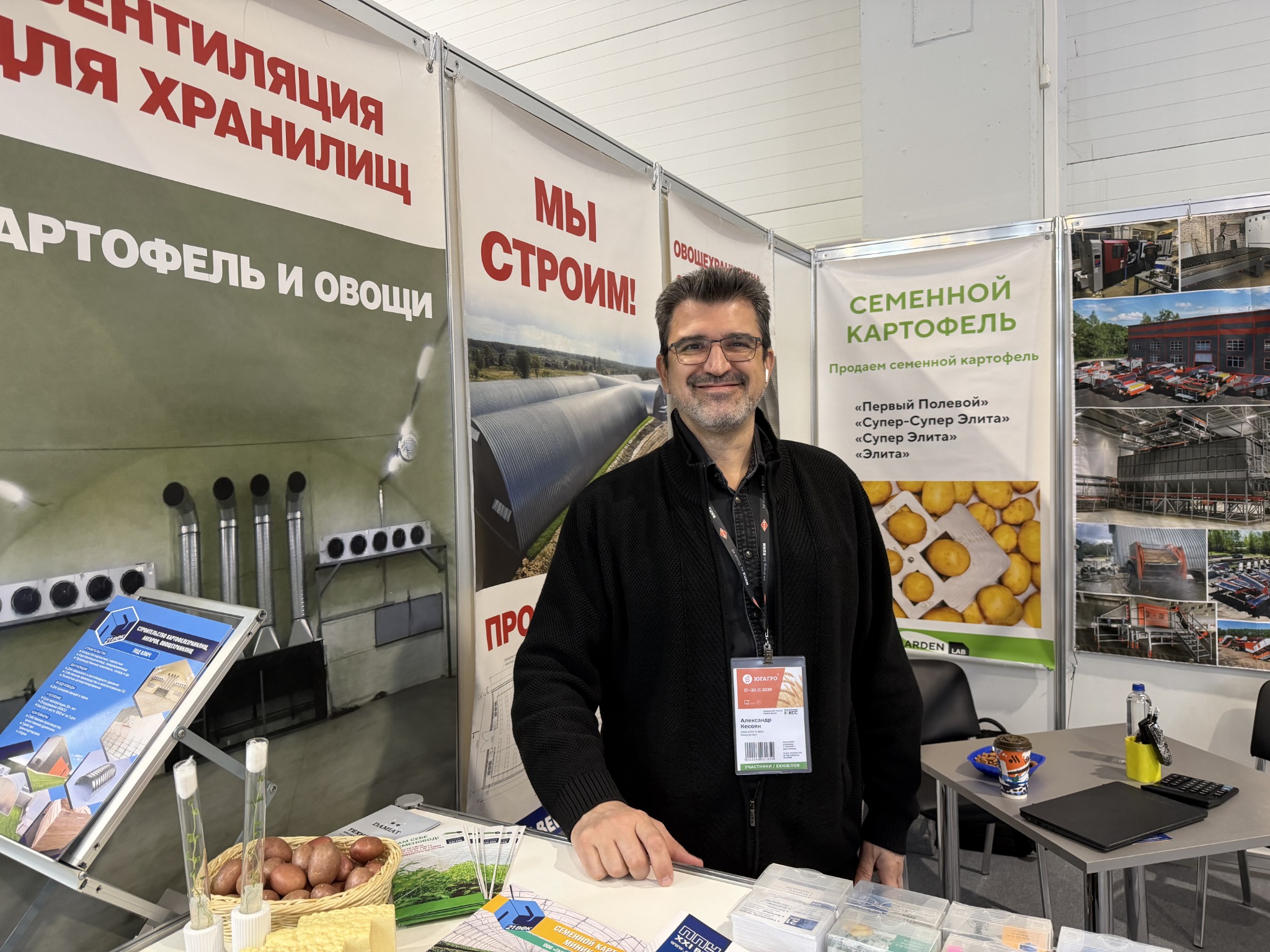
How can a potato farm invest in storage when borrowing is expensive and cash is limited? In an interview supplied to Potatoes.News, PPU 21 VEK describes the projects it has undertaken during the 2026 season, the growing caution of its customers and the changes it plans for 2027. The company builds and modernises potato and vegetable stores; its observations reflect its own order book and experience.
More than 60 sites and more cautious customers
The company describes the season as difficult but successful. According to the interview, it has worked at more than 60 sites in Russia and Kyrgyzstan, with the Moscow, Tver and Tula regions among the busiest areas. It reports stronger demand for its storage construction services than in 2025.
At the same time, growers are taking greater care over investment decisions. The company says that the main obstacles are limited available cash and difficulty obtaining affordable credit. It sums up its customers’ approach as follows: “Money is expensive; we cannot afford to take risks.” This is the company’s assessment of its customers, rather than a statistical measure of the whole market.
Weekdays. Unsubscribe in one click.
Projects from box stores to bulk storage
In the Novgorod region, PPU 21 VEK reports completing a 2,700-tonne box potato store in June after starting work in April. The facility uses general ventilation. The company’s public project record confirms the start on 17 April 2026; an update on 15 June recorded completion of construction and insulation, with ventilation installation and commissioning still under way at that point.
In May, the company started five potato stores in the Tver region, each measuring 20 × 74 × 9 metres. The interview gives a combined capacity of 10,400 tonnes and a 1,500-square-metre grading building. The project combines box storage, VENTOGLAS ventilation and refrigeration equipment. The company’s public announcement also describes the five-store project and its ventilation and refrigeration systems.
The interview also reports completion of two bulk potato stores in the Astrakhan region in August and construction of the third phase of a storage project at Dedinovo in the Moscow region. Capacity figures for these two projects are omitted here because the Astrakhan figure differs between the interview and the earlier announcement, while the scope of the Dedinovo capacity figure is unclear.
What the snowy winter revealed
PPU 21 VEK links damage to some arched buildings during the past winter to prolonged snow accumulation and an absence of thaws. Its public account describes restoration work at a damaged store in the Tver region. The interview does not provide engineering investigation reports establishing the cause of each failure.
Snow depth alone is not a universal limit for a storage building. Permissible loads and the procedure for clearing a roof need to be established for the particular structure using its design and operating documentation and a qualified technical assessment. The numerical snow-depth thresholds in the supplied interview are therefore not presented as general operating advice.
The company considers restoration potentially less expensive than rebuilding when floors, retaining walls and ventilation can be retained. The choice still depends on an inspection and a comparison of the work required. Existing structures and systems should not be assumed to be undamaged without examination.
Modernisation and closer control of ventilation
Demand also continues for replacing ventilation, improving insulation and adding automation in existing stores. PPU 21 VEK says it begins with a site inspection and calculations before proposing a solution. In some cases, comprehensive reconstruction can cost more than a new building; staged work can spread investment over several seasons.
The company uses sprayed polyurethane foam for insulation and manufactures VENTOGLAS ventilation equipment. According to the interview, it has produced the system for more than 15 years and installed it in more than 1,100 stores in Russia, Kazakhstan, Uzbekistan, Kyrgyzstan, Armenia, Belarus and Tajikistan. These installation figures are supplied by the manufacturer.
For 2027, the company plans sensors on gates, doors, slide gates and dampers so operators can check their position remotely. The aim is to reduce operating errors, including situations where a system appears to be running but air is not reaching the crop. Further improvements to mobile applications are also planned.
Asked about seed, table and processing potatoes, the company stresses the value of preserving saleable quality. It describes stricter requirements for high-value seed stocks and says that, in its designs for potatoes intended for crisps, it considers greater insulation thickness because of the higher storage temperature. These are the company’s design considerations; individual storage specifications require a project-specific assessment.
Construction budgets and the limits of a payback estimate
In the interview, PPU 21 VEK gives the following indicative budgets for turnkey bulk stores, including earthworks and ventilation installation:
- 1,500 tonnes of capacity: approximately RUB 18 million.
- 3,500 tonnes: approximately RUB 36 million.
- 5,000 tonnes: approximately RUB 50 million.
The main cost items are the building, floors, insulation, retaining walls and ventilation. These are the company’s indicative 2026 estimates, not binding quotations. The interview does not specify the tax treatment or every element of the scope; actual budgets need to reflect the site, equipment and agreed specification.
The company suggests a payback period of one to two years in a scenario where selling potatoes after storage brings an additional RUB 10 per kilogram compared with selling directly from the field. That price difference represents additional gross revenue before storage costs and losses; it is not net profit or a guaranteed return.
A farm’s calculation needs to include the actual saleable volume, storage losses, electricity, operating costs, financing costs and the prices achieved. Crop condition also matters. The company notes that dry, healthy potatoes may require less ventilation than a wet or deteriorating lot. Storage equipment cannot reverse damage already present in the crop.
For small and medium-sized farms, the company proposes comparing modernisation with new construction, selecting equipment to match the farm’s needs and spreading construction and fit-out over two or three years where practical.
Plans for 2027 and the first step for growers
PPU 21 VEK expects further demand from southern Russian regions where some grain growers are considering vegetable production. In its assessment, shorter winters and a greater need for refrigeration can raise the cost of storage projects there. The company also says it continues to work with customers in Kazakhstan, Belarus and other CIS countries. These are company expectations and plans, rather than confirmed market forecasts.
For growers experiencing recurring storage losses, its main recommendation is to start with a full inspection of the existing store. The condition of the crop, building, insulation, ventilation and controls needs to be considered together before choosing an investment. The company closes the interview by wishing potato growers a successful 2027 season and favourable selling prices.
Sources and disclosure
This article is based on the interview supplied to the editorial team. PPU 21 VEK is a partner of Potatoes.News and the International Potato Tour. Project totals, prices, installation figures and future plans are attributed to the company; they have not been independently audited.
Public company records checked on 18 November 2026: Novgorod project; Tver project; Astrakhan project announcement; restoration after winter damage. Photograph supplied by Viktor Kovalev for this publication.