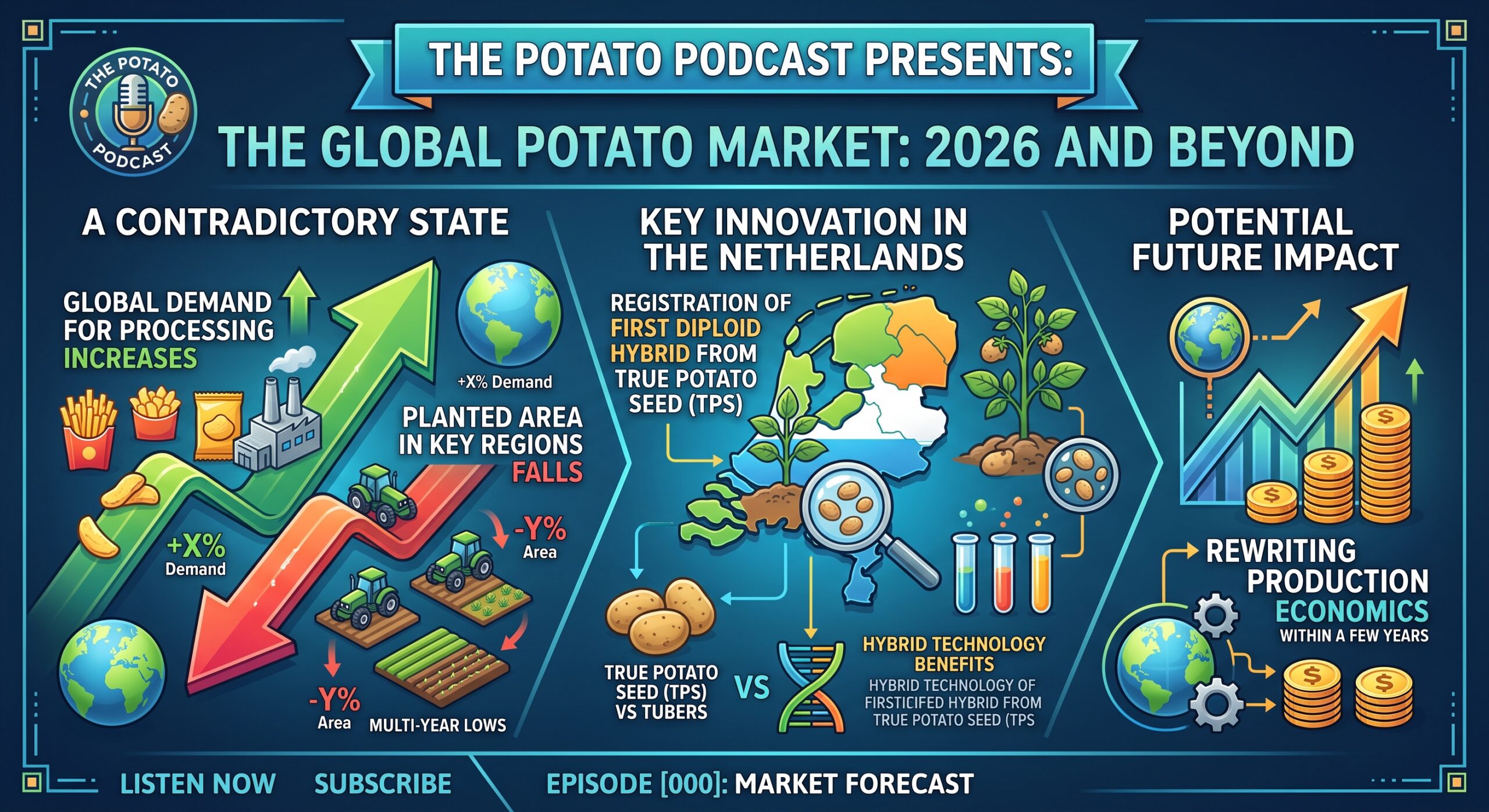
The global potato market entered 2026 in a state best described as contradictory: processing demands ever more raw material, while planted area in key regions is falling to multi-year lows. Against this backdrop, the Netherlands has registered the first diploid hybrid grown from true seed — an event that could rewrite the economics of production within a few years.
The Market Is Growing, But Not Through Hectares
The global potato market is valued at USD 124.46 billion in 2026, with a forecast of USD 149.38 billion by 2031 at a compound annual growth rate of 3.72%. World production stands at roughly 390.3 million tonnes, with an average yield of 22.9 t/ha.
The key point: growth is driven by productivity and consolidation, not by expanding acreage. Half of global consumption (50.18%) is concentrated in the Asia-Pacific region, while the fastest-growing market remains Africa at 5.08% per year.
The main engine of demand is processing. In developed countries, industrial buyers account for up to 60% of commercial output. Major processors such as McCain Foods and Lamb Weston are investing hundreds of millions of euros in capacity expansion and regenerative sourcing programmes. Quick-service restaurants add further pressure: in 2025 alone McDonald’s planned to open 1,000 new outlets in China, targeting 10,000 by 2028. Every one of those outlets is a guaranteed fries contract.
The constraints are equally clear:
- Climate. Drought and heat already cost Russia 14.5% of its 2024 crop, and in 2026 significantly reduced yields in Germany and France.
- Regulation. The new RUCIP 2025 rules and strict EU limits on pesticide residues (glyphosate, neonicotinoids) directly raise growers’ operating costs.
North America: An Eight-Year Low
In 2026, total potato planted area in North America fell to its smallest level in eight years.
In the United States, planted area contracted by 3.1% to 353,000 hectares — the lowest since 2013 — while the expected crop of 18.08 million tonnes is the smallest in thirteen years.
Canada, meanwhile, continues to grow its export revenue: shipments of potatoes and processed products reached CAD 3.7 billion, of which CAD 2.7 billion came from frozen French fries. The flip side of that specialisation is critical dependence on trade agreements with the US (USMCA) — any change in terms hits the industry directly.
Europe: Weather and a Mutating Late Blight
The European sector is contracting in 2026. Germany expects production to fall by 15%, France by 21%. The causes are combined: reduced area plus drought.
A separate and far less visible problem is late blight. Phytophthora infestans populations continue to mutate: the EU36 genotype remains dominant, but the share of genetically diverse “other” categories is rising — up to 85% in Denmark and Norway. The practical takeaway for agronomists is straightforward: protection schemes that worked yesterday are no longer universal, and fungicide strategies require greater complexity and local adaptation.
Asia and Africa: Two Different Growth Models
China and India hold their positions as the world’s largest producers and are actively developing processing lines and cold storage systems — in effect, building added value at home.
Africa is growing differently. In Kenya, Nigeria and South Africa, the drivers are aeroponic seed production and state irrigation programmes. The continent is essentially leapfrogging entire technological stages, bypassing conventional field-based seed multiplication.
Russia: 95% Self-Sufficiency, 11% Domestic Breeding
The Russian market operates within a food-security logic. Self-sufficiency is estimated at 95%, with production forecast to reach 8.4 million tonnes by 2030.
Yield in the organised sector (agricultural enterprises, farm holdings and individual entrepreneurs) reached 31.1 t/ha in 2025, but is expected at 27.9 t/ha in 2026 — more than three tonnes lower. That is well above the global average, yet the swing itself shows how much the result depends on the season.
The critical vulnerability is seed production. Domestically bred varieties account for 11% in 2026, against a target of 35% by 2030 set out in Government Decree No. 3878-r. The gap: four years and twenty-four percentage points.
The variety portfolio breaks down as follows:
| Indicator | Value (2026) |
|---|---|
| Total varieties in the State Register | 577 |
| Table varieties | 465 |
| For chip processing | 59 |
| For French fry processing | 28 |
Just 28 fry varieties — at a time when fries are pulling the global market — is a figure worth dwelling on.
In 2025, 253 varieties were in commercial cultivation. The undisputed leader is Gala, with 89,200 tonnes of seed plantings. Innovator, Lady Claire and Riviera also rank in the top tier.
The Paradox of the Half-Year: Seed Imports Quadrupled
The most telling figure on the Russian side comes from seed potato trade for January–June 2026.
Imports rose to 2,874 tonnes — a fourfold increase on the same period in 2025. The main suppliers were France (1,680 t) and Belarus (1,174 t). Exports, meanwhile, fell to 3,451 tonnes, with Kazakhstan the principal buyer (2,754 t).
In other words, against a backdrop of import substitution policy and active restrictions on foreign-bred material, seed purchases from abroad grew several times over. The explanation almost certainly lies in variety-specific demand: processors need particular varieties for particular technological tasks, and these cannot be swapped for “domestic varieties in general”. As long as the State Register lists 28 fry varieties, demand will go wherever the required variety exists.
The Technological Break: 25 Grams Instead of 2.5 Tonnes
The industry’s defining event of the year lies not in the statistics but in the biology. The Dutch company Solynta has officially registered the first diploid potato hybrid grown from true potato seed (TPS) — SOLHY019 — in the Netherlands’ state register.
The scale of the shift is easiest to convey with one pair of numbers: instead of planting 2,500 kg of tubers per hectare, 25 grams of seed covers the same hectare.
What changes in practice:
- Logistics. Seed can be transported and stored without a cold chain and without losses to respiration or sprouting.
- Plant health. True seed does not carry the diseases accumulated in tubers, eliminating the principal channel of virus transmission through planting material.
- Breeding speed. The diploid system dramatically accelerates the development of new varieties compared with the conventional tetraploid scheme.
A second technological lever works alongside it: aeroponics. Controlled-environment systems yield up to 900 mini-tubers per square metre, against 8 in soil. For rapid multiplication of clean lines, the difference is more than a hundredfold — which is precisely why African seed programmes are betting on the technology.
What the Regulators Are Saying
Expert commission sessions reviewing 2025 identified three effects:
- The entry into force of the Federal Law on Seed Production led to a significant drop in applications for crops not included in the food-security list.
- Quotas and restrictions on imports of foreign-bred seed reduced the number of applications for foreign varieties and hybrids.
- In 2026, 35 new potato varieties are undergoing state trials, 31 of them table varieties. The emphasis is on yield, tuber marketability and starch content.
That last point deserves a closer read: of 35 varieties under trial, four are aimed at processing. Trial priorities are reproducing the same imbalance already visible in the State Register.
Conclusion: From Gross Harvest to Resilience
In 2026 the industry is ceasing to measure success in tonnes. Other factors are becoming decisive: available storage and processing capacity, adoption of digital agronomy tools, and the shift to innovative breeding methods as a response to climate pressure.
For Russia, this implies a fairly specific agenda. Yield is already at a respectable level — the question is its stability from season to season. Self-sufficiency in ware potatoes has been achieved — the question is seed, and varieties for processing. And it is here that TPS technology may prove to be not an abstract headline from the Netherlands, but a way to shorten the four-year road from 11% to 35%.
This article is based on the analytical review “The State and Prospects of the Global and Russian Potato Market in 2026”.