When it comes to reporting about potato virus Y (PVY), it’s a good news, bad news kind of story.
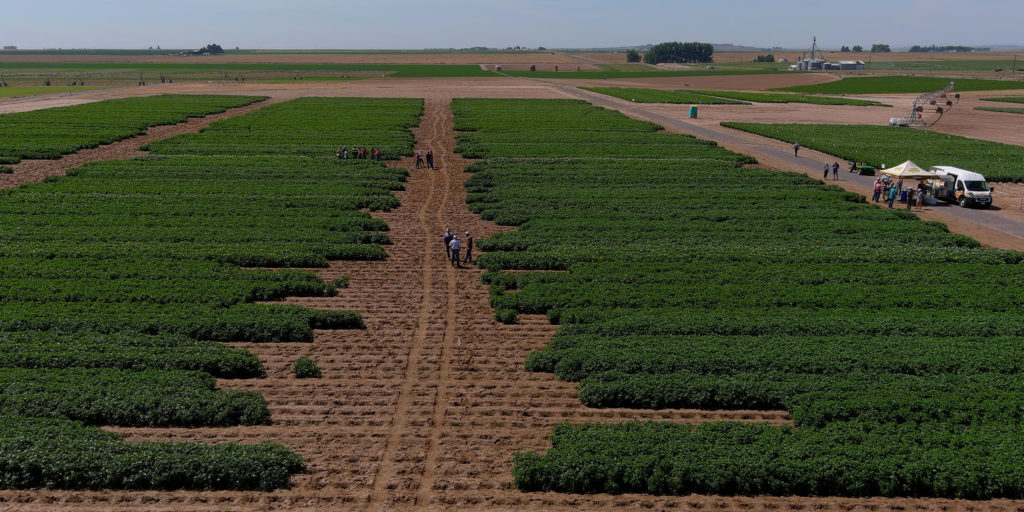
The good news is that researchers are seeing less PVY-O, especially in potato fields throughout the Pacific Northwest (PNW). The bad news is that, just like COVID-19 or any virus, PVY continues to mutate creating recombinant strains. In June, at Washington State University’s 58th annual commercial seed lot trial in Othello, Alex Karasev was emphatically positive about the lack of PVY-O at the trial.
“What we see, as the good news, we see degrees in genetic diversity so we see certain strains of the virus disappearing,” said Karsev, a professor of plant virology at the University of Idaho. “So, the latest victim of this disappearance is PVY-O virus, it’s the first year I do not see a single sample of it in the field.”
Karasev said that PVYN-Wilga and PVY-NTN currently are the two prevalent strains dominating potato fields in the PNW. He said that Wilga comprised an estimated 76%, NTN comprised an estimated 21% and about 2% of an additional recombinant strain called PVY-NO were the PVY strains found in the PNW. He said that the recombinant strain NO is the toughest one to develop resistance to.
Weekdays. Unsubscribe in one click.
Karasev hypothesizes that recently released new potato varieties are part of the explanation for the lack of PVY-O. “Why you see such low diversity of this PVY-O virus, it’s probably because these cultivars that are released recently, they have certain level of resistance, especially to PVY-O,” Karasev said. “That may be why it is gone because it just cannot penetrate these new cultivars.” Karasev said that a lot of varieties have strain specific resistance against PVY-O.
“Actually the majority of modern cultivars they have good resistance against this specific strain,” he said, “so breeders certainly did a very good job selecting resistant cultivars, they just didn’t know that it was a single strain that was circulating in the fields they actually selected strain-specific resistance.” Karasev said that he is participating in a research grant to develop management tools to reduce PVY and another emerging virus — potato mop-top. Both diseases induce necrotic tuber symptoms.
“We have multiple research projections,” he said. “So, trying to create management tools, a better certification system and to go after resistance, broad-type resistance to this virus. Also, we have an extension objective: trying to educate growers how to better use these new research tools.”
Nina Zidack, director of the Montana Seed Potato Certification Program at Montana State University, said that she and her staff have definitely seen lower levels of PVY in Montana.
“I largely attribute that to some really positive changes in grower practices that we’ve had in the state,” Zidack said. “Our growers are a lot more conscious of keeping their early generation seed lots separated from all other potatoes so we’ve got some growers that are actually growing their nuclear and generation plots 150, 200 miles away from the Gallatin (County) just to keep them isolated and it’s really paid huge dividends. The overall virus levels have gone down a lot.”
Montana growers plant almost 11,000 acres of seed potato annually. Russet Burbank ranks number one in acreage followed by Umatilla, Clearwater Russet, Ranger Russet and Alturas. Zidack said that Wilga is the dominant PVY virus strain in Montana at about 80%, followed by NTN with between 12 and 14%. Recombinant strains of viral diseases like PVY are to be expected, Zidack said.
“There will be another one coming down the pike, I’m sure,” she said. “There could be some circulating out there that we haven’t even really identified yet in the background. What those strains are doing, they’re adapting to whatever resistance profiles are out in the environment now and when you start exerting pressure on them by having resistance in cultivars to other strains, new strains will develop at some point to overcome that resistance.”
Foliar transmission by aphids is the primary source of PVY virus infection in potatoes. Zidack said that Montana growers have found great success reducing PVY transmission with weekly applications of mineral oils combined with traditional insecticides. “Probably the most important tool is mineral oil treatments,” she said, “and those basically they have to be applied at least weekly because they need to protect all newly emerging foliage and we’re recommending that those mineral oil treatments continue through vine-kill.”
Zidack said that when she first arrived in Montana 13 years ago there were only one or two growers using mineral oil treatments, but she estimates 70-80% are now using the treatments. Mark Pavek, Washington State University Professor of Potato Extension and Research, oversees the seed lot trial in Othello. He agreed with both Karasev’s and Zidack’s assessments of the 2021 seed lot trial, saying that “In 2021 we saw a lot less PVY in the seed lot samples compared to previous years but if you look across the record of the seed lot trial the PVY levels fluctuate but this year seemed to be interestingly low.”
Pavek wasn’t sure why PVY levels were lower this year, but he was not ready to assign the result to new varieties because during the past three to five years the number of seed lots from various varieties has been similar in numbers. Pavek said that the change in the level of PVY infections in 2021 from 2020 was too quick to only credit new varieties but that environment also had a role.
“I think that something may have happened the year where the seed was grown to give us better results,” he said. “Maybe they had a colder winter, fewer insects but something reduced PVY virus I think, but I don’t think it was necessarily due to variety.”
However, Pavek said that if lower levels of PVY repeat at next year’s field trial then “we can look and see if it is more than just the environment but if it doesn’t repeat then I will think that it was largely due to environment but again also due to change in strains from PVY-O to the different strains that are out there.”
Speaking of next year’s seed lot trial, Pavek expressed hope “that the 2022 field day is back to normal.” He also said next year’s field day would have a demonstration plot featuring different varieties infected with PVY strains. “People can come and look at like 20 varieties commonly grown in the area and see how the different strains look in those varieties,” Pavek said, “and see if you can see them in the foliage and that will be next year at the field day.”