
Potato late blight: ever-present disease
Potato late blight, caused by Phytophthora infestans oomycete, is the most important disease of potato cultivation in the world. This disease affects both leaves, stems and tubers, reducing the yield by more than 50%.

Potato late blight, caused by Phytophthora infestans oomycete, is the most important disease of potato cultivation in the world. This disease affects both leaves, stems and tubers, reducing the yield by more than 50%.
Late blight is a polycyclic disease, that is, it has several cycles of infection and inoculum production during the same growing season, while favorable conditions of moderate temperatures (7 to 27 ° C) and relative humidity above 80% are present. . The pathogen can be maintained from season to season as mycelium on infected potato tubers, whether it be seed, waste or crop residues in the field. These tubers can give rise to a diseased plant, in which sporangia are produced that are dispersed by rain and wind, allowing the infection of new plants and tissues.
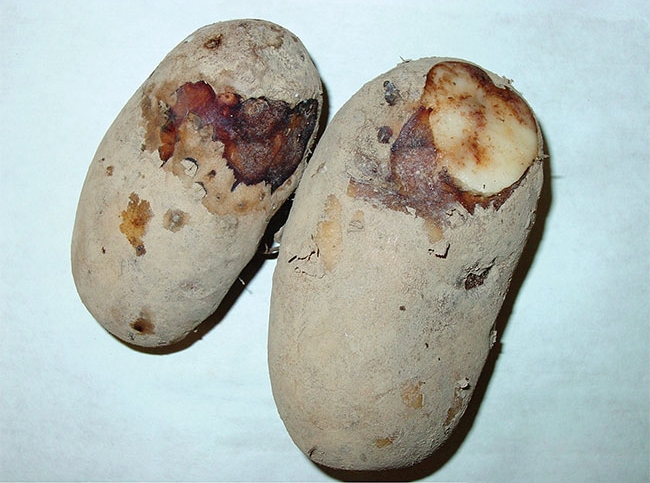
Initially, the disease manifests itself as small, irregular spots that are light green to dark green, which start at the edges of the leaves and spread without respecting the veins. Under favorable environmental conditions, the spots increase in size, turning into large brown to black necrotic lesions, and that, in the presence of free water, a whitish efflorescence can be observed on the underside of the infected leaf, which is formed by sporangia of the pathogen. On stems, light brown or dark brown lesions can be seen, which elongate and encircle the stem, making them brittle. The external part of the infected tubers have slightly sunken irregular areas, where the peel takes a brown to reddish color,
Weekdays. Unsubscribe in one click.
MANAGEMENT OF DISEASE
For the control of this pathogen, an integrated management of the disease is recommended, which implies cultural and chemical control. Therefore, a late blight control strategy should consider:
Property hygiene: elimination of all sources of inoculums, that is, remains of tubers, voluntary plants, foci of the disease, among others, and which must be discarded, either by burying, composting or burning.
Cultural management that does not favor the disease: such as use where possible of less susceptible cultivars, balanced nitrogen fertilization according to the production objective, planting density that favors inter-row ventilation, avoid damage to plants and tubers in agricultural work , efficient irrigation that avoids floods, among others.
Use of fungicides at the right time: When using fungicides to control this disease, it is important to use them optimally, knowing the efficiency of control, mode of action and, fundamentally, when to make the first application and its frequency, which will depend on the resistance of the cultivar, the climatic conditions. and the presence of the pathogen in the area.
It is important to note that fungicides are most effective in the initial stage of infection, before symptoms can be easily seen, so they must be applied preventively when favorable environmental conditions for infection arise. No fungicide can completely cure an infection, the effect is less once the blight has established, especially when the climate is favorable to blight and the disease is very active.
Fungicide applications should be carried out using the commercially recommended doses, with an appropriate nozzle that produces drops for good coverage and wetting of the plant, especially the underside of the leaflets in the case of contact fungicides. The product should be prevented from dripping onto the ground in order to save on the application cost and avoid environmental contamination. In addition, the residual effect of the product used must be known, that is, the protection time of the plant against the pathogen. Most late blight control products have a residual effect of 7 days and exceptionally 10 days.
ALERT SYSTEM EARLY AND APPLICATION OF FUNGICIDES
Since late blight depends on favorable environmental conditions, early warning systems are very useful support tools. These systems use models based on climatic parameters to predict the risk of disease development.
In Chile, INIA developed and implemented an early warning system for late blight, available on the platform http://tizon.inia.cl , which uses data from the INIA agrometeorological network http://agrometerologia.cl to determine the hazardous condition around each weather station. Today this system has 5,000 registered users, who can access information directly from the platform, by email or by text messaging.
Our results show that the use of an early warning system is capable of reducing the number of applications necessary for efficient disease management, between 64 and 33% compared to a fixed calendar control, depending on the condition of the area and season.
The INIA alert system indicates the current condition for the release of sporangia and infection, therefore, when a favorable condition occurs, the recommendation is to protect the culture. Alerts allow timely and efficient use of chemical control, reducing costs and environmental impact.
The INIA early warning system indicates the risk condition of the disease using colors:
RED: VERY FAVORABLE conditions for the development of Late Blight. Fungicide applications are recommended. Keep the crop protected considering the residual effect of the product.
ORANGE: FAVORABLE condition for Late Blight. Fungicide applications are recommended. Keep the crop protected considering the residual effect of the product.
YELLOW: MEDIUM-LOW condition for Late Blight. Check the culture in the next 3 days. Protect the crop if you use susceptible variety or are under irrigation.
GREEN: There are no conditions for the development of Late Blight. The application of fungicides is not necessary.

Additionally, in the INIA alert system platform, the condition forecast for the next 3 days is available. Thus users can make driving decisions well in advance.