
Potato cyst nematodes: devastating pests
Potatoes (Solanum tuberosum L.) are an important global food since they are rich incarbohydrates and offer significant amounts of protein, vitamins, and dietary fiber . Although potatoes thrive best in temperate climates, they are grown in over 150 countries . Like many agricultural crops, potatoes encounter challenges from an array of pests and pathogens. Among these, potato cyst nematodes (PCNs) stand out as one of the most serious pests in potato production.
Two species of PCNs, Globodera rostochiensis (Woll.) and Globodera pallida (Stone), are significant threats to plants in the Solanaceae family. Originating in South America’s Andean region, these nematodes have established a global presence alongside potato. The initial spread of PCNs was likely an introduction to Europe that occurred in the 1850s through contaminated seed shipments . These shipments were prompted by Europe’s search for late blight-resistant germplasm following the devastation of the Irish Potato Famine . It was not until 1881 that PCN damage was recorded, since it took nearly three decades for PCN populations to reach levels needed to cause noticeable damage to the crop .
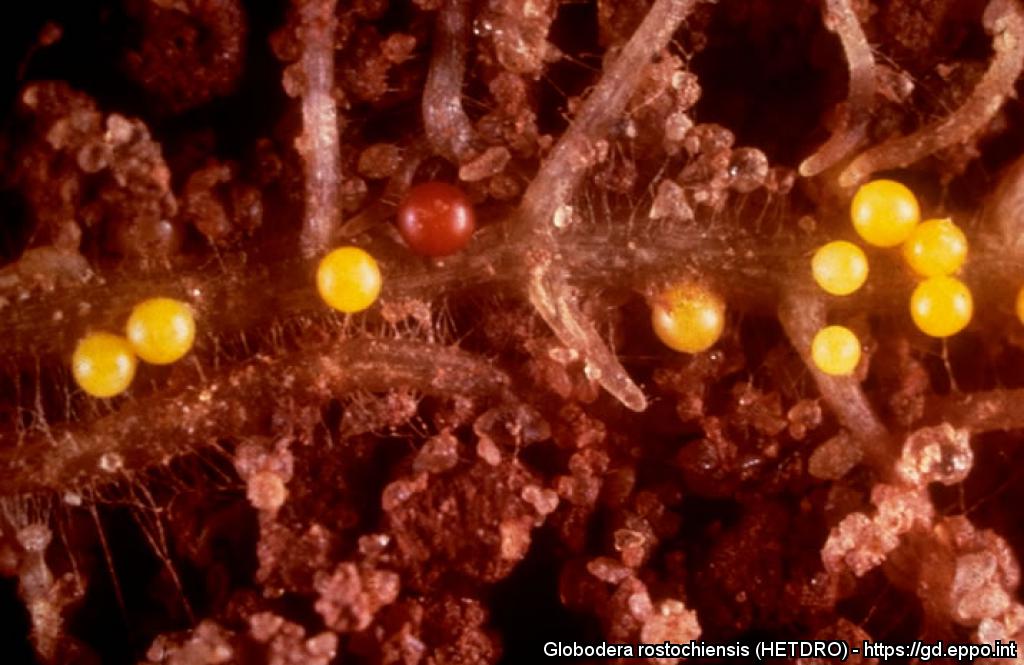
To create effective solutions for combating PCNs, it is important to understand their life cycle. Both G. rostochiensis and G. pallida exhibit similar life cycles . Prior to hatching, the first-stage juvenile (J1) nematode undergoes its first molt within the cyst and becomes a second-stage infective juvenile (J2). Hatching from the egg is dependent on various environmental factors, with the primary trigger being root exudates secreted by host plants . Such exudates signal to the J2 that a viable food source is nearby. After finding a host root, the J2 punctures it and moves to the pericycle. Within this region, the J2 selects a cell to transform into a feeding site, known as a syncytium. The J2 undergoes three additional molts to progress toward the adult stage. During these developmental molts, the nematode’s sex is determined based on nutrient availability. Limited nutrients result in male PCNs, while sufficient nutrients produce female PCNs . The fourth and final molt marks the transition to the adult stage. Females remain in the root to continue nutrient uptake and expand in size until they rupture the cortex of the root. Males exit the root to locate females and are guided by pheromones produced by the latter for sexual reproduction . After fertilization, the female enlarges and eventually dies in a swollen state. The nematode cuticle hardens to form a protective cyst wall. Cyst color provides a simple way to distinguish between the species. Globodera rostochiensis cysts are golden yellow, while G. pallida cysts are white or cream colored.
Weekdays. Unsubscribe in one click.
Inside the cyst, hundreds of J2 nematodes develop from J1s within eggs and wait for a signal to hatch. These dormant eggs can persist in the soil for 20 or more years without a host crop . The exceptionally long period that PCNs can survive without a host poses significant challenges for growers as it demands thorough care and strategic planning for effective PCN management. A typical crop rotation (e.g., susceptible potato followed by 3 years of various nonhost crops) is effective in managing many other soilborne diseases but is too short to meaningfully reduce PCN population levels .
PCNs can significantly reduce potato yield depending on the environmental conditions, initial PCN density, and cultivar grown . Yield reduction is not caused by damage to the tubers, but rather stems from the nematodes diverting essential nutrients, which disrupts the plant’s growth and lowers productivity . As nematodes enter and move through the roots, they also inflict physical damage, which makes the plant susceptible to secondary infections from other pathogens . Additionally, PCNs impair root function by reducing root elongation and decreasing nutrient uptake). This leads to stunted potato crop growth and yellowing leaves . While these symptoms are indications of PCNs, they are not exclusive to the pest. This allows them to go undetected over prolonged periods. The typically patchy occurrence of PCN symptoms throughout an infested field is attributed to uneven distribution of PCNs, since their limited mobility confines them to localized pockets. The spread of PCNs is typically facilitated by contaminated farm machinery, equipment, or seed potatoes covered with infested soil.
Because PCNs can dramatically reduce yield and are difficult to manage, in many jurisdictions (such as the United States), PCNs are classified as quarantine pests. This designation mandates that affected growers adhere to enhanced phytosanitary measures to prevent further spread and to facilitate a gradual reduction and eventual elimination of the nematode population .
An array of methods exists to manage PCNs, including the use of nematicides, trap crops, and soil treatments . Since this review is focused on control by using resistant varieties, we will not discuss the other methods further, other than to note that they exhibit varying levels of efficiency and that they can be used to reduce PCN populations either alone or in conjunction with the deployment of resistant varieties.
Resistant varieties are typically utilized as part of a crop rotation. New York’s response to the discovery of G. rostochiensis represents a success story of how crop rotations can control PCNs without the need for long-term use of nematicides .
Like trap crops, the resistant varieties in this rotation cause PCNs to hatch but allow little or no reproduction. This reduces G. rostochiensis inoculum levels by 90% or more each time a resistant variety is grown . The nonhost crop reduces inoculum levels further, while the susceptible cultivar allows inoculum levels to increase, albeit not to levels higher than when the rotation began. The purpose of the susceptible cultivar has evolved over time. Initially, it was included because many growers did not like the resistant varieties available when the rotation scheme was first established. Nowadays, a susceptible cultivar is encouraged since it helps slow the development of resistance-breaking G. rostochiensis strains.
In addition to crop rotation, New York employs other management practices to aid in PCN control, including mandated washing of farm equipment before it can leave an infested field. The USDA-APHIS surveys the soil in infested fields after each potato crop to ensure that PCN population levels have not increased to a level where spread is a risk. Increasing population levels can be an indication that a resistance-breaking strain has developed. Ultimately, New York’s successful management of G. rostochiensis was only possible through a collaborative effort involving breeders, nematologists, extension scientists, growers, and state and federal regulatory officials who acted in concert to contain the pest .
Reference: EPPO (2024) EPPO Global Database. https://gd.eppo.int
Reference: Spychalla, P., & De Jong, W. S. (2024). Breeding for potato cyst nematode resistance in Solanum tuberosum. Crop Science, 64, 1167–1182. https://doi.org/10.1002/csc2.21244