Peru: reported Guatemalan potato moth detection in Huánuco turns attention to seed movement
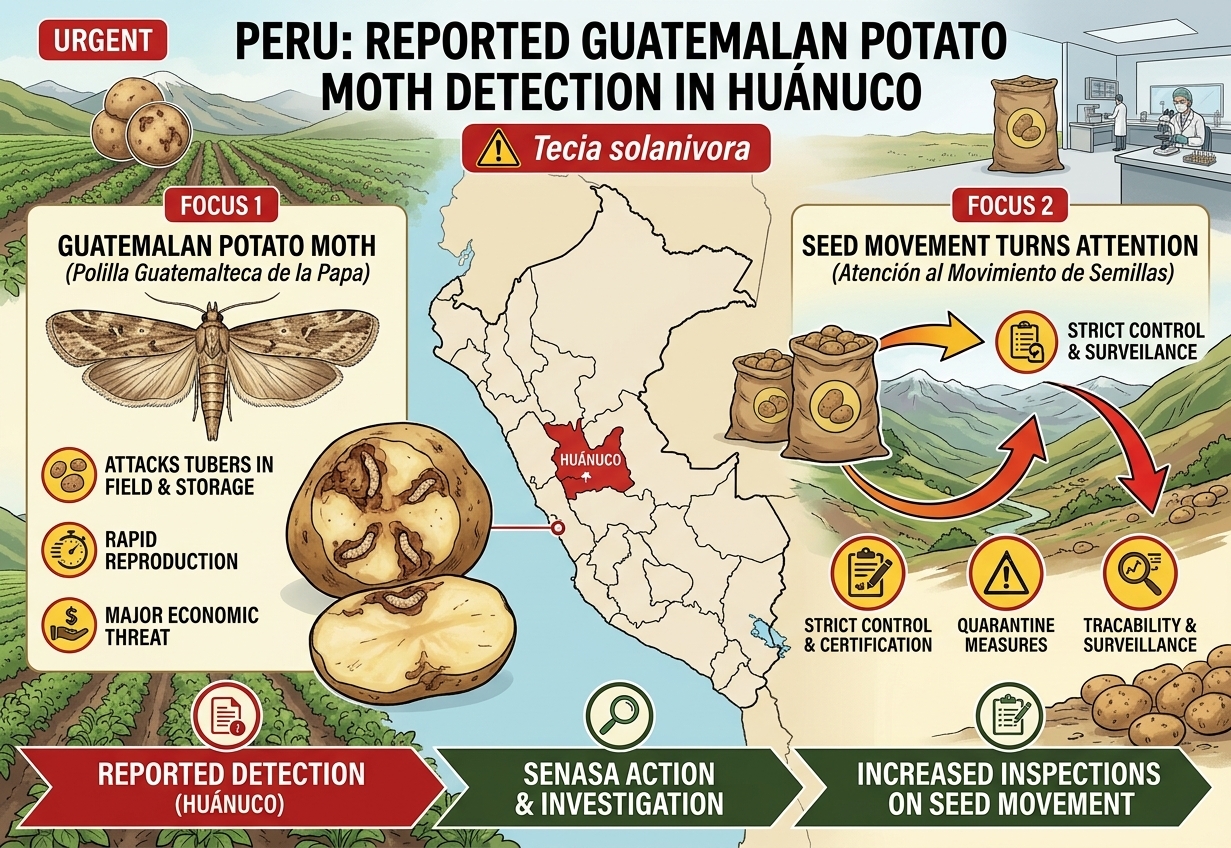
A possible finding of Tecia solanivora in the district of Pillco Marca has prompted calls for tighter controls on seed potato entering Huánuco. But official records show the pest is already present in the region — which changes what SENASA’s confirmation would actually mean.
Reports circulating in Huánuco, one of Peru’s principal potato-producing regions, describe a possible detection of the Guatemalan potato moth (Tecia solanivora) in the district of Pillco Marca. The finding has not been confirmed publicly by the Servicio Nacional de Sanidad Agraria (SENASA), and until it is, the correct description remains a suspected detection under surveillance rather than a verified outbreak.
Alejandro Mendoza Aguilar, the specialist who raised the alarm in local media, said he had been informed of the suspected detection roughly two weeks earlier and did not indicate that SENASA had issued any official confirmation. He said the agency is running pheromone-trap monitoring to establish whether the pest is present.
Weekdays. Unsubscribe in one click.
The context most coverage has missed
Coverage of the Pillco Marca reports has framed the episode as a potential new incursion. Peru’s own official record says otherwise.
In a pest report submitted to the International Plant Protection Convention (IPPC) on 28 August 2024 — reference PER-04/3 — SENASA notified Tecia solanivora as present, not widely distributed, and under official control, with a declared geographical distribution covering five potato-producing regions: Cajamarca, Huánuco, Lambayeque, La Libertad and Piura. The notification states that phytosanitary measures aimed at eradicating the pest are being implemented.
Huánuco, in other words, has been on the official list of affected regions for two years. The question raised by Pillco Marca is therefore not whether the moth has reached Peru, or even whether it has reached the region, but whether the known infested area now extends into a district that had not previously been delimited.
That distinction matters for what comes next. A SENASA statement would not establish a first national record; it would define the boundaries of an affected area and determine which restrictions apply to the movement and planting of seed potatoes within a region already subject to official control measures.
It also means that older SENASA public-information material describing T. solanivora as absent from Peru — still widely circulated and still indexed online — no longer reflects the country’s phytosanitary status.
Why seed potatoes are the pressure point
Huánuco’s growers depend heavily on seed tubers brought in from other parts of central Peru. Mendoza Aguilar pointed specifically to Jauja, in the Junín region, among the supplying areas, and argued that trap monitoring alone is insufficient: any credible response, he said, would require coordinated action between the regional government, the agriculture sector and SENASA, extended to the regions that supply Huánuco with seed.
The reasoning is straightforward. Infested tubers are the principal long-distance pathway for T. solanivora, and soil accompanying tubers can carry eggs or pupae. Moving uncertified or untested material between regions is how the pest established itself across northern South America in the first place, and it is the mechanism most likely to extend an existing Peruvian infestation into new districts.
A pest that hides until harvest
Tecia solanivora deposits its eggs in the soil at the base of the plant — according to Mendoza Aguilar, during flowering — or directly on exposed tubers. Newly hatched larvae bore through the tuber skin and excavate galleries as they feed, initially near the surface and then deeper into the flesh, leaving frass and larval exuviae that darken the tunnels.
The result is loss of weight and quality, and an entry point for secondary organisms. Affected tubers frequently develop rots and become entirely unmarketable.
The operational difficulty is that, unlike other members of the potato tuber moth complex, T. solanivora damages the tuber alone and leaves no foliar symptoms. An infestation can therefore develop unnoticed through the growing season and only become apparent at harvest or in store. Mendoza Aguilar noted that control becomes substantially harder once the canopy has closed.
Biologically, the species is adaptable across a wide altitudinal and thermal range. SENASA technical material puts the life cycle at 35–50 days between 16°C and 29.5°C, allowing seven to ten generations a year, extending to 67–75 days and four to five generations at 12–15°C. Adults live around 22.5 days under favourable conditions, and females lay approximately 290 eggs.
International standing
The species originated in Guatemala and spread through Central America — Costa Rica and Panama in 1973, then Venezuela in 1983, Colombia in 1985 and Ecuador in 1996 — largely through the tuber trade. It reached Tenerife in the Canary Islands in 1999 and mainland Spain in 2015, with the first record in Galicia; it remains under official control there and in Asturias.
Some authors regard it as the single most important insect pest of potatoes worldwide. It is listed as a Union quarantine pest in Annex II of Commission Implementing Regulation (EU) 2019/2072, and infested tubers and accompanying soil are recognised as the pathways of concern.
For trading partners, the practical implication of the Peruvian situation is less about a single district than about traceability: a pest under official control in five producing regions, moving principally through seed material, tests the seed certification and movement-restriction systems rather than border inspection alone.
Editorial notes
- [VERIFY] Alejandro Mendoza Aguilar’s institutional affiliation and job title are not stated in any available source. He is described here only as a specialist. Confirm before publication if a title is required.
- [VERIFY] The suspected Pillco Marca detection rests on a single local media report quoting one specialist; no SENASA statement, resolution or IPPC update had been issued at the time of writing.
- The reframing in section two is the substantive editorial intervention: the Argenpapa item that prompted this piece does not reference IPPC report PER-04/3 and presents the episode as a possible new appearance. The official 2024 notification contradicts that framing.
- Argenpapa’s closing section on the pest’s absent status in Argentina has been removed as irrelevant to an international readership and replaced with EU regulatory context.
- Spanish-language secondary sources were used for the local reporting; quotations have been rendered in indirect speech.
Sources
- Argenpapa, “Perú: Una posible detección de polilla guatemalteca pone en alerta a los productores de papa de Huánuco”, 12 September 2026 — https://www.argenpapa.com.ar/noticia/17703-peru-una-posible-deteccion-de-polilla-guatemalteca-pone-en-alerta-a-los-productores-de-papa-de-huanuco
- Ahora (Huánuco), “Alertan posible hallazgo de polilla guatemalteca en Pillco Marca”, 11 September 2026 — https://ahora.com.pe/regional/alertan-posible-hallazgo-de-polilla-guatemalteca-en-pillco-marca-y-advierten-rie
- IPPC, Pest Report PER-04/3, “Reporte de Tecia solanivora — Perú”, 28 August 2024 — https://www.ippc.int/en/countries/peru/pestreports/2024/08/reporte-de-tecia-solanivora/
- SENASA Peru, “Tecia solanivora: una amenaza al cultivo de papa” (biological parameters; note: presence statement superseded) — https://www.senasa.gob.pe/senasacontigo/tecia-solanivora-una-amenaza-al-cultivo-de-papa/
- EFSA Panel on Plant Health, “Pest categorisation of Tecia solanivora“, EFSA Journal 2018;16(1):5102 — https://www.ncbi.nlm.nih.gov/pmc/articles/PMC7009430/
- Bulgarian Centre for Risk Assessment on the Food Chain, information note on Tecia solanivora (EU regulatory status) — https://corhv.government.bg