Peru: Potato Output Falls 19.6% in July to 360,986 Tonnes, but Lima Supply Holds
Peru's July potato production fell 19.6% as Arequipa's crop collapsed, but Lima's main wholesale market received almost the same volume as a year earlier.
Peru produced 360,986 tonnes of potatoes in July 2026, 19.6% less than in July 2025, according to data from the National Institute of Statistics and Informatics (INEI) reported by La República and Jornada on 25 September. Yet supply to Lima’s main wholesale market fell by only about 1%.
The decline came mainly from the south. Output in Arequipa fell 79.2%. Pasco was down 26.2% and Apurímac 19.5%. La República also reports a 12% fall in Cusco, and says the six main producing departments account for 62.6% of national output.
Other regions grew strongly. Production in Piura rose 141.5%, and La República reports a 22.1% increase in Junín. Huancavelica and Huánuco also posted gains, according to the newspaper.
Weekdays. Unsubscribe in one click.
Lima market stays supplied
The Gran Mercado Mayorista de Lima (GMML) received 59,895 tonnes of potatoes in July 2026, up to 30 July, compared with 60,475 tonnes a year earlier. The difference was only 580 tonnes. Both outlets explain that INEI measures total national output, while the Ministry of Agrarian Development and Irrigation (MIDAGRI) tracks what arrives at the wholesale market from many regions.
White potatoes averaged S/0.98 per kilogram in July 2026, down 16.1% from S/1.17 a year earlier. Canchán averaged S/1.08 per kilogram, according to Jornada, while La República gives S/1.43 for the Única variety.
Higher prices in late September
Prices at the wholesale market were much higher two months later. On 25 September, canchán averaged S/2.54 per kilogram at the GMML, with a maximum of S/2.60, according to Revista Lombriz, citing MIDAGRI data. Única averaged S/2.33 and Yungay S/1.03. The gap between canchán and Yungay was S/1.51 per kilogram on the same day. The July averages and the September daily prices come from different reports, so they should not be compared directly.
Why it matters
The July data show that Peru’s potato supply depends on where the crop is grown, not only on how much. A sharp fall in the south was offset by growth in the north and centre, which kept Lima supplied and prices low in mid-year.
The late-September prices suggest a tighter market for the most popular varieties, while others, such as Yungay, remain cheap. For growers, the choice of variety and the timing of sales now make a large difference to income. Traders and processors should follow MIDAGRI’s daily GMML data and the next INEI monthly report for August.
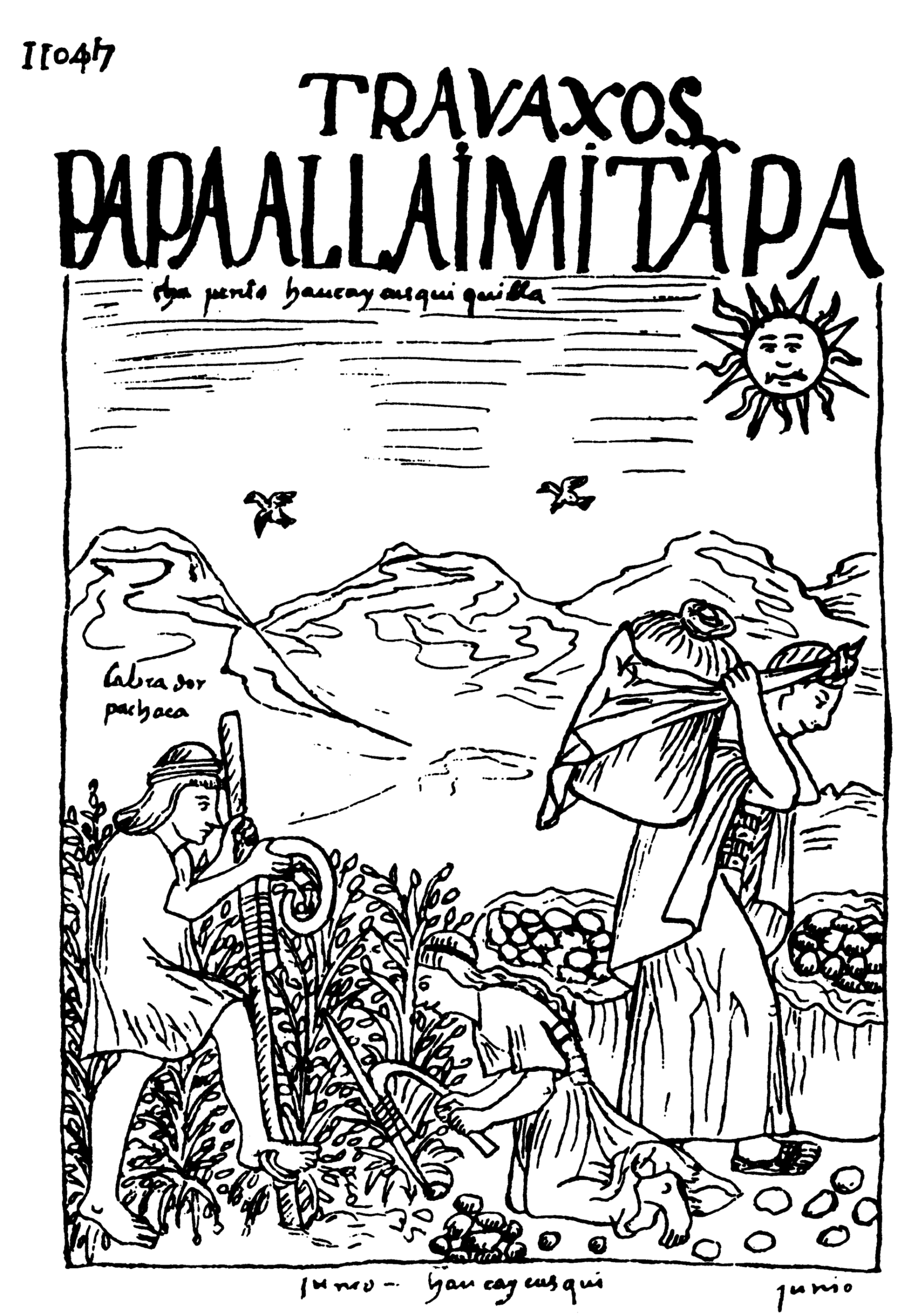
Photo: June, the time of digging up potatoes, a 1615 drawing by the Andean chronicler Guamán Poma (illustrative). Felipe Huaman Puma de Ayala / Wikimedia Commons, Public domain