
Peru: Potato Output Doubles to 6.58 Million Tonnes Since 2000 as Yields Reach 19.5 t/ha
Peru harvested 6.58 million tonnes of potatoes in 2024, twice the 2000 level, as average yields rose to 19.5 t/ha. More than 710,000 families grow the crop.
Peru harvested 6.58 million tonnes of potatoes in 2024, according to FAOSTAT data published by Our World in Data. In 2000, the country produced 3.27 million tonnes. Output has therefore roughly doubled in 24 years.
The Ministry of Agrarian Development and Irrigation (MIDAGRI) gives a similar figure. It reported 6.52 million tonnes for 2024, against 5.43 million tonnes in 2023. FAOSTAT shows 5.46 million tonnes for 2023. Both sources point to a jump of about 20% in one year.
Yield, not land, drove the growth
Average yield rose from 11.5 t/ha in 2000 to 19.5 t/ha in 2024, according to FAOSTAT. In 2014 it was 14.8 t/ha. Harvested area moved much less. The ministry counted 313,606 harvested hectares in 2023, down from 330,790 hectares in 2022.
Weekdays. Unsubscribe in one click.
The crop is highly fragmented. More than 710,000 families grow potatoes, according to MIDAGRI. On average, that is less than half a hectare per family. Production covers 19 regions, and about 90% is concentrated in the highlands. The largest areas in 2023 were in these regions: Puno (54,960 ha), Huánuco (42,736 ha), Ayacucho (30,552 ha), Cusco (29,156 ha) and La Libertad (26,550 ha).
Potatoes are a core food. Consumption is above 95 kg per person per year, according to the ministry. The 2024 crop was worth S/ 8.314 billion. That equals 10.5% of the value of national agricultural production. The crop also generates more than 27 million working days per year. More than 4,000 potato varieties are registered in the country.
Room to grow
A yield of 19.5 t/ha is still modest. FAOSTAT shows 35.8 t/ha in Argentina and 34.5 t/ha in Chile in 2024. Most Peruvian potatoes grow on small highland plots. Weather therefore moves the national total strongly from year to year.
Why it matters
Peru is the largest potato producer in Latin America, according to MIDAGRI. Its supply depends on hundreds of thousands of small farms, not on a few large growers. The swing between 2023 and 2024 shows that national output can change by a fifth in one season.
For seed, fertiliser and machinery suppliers, the gap between 19.5 t/ha and about 35 t/ha in neighbouring countries is the main opportunity. For buyers, the fragmented supply base means volatile volumes and prices.
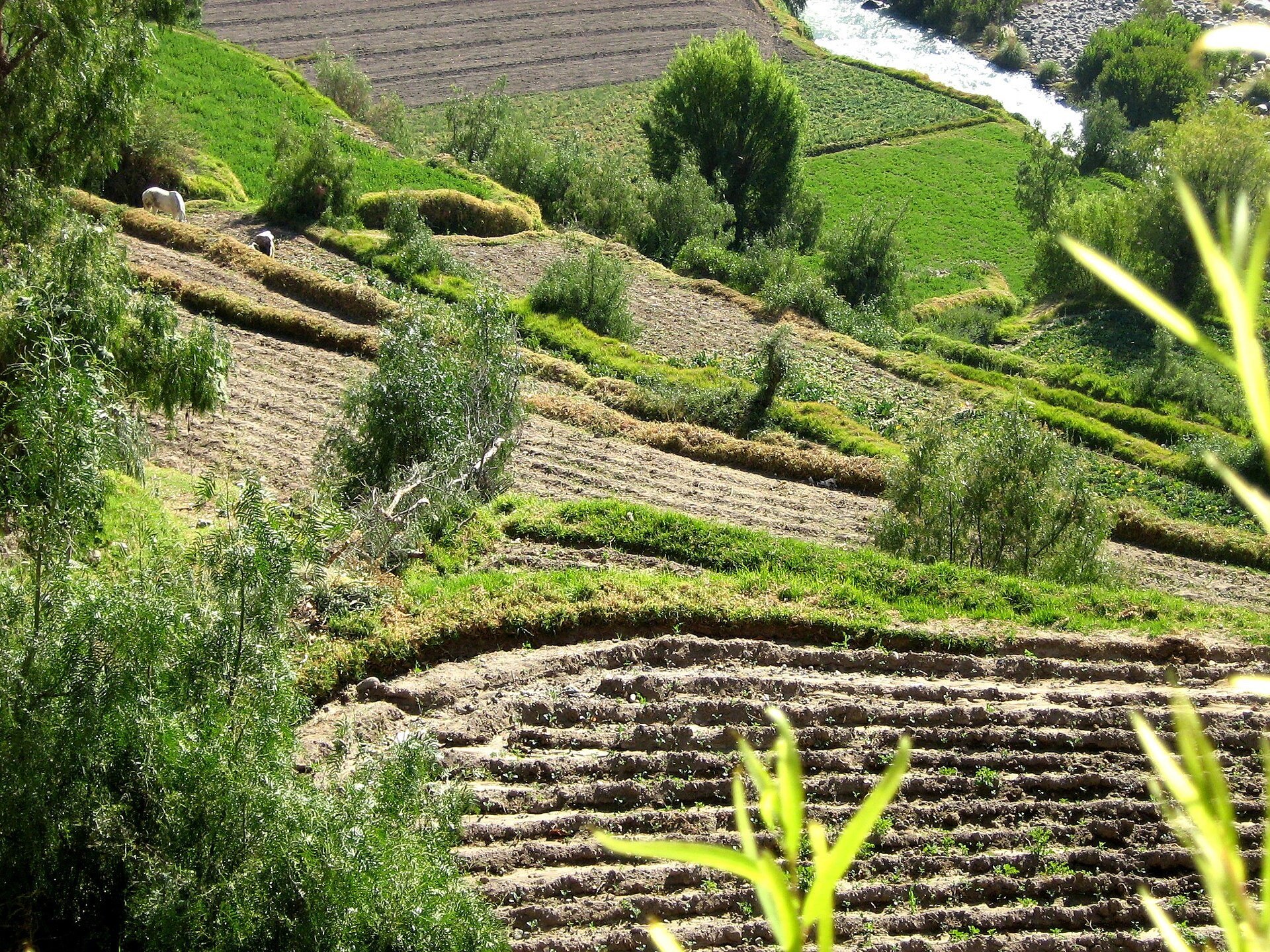
Photo: Terrace farming in the Andes, Peru (illustrative). J. Thompson / Wikimedia Commons, public domain