Peru: El Niño clouds the start of the 2026/27 main potato season
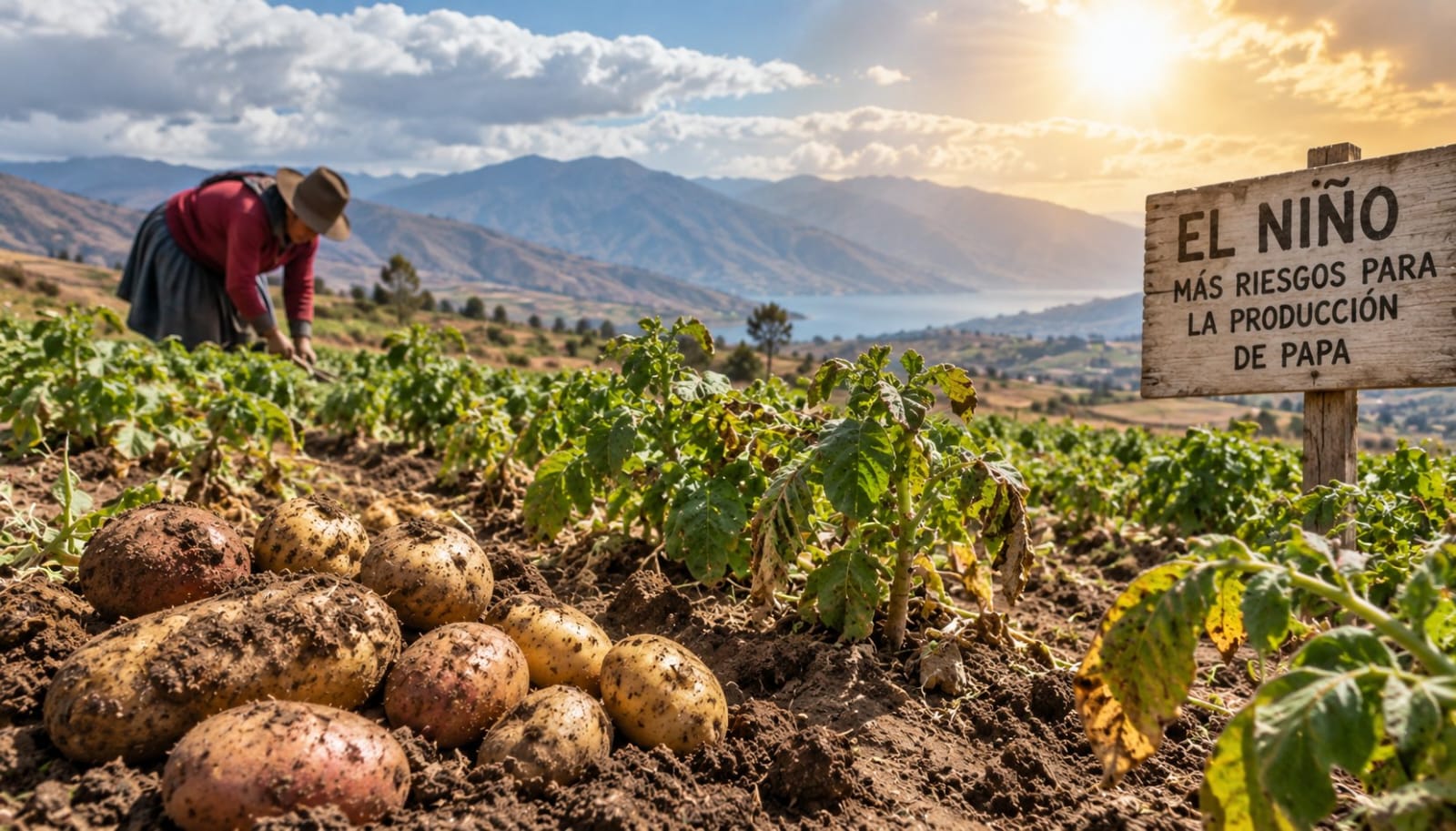
Peru’s coastal potato valleys face medium to high agroclimatic risk through November as El Niño conditions coincide with planting of the country’s main potato season, according to the national meteorological and hydrological service, Senamhi. Warm conditions could disrupt crop growth, tuber initiation and maturation, while the southern-hemisphere spring may bring heavier pest pressure. The Andean highlands, where most of Peru’s potato area lies, face lower but uneven risk.
Senamhi prepared the risk assessment, which runs to November, in response to the developing El Niño and shared it with the Peruvian business daily Gestión, which published it on 17 September. The assessment measures agroclimatic risk, meaning the likelihood that weather conditions will be unfavourable for specific crop growth stages. It is not a yield forecast.
Irrigated coastal valleys most exposed
Senamhi identifies the irrigated valleys of Peru’s central and southern coast as the most vulnerable areas. It expects pockets of medium and high risk to persist there until November, affecting plant growth, tuber set and maturation.
Weekdays. Unsubscribe in one click.
In its earlier outlook for August to October, published in mid-August, the agency explained the mechanism. It said the risk stemmed from higher crop water demand and from temperatures that, depending on the growth stage, could impair tuber initiation and bulking. It urged growers to manage irrigation carefully, warning that water stress could reduce tuber size and commercial quality.
The agronomy is well established. Potatoes initiate tubers most readily under cool night temperatures. When nights stay warm for long periods, the plant diverts assimilates towards foliage at the expense of tubers. This means the warm anomaly typical of a coastal El Niño can delay tuber set even where irrigation is adequate.
Highlands: lower risk, but not uniform
Most of Peru’s potato area lies in the Andean highlands, known locally as the sierra. For the central sierra, Senamhi expects low and medium risk to prevail from September to November. It flags localised high-risk areas, mainly on the western slopes of the central Andes, in the southern sierra and on the Altiplano, the high plateau around Lake Titicaca.
In the highlands, soil moisture at planting is the critical variable. In August, Senamhi warned that the gradual start of main-season planting in the central sierra makes the crop particularly sensitive to soil moisture. Insufficient moisture at planting and emergence could delay sprouting and lead to uneven stands, and late frosts remain a threat to newly emerged crops at higher altitudes. The agency advised growers to plant only once soils hold adequate moisture and to avoid early planting where water is scarce.
This fits the broader outlook from ENFEN, Peru’s multi-sector commission that monitors El Niño. ENFEN expects above-normal rainfall on the northern coast from November, alongside a risk of water deficits in parts of central and southern Peru over the same period. Highland potatoes are largely rain-fed, so for them the drought risk matters more than the prospect of northern flooding.
Which pests to watch
The September assessment carries only a general warning about higher pest pressure in spring. The August outlook was more specific. It said warm, relatively dry conditions in some areas could favour the gall midge Prodiplosis longifila, potato tuber moth, leafminer flies and cutworms. Senamhi called on growers to maintain phytosanitary monitoring and to adjust irrigation frequency to the crop’s growth stage.
A third of the planted area in play
As reported by Gestión, Senamhi places Peru’s two principal crops, potato and rice, at high to very high agroclimatic risk between September and November, the period when both begin their main planting campaigns. Together they account for 38.2% of the area planted in the 2026/27 season.
The headline “very high” rating, however, applies to rice. The published material assigns it specifically to rice in the Partidor basin in the northern region of Piura. For potato, Senamhi’s assessment is medium to high.
Potato is Peru’s second most widely planted crop after rice. Planting intentions for the 2025/26 season exceeded 311,000 ha. Area figures for 2026/27 have not yet been published in the available sources.
Economic backdrop
Peru’s agriculture is already under strain. According to Gestión, the sector contracted by 1.9% in the first half of 2026, and the Ministry of Economy and Finance expects a 3.2% decline for the full year.
In August, ENFEN projected that the coastal El Niño would last until April 2027. It said the event would most likely remain strong, without ruling out escalation to “extraordinary” magnitude by the end of 2026. In September, Scotiabank analysts told Gestión they were revising their agricultural forecasts on the basis of an extraordinary event.
The farm federation Conveagro, which represents 30 agricultural organisations, has presented the Ministry of Agrarian Development and Irrigation (Midagri) with an emergency agenda. It calls for financing support and debt restructuring for the growers hardest hit by El Niño.
Sources: Senamhi agroclimatic risk assessments as reported by Gestión (16 August and 17 September 2026); ENFEN.