A new study from Peru suggests that drone-based multispectral imaging can help breeders compare late-blight resistance across thousands of potato genotypes. The strongest results came after disease had developed sufficiently to separate resistant and susceptible material, making flight timing central to the proposed selection method.
Two large trials, one breeding question
The PLOS ONE paper published on 3 November 2026 evaluated two trials comprising 2,745 breeding clones and 492 genebank accessions. Hildo Loayza and colleagues, including researchers from the International Potato Center and Peruvian partner institutions, compared image-derived estimates of late-blight severity at genotype level.
The work addresses a practical bottleneck: visual scoring must be repeated across many plots as an epidemic develops. In a large selection population, the challenge is to compare material consistently while retaining the field evidence needed to identify useful resistance. The experiment assessed whether an aerial measurement could preserve those differences.
Weekdays. Unsubscribe in one click.
What machine learning added
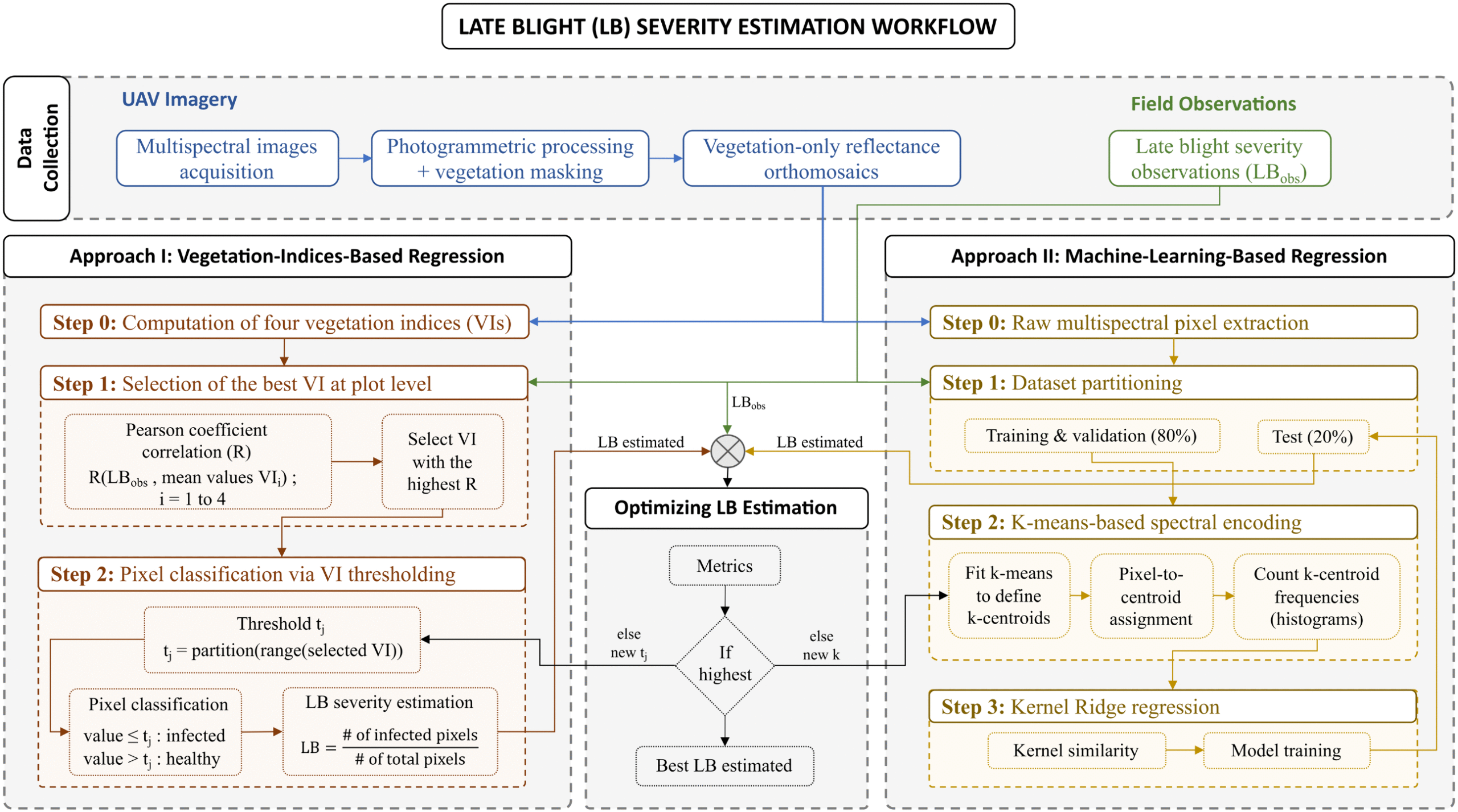
The researchers compared vegetation-index approaches with a framework combining K-means clustering and Kernel Ridge Regression. NDVI was strongly associated with visually assessed disease, particularly at advanced stages. The multispectral machine-learning approach nevertheless performed better than the linear NDVI models, capturing nonlinear relationships between the spectral response and disease development.
The comparison matters because a familiar index and a more complex model need to be evaluated against the same biological reference. An algorithm’s name is not itself evidence of useful selection. Here, the reference included the area under the disease progress curve, which integrates disease observations over time rather than treating one image as a complete season.
A well-timed flight is different from early warning
Model-derived genotype estimates were most consistently related to disease-progress measurements in later acquisitions. Selection agreement improved at intermediate to advanced disease stages. The authors conclude that a single inspection at those stages can capture enough variation to distinguish genotypes within the evaluated trials.
That conclusion concerns resistance ranking under the trial conditions. It should not be recast as proof that one flight will diagnose every early infection, distinguish every cause of damaged foliage or replace routine crop protection decisions. The useful timing depends on the task: detecting an initial problem and ranking a breeding population are different objectives.
What a breeding programme can take forward
For breeding teams, the study provides a documented approach to testing high-throughput phenotyping against their existing scoring system. A local evaluation could compare genotype rankings, selection agreement and the handling of checks across acquisition dates. It should retain the trial layout, disease stage and image-processing method with each result.
For growers and technology suppliers, the immediate significance is a research method rather than a universal diagnostic product. Wider deployment would need evidence for the intended population, environment and decision. The paper gives a clear basis for that next step: evaluate whether an imaging workflow preserves the biological differences that matter to selection, and identify when collecting the image adds the most value.
Key points
- The trials evaluated 2,745 breeding clones and 492 genebank accessions.
- Multispectral machine learning outperformed linear NDVI approaches in the study.
- The strongest selection results came at intermediate to advanced disease stages.
Figure 1: NDVI and KRR-based late-blight severity estimation workflow. Loayza et al., PLOS ONE (2026), DOI: 10.1371/journal.pone.0347446. Creative Commons Attribution (CC BY).