The International Potato Center’s November cryo-deposit initiative in Lima puts a less visible part of potato security in focus: preserving living genetic resources that a conventional seed vault cannot adequately safeguard.
A November initiative in Lima
In its announcement for the 5 November 2026 cryo-deposit event, CIP described a coordinated deposit by Brazil, Chile and Ecuador at The Plant Cryo Vault. The listed contributions comprise pineapple and cassava resources from Brazil’s Embrapa, ten potato accessions from Chile’s INIA, and groundnut resources plus three potato accessions from Ecuador’s INIAP. An accession is a separately maintained genetic-resource sample, not a new commercial variety or a volume of planting seed.
CIP says the deposited material remains the property of the contributing countries. The vault acts as custodian and returns material on request; the safety copies are not a collection made freely available for experimental use. That distinction matters when interpreting a conservation announcement as evidence of access for breeding or commercial multiplication. Those are separate questions governed by the relevant arrangements.
Weekdays. Unsubscribe in one click.
Why potatoes need more than dried-seed storage
CGIAR’s cryopreservation guidance explains why some crops need an alternative to conventional seed banking. Potato plants raised from botanical seed do not necessarily preserve the exact genetic identity of the parent. Keeping living material allows a particular clone to be conserved. Field collections remain exposed to pests, disease and environmental fluctuations, while maintaining plants in tissue culture requires repeated care and transfers.
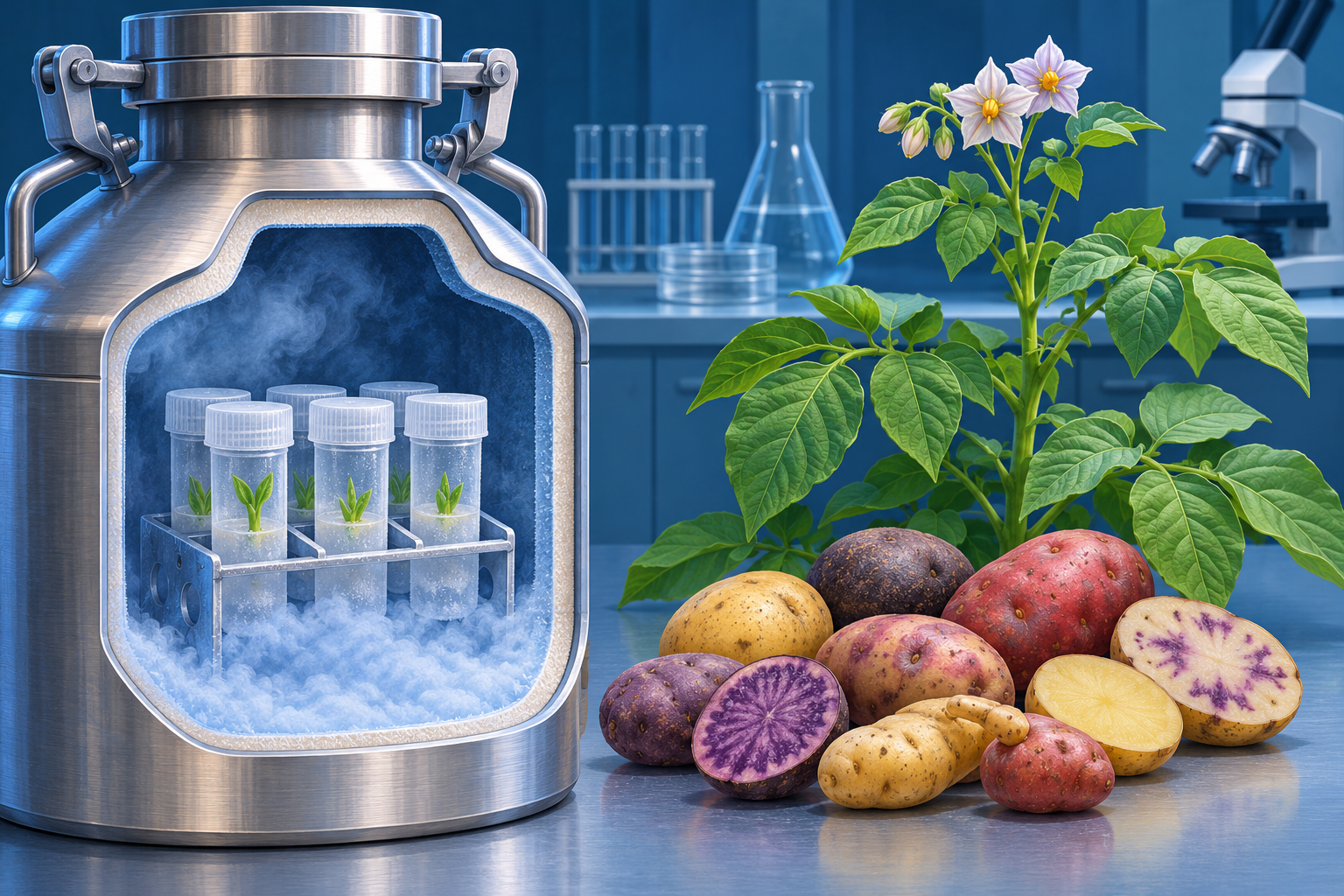
Cryopreservation stores suitable living tissues at ultra-low temperatures, commonly using liquid nitrogen at about −196°C. Many CGIAR collections use shoot tips from plants grown in vitro, with protocols adapted to the crop. Suppressing metabolic activity offers a way to preserve material without repeatedly growing the entire plant. The method still requires infrastructure, specialist skills and reliable procedures; the low temperature alone is not a conservation programme.
The recovery test matters as much as the freezer
FAO’s Genebank Standards, published in 2013, make quality and recovery central to cryopreservation. Selected plant tissues should remain capable of onward development after preservation. The stages of a protocol must be tested and optimised for viability, rather than assuming that survival of storage automatically means successful plant regeneration. Preparation, cooling, retrieval and establishment are linked parts of the process.
For the potato industry, the implication is long-term rather than an immediate increase in seed supply. Conserving an accession protects the possibility of recovering its genetic identity. It does not demonstrate that the accession has a commercially useful resistance trait, that it is suited to a particular production region, or that clean planting stock is ready for sale. Those outcomes require additional evaluation and multiplication.
The Lima initiative therefore belongs alongside other forms of conservation and crop improvement. Its practical contribution is a safety reserve with defined custody and a route back to living plants. Protecting that reserve can help future research retain options that would be lost if an original collection disappeared.
Sources
CIP announcement for the 5 November 2026 deposit; CGIAR, Cryopreservation; FAO, Genebank Standards (2013), section 6.5. Sources checked on 17 November 2026.
Cover: AI-generated editorial illustration; it does not depict a specific facility, field or machine.