The Netherlands grows three different potato crops, and in 2026 they moved in different directions. Statistics Netherlands (CBS) said on 30 June 2026 that the total potato area fell 8.4% to nearly 150,000 hectares. This is the smallest area since 2012.
The cut came almost fully from ware potatoes for the fresh market and for processing. Their area fell 15.1% to 70,200 ha. The area of seed potatoes rose 0.8% to 42,100 ha. Starch potatoes fell 4.0% to 37,700 ha. The farm paper Nieuwe Oogst reported the same numbers. CBS links the cut to the large 2025 harvest, which pushed prices down and made farmers move to grain.
Three crops, three markets
In 2026 ware potatoes cover about 47% of the Dutch potato area, seed potatoes about 28% and starch potatoes about 25%. Each crop has its own buyers: ware potatoes go to packers and fries factories, seed potatoes to growers at home and abroad, and starch potatoes to starch factories.
In 2025 the picture was different. CBS counted 83,100 ha of ware potatoes, 41,900 ha of seed and 39,400 ha of starch potatoes, 164,400 ha in total. It was the first time since 2000 that ware potatoes passed 80,000 ha; in 2000 they covered 87,400 ha. CBS also noted that starch potatoes have fallen below a quarter of the area, while in the past their share was around 30%.
The long view
The FAOSTAT series, published by Our World in Data, shows that the Netherlands did not lose potato land like most of Europe. In 1961 Dutch farmers produced 3.72 million tonnes at 28.0 t/ha, on about 133,000 ha. In 2000 they produced 8.23 million tonnes at 45.7 t/ha, on about 180,000 ha. In 2024 production was 6.37 million tonnes at 41.7 t/ha, on about 153,000 ha. So the area is still larger than in 1961, but smaller than at its peak around 2000.
Why it matters
Seed potatoes are the most stable part of the Dutch potato sector. In 2026 their area even grew a little while ware prices were low. This stability matters for the many countries that buy Dutch seed.
The ware crop is the flexible part. A cut of 15% in one year shows how fast Dutch farmers react to prices. Fries processors in the Netherlands and Belgium should expect Dutch ware supply to swing more from year to year than seed or starch supply.
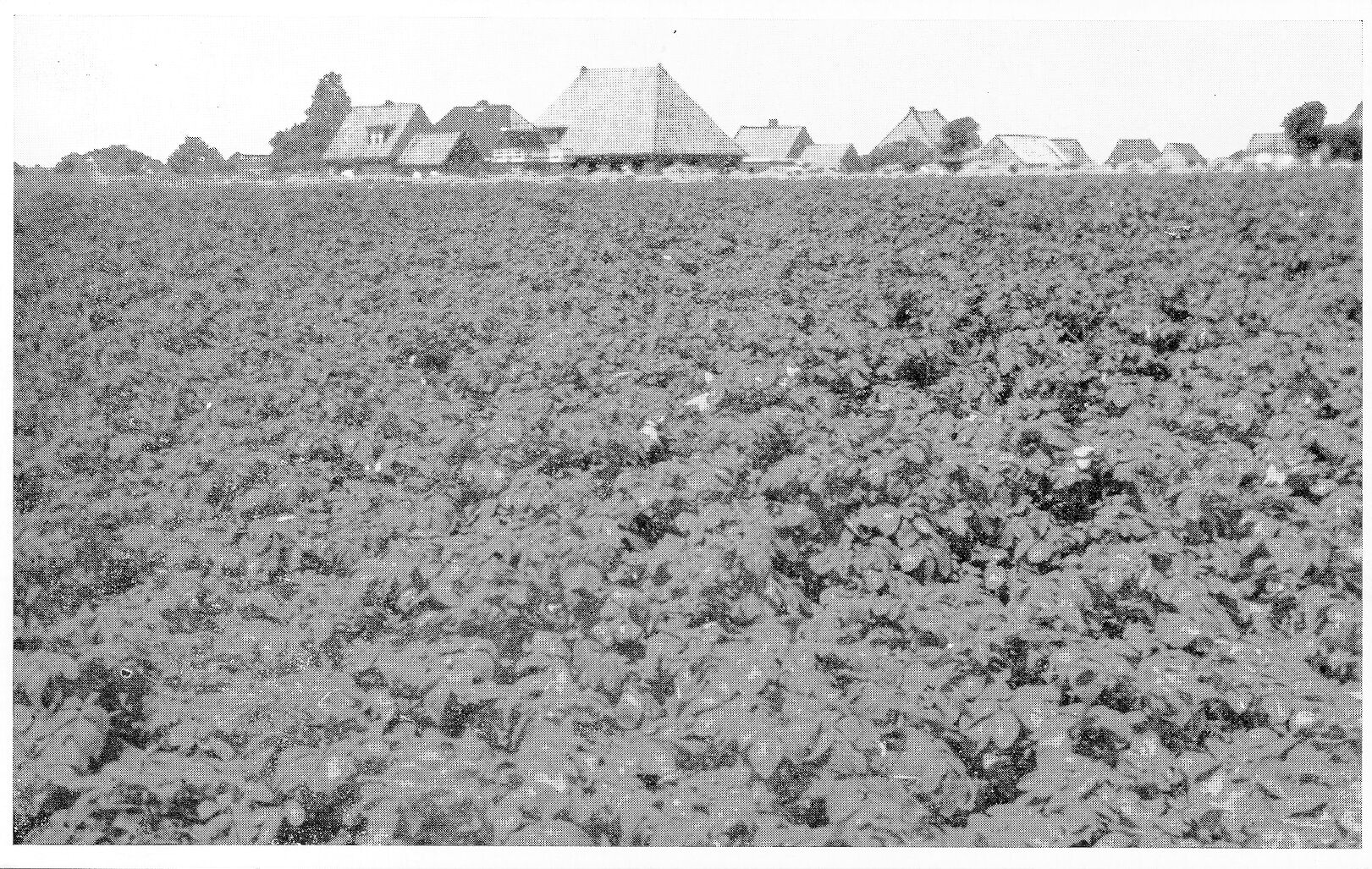
Photo: Farm fields in Het Bildt, Friesland, the Netherlands, around 1920 (illustrative). Unknown / Wikimedia Commons, Public domain