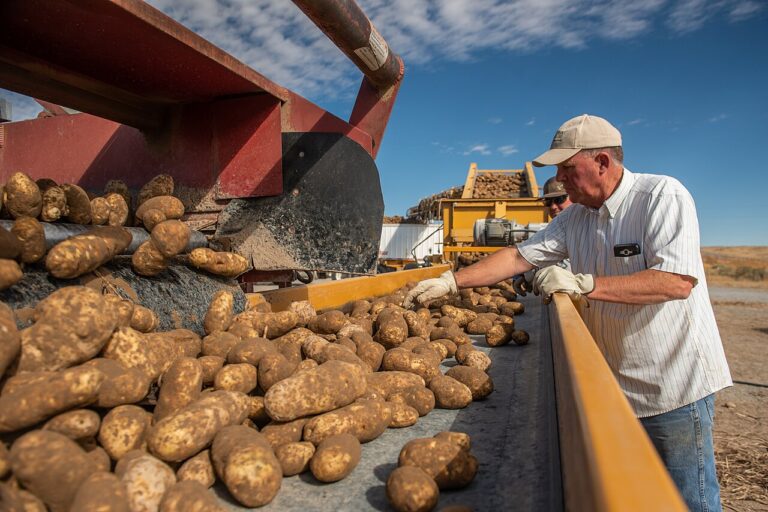
Meeting the Processing Challenge: How Belarusian Breeders Are Developing Next-Generation French Fry and Chip Potato Varieties

Minsk — Samokhvalovichi. Demand for specialized processing potatoes across Eastern Europe and the CIS region has grown by more than 35% over the past three years. New continuous-fry frozen French fry processing lines, potato flake installations, and expanded snack manufacturing plants have created an acute deficit of raw material with strict biochemical and morphometric specifications.
Historically, industrial processors relied heavily on established European varieties (Innovator, Lady Claire, Opal, Fontane). However, escalating logistical barriers, seed certification delays, and the vulnerability of long-distance supply chains have accelerated the shift toward domestic breeding programs. At the Scientific and Practical Center of the National Academy of Sciences of Belarus for Potato and Fruit and Vegetable Growing (Samokhvalovichi), trial plots and biotech facilities are finalizing the validation of prospective clones engineered to compete directly with global benchmarks.
The Biochemical Barrier: What Processing Plants Pay For
While fresh market potatoes are judged primarily on skin brightness, shallow eyes, and culinary boiling quality, the industrial processing sector operates on a rigid biochemical matrix:
Weekdays. Unsubscribe in one click.
- Reducing Sugars (Glucose & Fructose) $\le 0.15–0.20\%$: At temperatures exceeding 170 °C, reducing sugars react with free amino acids (asparagine) via the Maillard reaction, creating dark, unappealing streaks, a bitter caramelized flavor, and elevated acrylamide levels.
- Dry Matter Content $\ge 21.0–24.0\%$: High specific gravity guarantees a crisp, rigid structure for French fries and chips while significantly lowering oil pickup during continuous frying.
- Cold-Induced Sweetening (CIS) Resistance: The genetic ability of tubers to remain stored at $+6\dots +8\ ^\circ\text{C}$ for 7–9 months without rapid sucrose breakdown into fermentable sugars.
Key Quality Benchmarks: French Fries vs. Chips
| Parameter | French Fries Specification | Potato Chips Specification | Impact of Non-Compliance |
| Reducing Sugars | $\le 0.20\%$ | $\le 0.15\%$ (Target $\le 0.10\%$) | Uncontrolled browning, bitter taste, acrylamide formation |
| Dry Matter (DM) | $20.5–23.0\%$ | $22.0–25.0\%$ | Sogginess, hollow cores, excessive frying oil uptake |
| Tuber Shape | Long-oval, length $\ge 75\text{ mm}$ | Round / Short-oval, $45–65\text{ mm}$ | Yield loss in slicing; high waste in peeling line |
| Eye Depth | Very shallow | Very shallow | High peeling loss during abrasive or steam peeling |
| Storage Window | $+6\dots +8\ ^\circ\text{C}$ with ventilation | $+7\dots +9\ ^\circ\text{C}$ with CIPC/ethylene | Sugar spike after dormancy break |
The Breeding Pipeline: Clones in the Spotlight
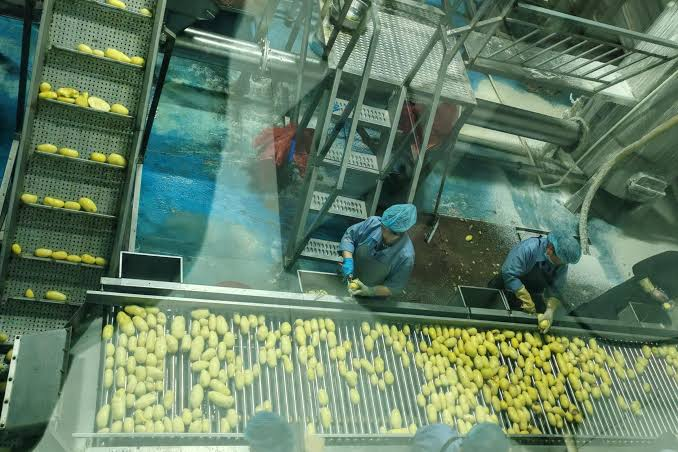
Using marker-assisted selection (MAS) and biochemical profiling, breeders at Samokhvalovichi have advanced several dedicated lines:
- Mastak (Chip processing / Dual-purpose): A mid-season variety with dry matter reaching 23.5% and low glucose accumulation under commercial ventilation regimes. It demonstrates robust field tolerance to common scab (Streptomyces scabies) and black scurf (Rhizoctonia solani).
- Garantiya (Crisp production): An early-to-medium variety suited for direct “field-to-factory” delivery in late August and September, bypassing long conditioning cycles.
- Advanced French Fry Hybrids (Line 14-xx): Feature an elongated tuber index ($>1.6$), high recovery of Extra Long strips ($>70\%$), and minimal core discoloration.
Dedicated Agronomic Protocols for Processing Crops
Growing processing potatoes demands strict adjustments to standard agronomic programs:
- Split Nitrogen Management: Excess late-season nitrogen delays skin set, dilutes dry matter, and spikes free amino acid levels. Basal nitrogen must be applied prior to tuber initiation.
- Potassium Sulfate Over Potassium Chloride: Chloride ions ($Cl^-$) depress starch accumulation and dry matter. Agronomists specify potassium sulfate ($K_2SO_4$) combined with magnesium and zinc to optimize cellular turgor and reduce bruising during mechanical harvest.
- Controlled Desiccation: Canopy burndown must be timed 14–18 days prior to harvest to allow full skin maturation, preventing mechanical skinning on harvester webs and intake hoppers.