
Heat inside the ridge: why three degrees can cost half a crop
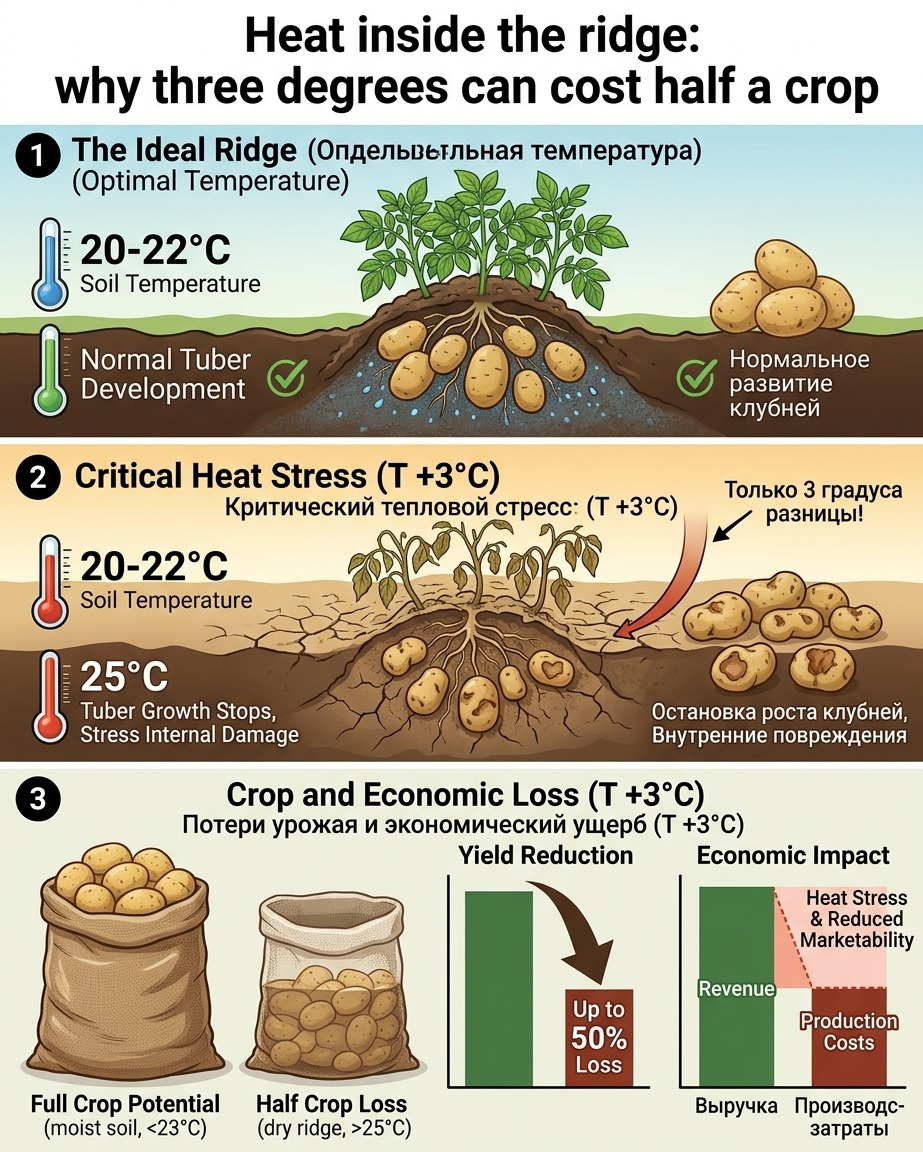
A canopy can look sound while the saleable part of the crop is already lost. Losses in East Asia this August and the European season now being lifted point to the same mechanism: the temperature that decides the outcome is not the one recorded two metres above the ground.
A field that gave no warning
In August, a grower in South Korea’s Gangwon province walked into a potato field that looked broadly normal from the headland. A week earlier it had shown nothing unusual. When the crop was lifted, the tubers came out soft and unfit for sale. The grower’s own description — that they resembled potatoes already cooked — travelled quickly, precisely because it was vivid.
Weekdays. Unsubscribe in one click.
The agronomic point underneath the phrase matters more. A canopy that still appears functional can sit on top of a badly damaged crop.
The Korean event belonged to a wider run of exceptional temperatures across East Asia. On 2 August 2026, Yangsan recorded 42.5 °C, the highest figure since modern observation began in the country in 1904. Japan, China, Hong Kong and North Korea were affected by the same heat.
One caveat belongs in any account of this. Describing every soft tuber found during a heatwave as having cooked in the soil is a grower’s shorthand, not a diagnosis. Disease, waterlogging and other physiological disorders produce deterioration too, and warrant separate investigation before heat is assigned the whole blame.
The ridge keeps its own climate
Heat risk is usually judged from weather stations and air-temperature forecasts. Those readings are useful, but they are not what the developing tuber experiences. It sits in a shallow soil environment governed by solar radiation, soil moisture, ridge dimensions, soil colour, canopy cover, irrigation and wind. On an exposed ridge, the temperature in the upper soil can diverge sharply from the standard air figure.
That gap matters because potatoes are a cool-season crop. The plant can keep producing stems and leaves at temperatures that are already interfering with the signals governing tuber initiation and bulking.
High daytime temperatures raise respiration and water demand. Warm nights are a particular problem: the plant goes on burning carbohydrate through respiration at the point when it should be moving and storing it in the tuber. The canopy carries on growing while a smaller share of the plant’s energy reaches the part that will actually be sold.
Heat also compresses the cycle. A crop that develops faster is not producing more. It reaches maturity sooner, which leaves fewer effective days for bulking and dry-matter accumulation.
What three degrees did in controlled conditions
Work in China gives a sense of what an apparently modest shift can mean. Li Jieping, a researcher at the International Potato Center, ran controlled experiments on two widely grown Chinese varieties, with conditions set to simulate temperatures roughly 3 °C above the current average for northern producing regions such as Hebei and Inner Mongolia.
Development accelerated by about ten days. Yield fell by more than half, and the tubers harvested were markedly smaller than those from the current-temperature treatment.
The result should be read for what it is. It was not a forecast that every commercial field loses half its yield when temperatures rise three degrees. Controlled environments cannot reproduce the full set of interactions found in a production field, and varieties differ considerably in how they respond to heat.
Its value lies elsewhere. A longer frost-free period cannot be read automatically as a longer productive season: development speeds up while commercially useful growth contracts. In China, the world’s largest producer, that carries implications for food security and for grower incomes. The underlying physiology applies well beyond it.
Water does not cancel temperature
A hot crop is usually a water-stressed crop as well. The two pressures interact, but they are not interchangeable.
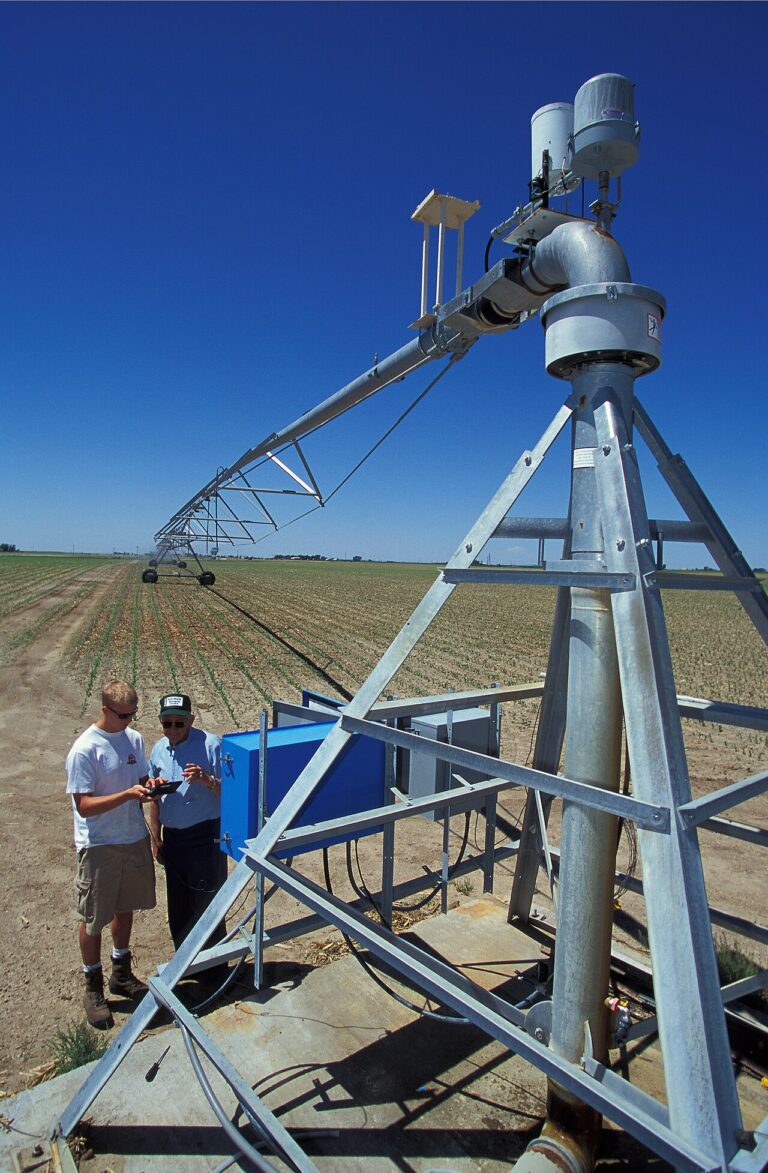
As soil moisture falls, stomata close, photosynthesis declines, canopy growth slows and less energy reaches the tuber. Irrigation addresses that specific form of stress, provided water and delivery capacity exist. It can also cool soil temporarily through evaporation, and a moist ridge behaves differently under solar heating than a dry one.
It does not, however, override temperature. A fully irrigated crop can still show depressed tuber initiation, elevated respiration and quality defects through a sustained hot spell, particularly where nights stay warm. Applying more water than the root zone can hold brings its own costs: nutrient leaching, poor aeration, erosion and conditions that favour disease.
The working objective is not to treat irrigation as a general antidote to heat, but to hold soil moisture steady and avoid the sharp wetting-and-drying cycles that compound heat injury.
There is a commercial dimension to this as well. Even where water is available, pumping capacity is typically sized around historical peak demand. A heatwave covering a whole district can push wells, reservoirs, abstraction allocations and electricity supply against their limits simultaneously.
Quality fails before tonnage does
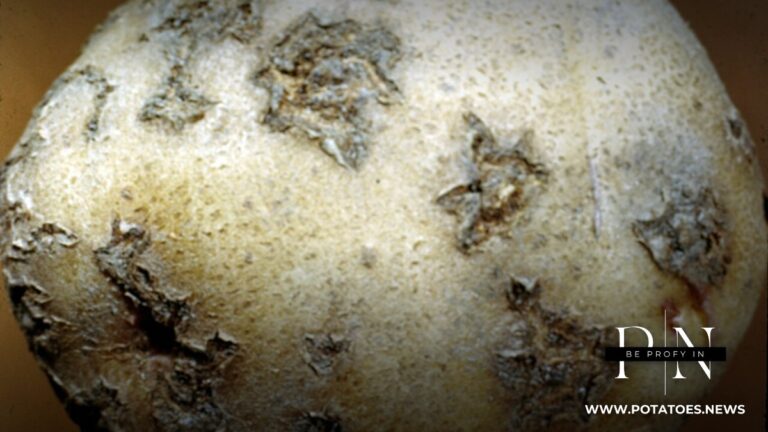
Yield is only part of the equation. Temperature combined with uneven moisture drives second growth, misshapen tubers, growth cracks and internal physiological disorders. High temperatures close to the ridge surface raise the risk of damage to shallow tubers, while interrupted growth produces a size profile that misses the intended market.
Processing crops carry additional exposure. Heat stress alters dry-matter accumulation and sugar metabolism, and with them fry colour, texture and factory recovery. A field can hold respectable gross tonnage while losing a disproportionate share of its contract value. That is why hectare-based crop reports and what intake actually records at the factory tend to diverge in a hot season.
Post-heat assessment therefore needs to go beyond a yield estimate. Regular digs should track tuber number, size distribution, shape, internal condition and specific gravity, with samples representing different soil zones and irrigation positions rather than the most accessible part of the field.
Storage managers need an accurate field history too. Tubers that have been through physiological stress do not necessarily behave like an unstressed crop, even when nothing obvious shows at intake. Field identity should be held long enough to assess storability, rather than letting uncertain lots disappear into a large bulk store.
The canopy is cooling infrastructure
A closed canopy shades the ridge and reduces direct solar heating, so its role is not confined to intercepting light. Anything that delays closure leaves soil exposed during the period when tubers are forming — weak seed vigour, compaction, nutrient imbalance, early disease, herbicide injury or uneven emergence. Protecting early canopy development is, in practice, part of heat management.
Ridge geometry works the same way. Planting depth and soil cover influence the temperature a tuber experiences, but deeper is not automatically better: excessive depth can delay emergence, increase harvest losses, or place seed into colder, wetter or more compacted soil.
Mulches and retained residues moderate soil temperature in some systems while altering moisture, pest and disease pressure and harvesting practicality. The same trade-off applies to planting date. Shifting the crop so that initiation and early bulking avoid the hottest historical window reduces heat exposure but can introduce frost risk, conflict with rotation and labour planning, or move lifting into wetter conditions. Adaptation exchanges one risk for another; the task is to make that exchange deliberately.
Not every grower has the same room to move
The recommendations that follow a heat event — change variety, improve irrigation, shift the planting window, invest in monitoring — assume the grower controls those decisions. Many do not. Contract specifications restrict cultivar choice, seed availability determines what can be planted, water rights and pumping capacity cap irrigation, and tenancy arrangements discourage long-term investment.
Smallholders have the narrowest range of options. A grower without irrigation cannot cool a ridge with water that does not exist, and one dependent on saved or locally traded seed cannot obtain a newly released heat-tolerant cultivar in time for the next season. The consequences of heat are therefore distributed unevenly: better-resourced businesses can buy sensors, spread risk across fields and absorb an experimental year, while others carry the loss personally.
Europe 2026: the same mechanism at a different latitude
The European season illustrates the point on different ground. On 24 August, the French producer organisation UNPT put the national average yield for the 2026 ware crop at approximately 37.4 t/ha — 14% below the 43.5 t/ha of 2025 and 13% below the five-year average of 43.1 t/ha. Combined with a reduced planted area, that implies production down by roughly 23%, close to two million tonnes. Acreage cuts made after the 2025 oversupply collided with five successive heatwaves and an exceptional water shortage.
The clearest documented case of a size-distribution failure is Belgium, where heavy spring rainfall followed by extreme heat and drought compacted soils into hard clods, restricting tuber growth and producing undersized material unsuitable for fries. For the Netherlands, no equivalent confirmed data on size distribution was available at the time of writing; the yield forecast there stands at 43.3 t/ha, 6% below 2025.
The common factor holds. The loss is registered not only in gross tonnage but in shape, dry matter and fry colour — the part of the crop the factory sees rather than the part the area statistics describe.
Measuring what the tuber experiences
The Gangwon losses expose the limits of canopy observation. An inexpensive soil-temperature probe placed at tuber depth supplies information a regional weather station cannot. Placement should represent the real production zones: the exposed side of a ridge, areas with a thinner canopy, different soil types, contrasting irrigation positions.
The value is less in a perfect data stream than in linking temperature to crop response. Growers can record when critical thresholds persisted, then set those periods against digs, grade-out, specific gravity, defects and storage performance. Over several seasons a business builds its own evidence on which fields, cultivars and growth stages are most exposed.
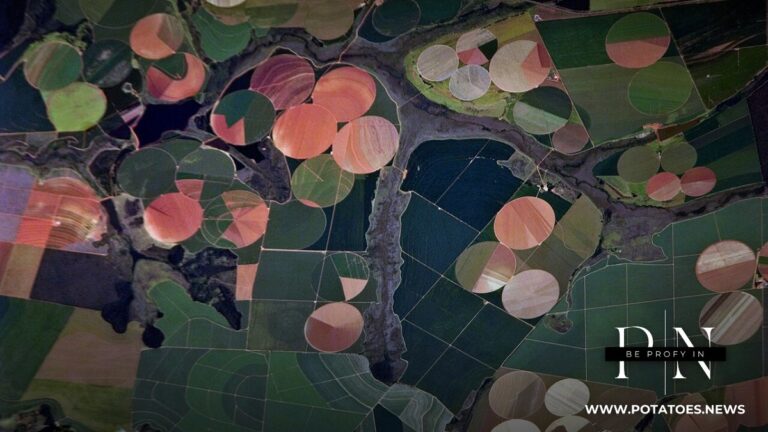
Remote sensing identifies canopy stress and surface-temperature patterns across large areas but cannot inspect a tuber. Digging remains indispensable. The strongest systems run forecasts, soil measurements, canopy observation, irrigation records and physical sampling together, since each captures a different part of the problem.
Potato production has historically managed temperature through geography and timing — cool seasons, temperate regions, higher elevations. Those advantages are becoming less dependable as extreme heat reaches areas once regarded as naturally protected. For now, the most practical change available is also the simplest: stop treating air temperature as the whole story. The crop is forming below the canopy, inside a ridge with a climate of its own.
Sources: Potato News Today, ‘What the canopy cannot tell us: Heat damage hidden inside the potato ridge’, 10 September 2026 (Lukie Pieterse); The Guardian, August 2026; Reuters, on International Potato Center heat-tolerance research; UNPT crop projection, 24 August 2026; AFP/phys.org, 26 August 2026; Nieuwe Oogst, Dutch yield forecast; World Meteorological Organization, State of the Climate in Asia.