Greece has become a small potato producer and a large potato importer. FAOSTAT data, published by Our World in Data, show a harvest of 1.08 million tonnes in 1980 at 16.7 t/ha. This means an area of about 65,000 ha, the highest in the series. In 2024 Greece harvested 332,910 tonnes on 10,540 ha, according to Eurostat. The area is 84% smaller than in 1980.
The Greek farm portal Agrotypos, in an analysis of FAOSTAT data published on 27 January 2026, describes the same trend: about 56,000 ha in 1961, a peak around 1980 and just over 10,000 ha in 2024.
Higher yields, smaller crop
Yields rose strongly. The average was 7.1 t/ha in 1961, 20.7 t/ha in 2000 and 31.6 t/ha in 2024. But the gain in yield did not stop the fall in production after 2010. The harvest was about 923,000 tonnes in 2010, 450,640 tonnes in 2020 and 332,910 tonnes in 2024.
Eurostat shows a weaker year in 2025: 282,720 tonnes on 11,310 ha, with a yield of 25.0 t/ha. For 2026 Eurostat shows 11,790 ha, a small increase.
Egypt fills the gap
Imports are now close in size to the domestic crop. According to data from the Hellenic Statistical Authority (ELSTAT), analysed by Incofruit and reported by Powergame in March 2025, Greece imported 254,144 tonnes of potatoes worth €118.2 million in 2024. Volume rose 5.3% and value 12.9% on 2023.
- Egypt: 154,966 tonnes (60% of volume)
- France: 43,043 tonnes
- Cyprus: 21,904 tonnes
Powergame reports that Greece is the second largest destination for Egyptian potato exports after Russia. Imports in 2024 were equal to about 76% of the 2024 Greek harvest.
Why it matters
Greek growers now compete in their home market with Egyptian potatoes. Powergame reports that about 600 containers, or roughly 15,000 tonnes, arrived between January and early March 2025 alone. For Greek farmers, this means strong price competition.
For Egyptian exporters and for traders, Greece is a stable and growing outlet. For Greek policy makers, the question is whether support for local varieties and origin labels, such as those from Naxos or Nevrokopi, can slow the fall in area. The small rise in 2026 plantings is not yet a trend.
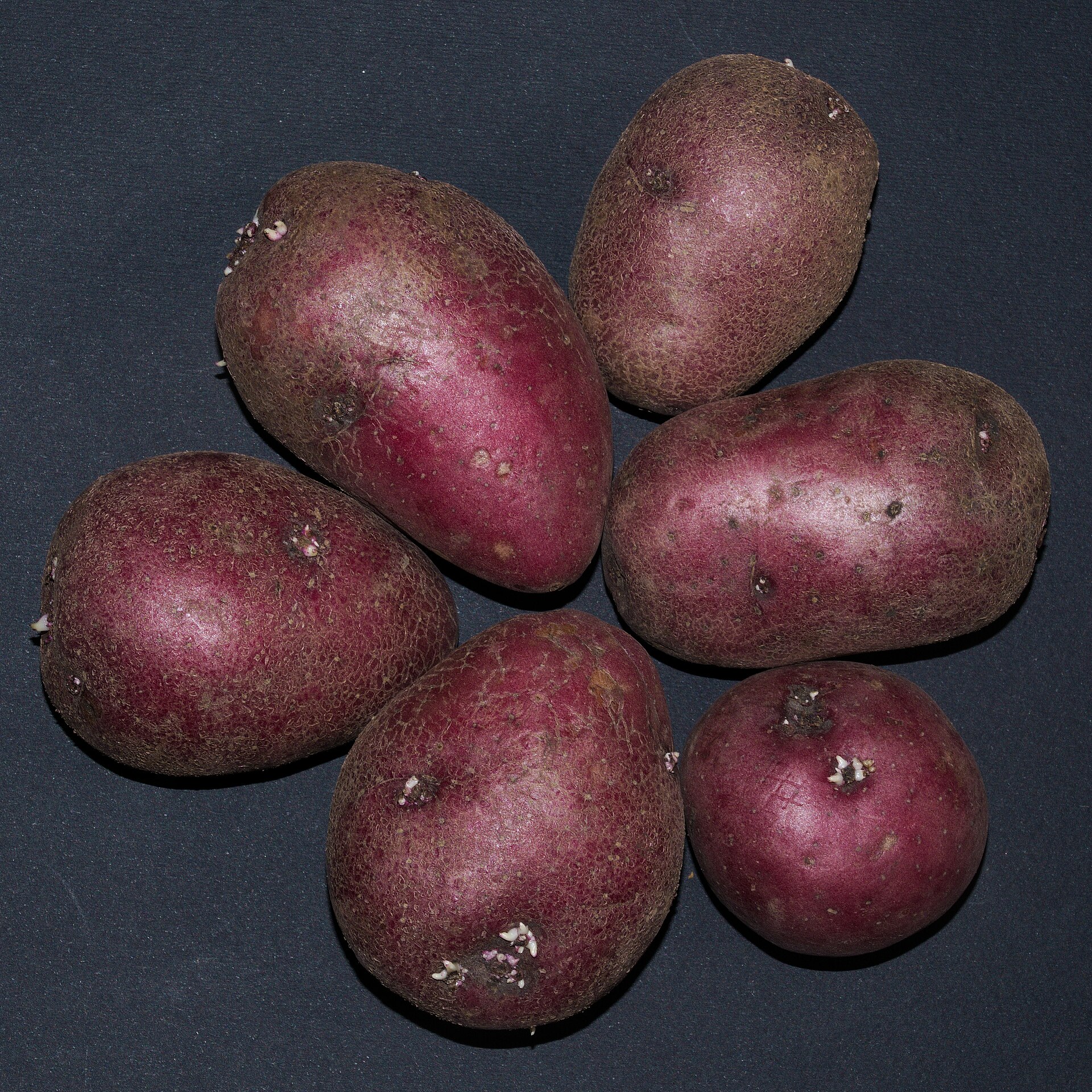
Photo: Potato plants of the Red Scarlett variety (not Greece) (illustrative). Bff / Wikimedia Commons, CC BY-SA 4.0