Global: Why a High-Yield Potato Can Lose Value — Darkening After Cooking Grows in Storage
After-cooking darkening depends on the balance of chlorogenic and citric acid in the tuber. Variety matters most, but soil, nutrition and storage time can turn a good crop into a spring discount.
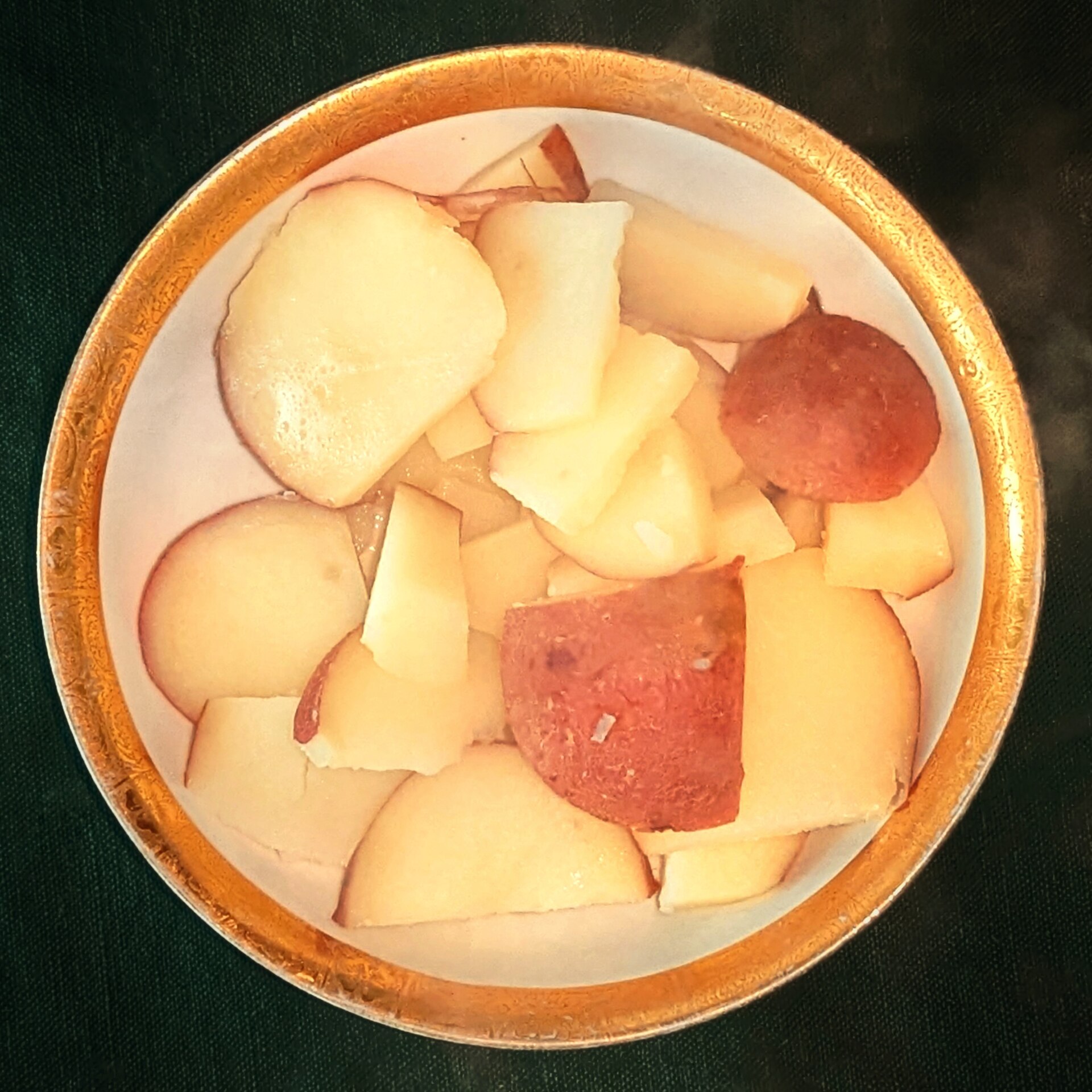
A high-yielding potato variety does not always pay. If boiled tubers turn grey or black on the plate, or taste bitter, buyers pay less or refuse the lot. Growers often see this in spring, when stored potatoes of such varieties sell at a discount. Two quality traits are behind most of these complaints: after-cooking darkening (ACD) and bitterness.
What causes darkening after cooking
ACD is “one of the most widespread, undesirable characteristics of cultivated potato”, according to a review by Gefu Wang-Pruski and Jerzy Nowak in the American Journal of Potato Research (2004). The flesh looks normal after boiling, but turns bluish-grey when it cools in the air. The cause is chemical. Iron in the tuber binds to chlorogenic acid, a natural phenol. After cooking, this iron compound oxidises and forms a dark pigment.
Citric acid protects the tuber, because it binds iron first. The review says the severity of darkening depends on the ratio of chlorogenic acid to citric acid: a higher ratio usually gives darker tubers. Both acids are controlled by genes, but they also change with the growing conditions.
Weekdays. Unsubscribe in one click.
Older field work in the UK showed the same. J. C. Hughes and J. L. Evans (European Potato Journal, 1967) grew several varieties on a black fen soil and a clay soil. Blackening was usually greater on fen soil, mostly because tubers had less citric acid. Year-to-year changes at one site were mainly due to weather.
Variety, field and store
- Variety. In trials in New Brunswick and Nova Scotia in 2000 and 2001, Russet Burbank always showed more darkening than Shepody. The variety effect was stronger than the location effect, Wang-Pruski and co-authors reported (Acta Horticulturae, 2003).
- Storage. In the same trials, darkening increased during storage in both varieties. This is why a variety can pass in autumn and fail in spring.
- Nutrition. A Nova Scotia study of 14 elements found phosphorus, calcium, copper and magnesium most strongly linked to ACD. Darkening was worst at the stem end. Fertiliser maker K+S says citric acid rises with potassium supply and peaks when tubers contain 2.5% potassium; this is a company claim.
Processors can partly stop ACD in French fries with sodium acid pyrophosphate. Fresh-market buyers cooking at home have no such tool.
Bitterness is a separate problem. It is linked to glycoalkaloids, which rise when tubers are exposed to light; POTATOES NEWS covered this in a separate article on the 200 mg/kg limit.
Why it matters
Yield is only one part of a variety’s value. For table potatoes, a variety prone to darkening can lose price after months in store. Before choosing a variety, growers can check official variety lists for cooking quality, ask breeders for ACD data after storage, and test boil samples in autumn and again in late winter. Soil type and potassium supply also deserve attention.
The topic was raised by practitioners in the MAX messenger chat «КАРТОФЕЛЬ И Т.Д. (Potato etc.)», a community of more than 1,100 potato growers and industry specialists. Participants are not named. Join the discussion.
Photo: A boiled potato (illustrative). Daderot / Wikimedia Commons, CC0