
Global: What Makes a Good Potato Variety for Chips, From 20–25% Dry Matter to Low Sugars
Potato varieties for chip processing need high dry matter, very low reducing sugars and tolerance to cold storage. Research and industry data show why only a few varieties meet all three.
Only a small group of varieties supplies most of the potato chip industry. The reason is a narrow set of quality demands. A potato for chip processing must combine high solids, very low sugars and good storage behaviour.
Dry matter and specific gravity
Potato chip makers want dense tubers. According to PotatoPro, the typical target is 20–25% dry matter. That corresponds to a specific gravity above about 1.080. A 2019 study in the journal Foods explained why. Higher dry matter gives more chips per tonne and lower oil uptake.
In that study, Wayumba and colleagues tested 21 breeding clones. Dry matter ranged from 18.4% to 25.1%. Specific gravity ranged from 1.079 to 1.096.
Weekdays. Unsubscribe in one click.
Low reducing sugars
Glucose and fructose cause browning in the fryer. The same reaction forms acrylamide. PotatoPro gives a reducing sugar target below 0.1% of fresh weight, ideally below 0.05%. Chip colour is often scored on a 1 to 5 scale, where 1 is light and 5 is dark.
Storage without sweetening
This is the hardest trait. Most varieties convert starch to sugar when stored cold. The Foods study notes that potatoes for chip processing are stored at about 8–12 °C to avoid this. Cold storage at 4 °C triggers low-temperature sweetening in most varieties.
Warmer stores, however, need sprout control. Since the loss of chlorpropham in the EU, that control is harder and costlier. A variety that gives light-coloured potato chips after cooler storage saves energy and reduces the need for sprout suppressants.
Field stress also counts
Some varieties react badly to heat. The stem-end defect leaves dark marks on potato chips at the stem end. Paul Bethke of USDA and the University of Wisconsin told Spud Smart in 2019 that warm nights are a main trigger. According to him, the varieties Snowden and Atlantic are susceptible, while Lamoka and Manistee are more tolerant.
Varieties widely used for potato chips include: Atlantic, Lamoka, Lady Rosetta, Snowden.
Why it matters
Potato chip makers need year-round supply of light-coloured product. Each extra month of storage raises the risk of sugar build-up. Varieties that tolerate cooler storage and heat stress reduce that risk. For growers, a contract variety is only as good as its storage record. Breeders who combine all these traits in one variety gain a strong market position.
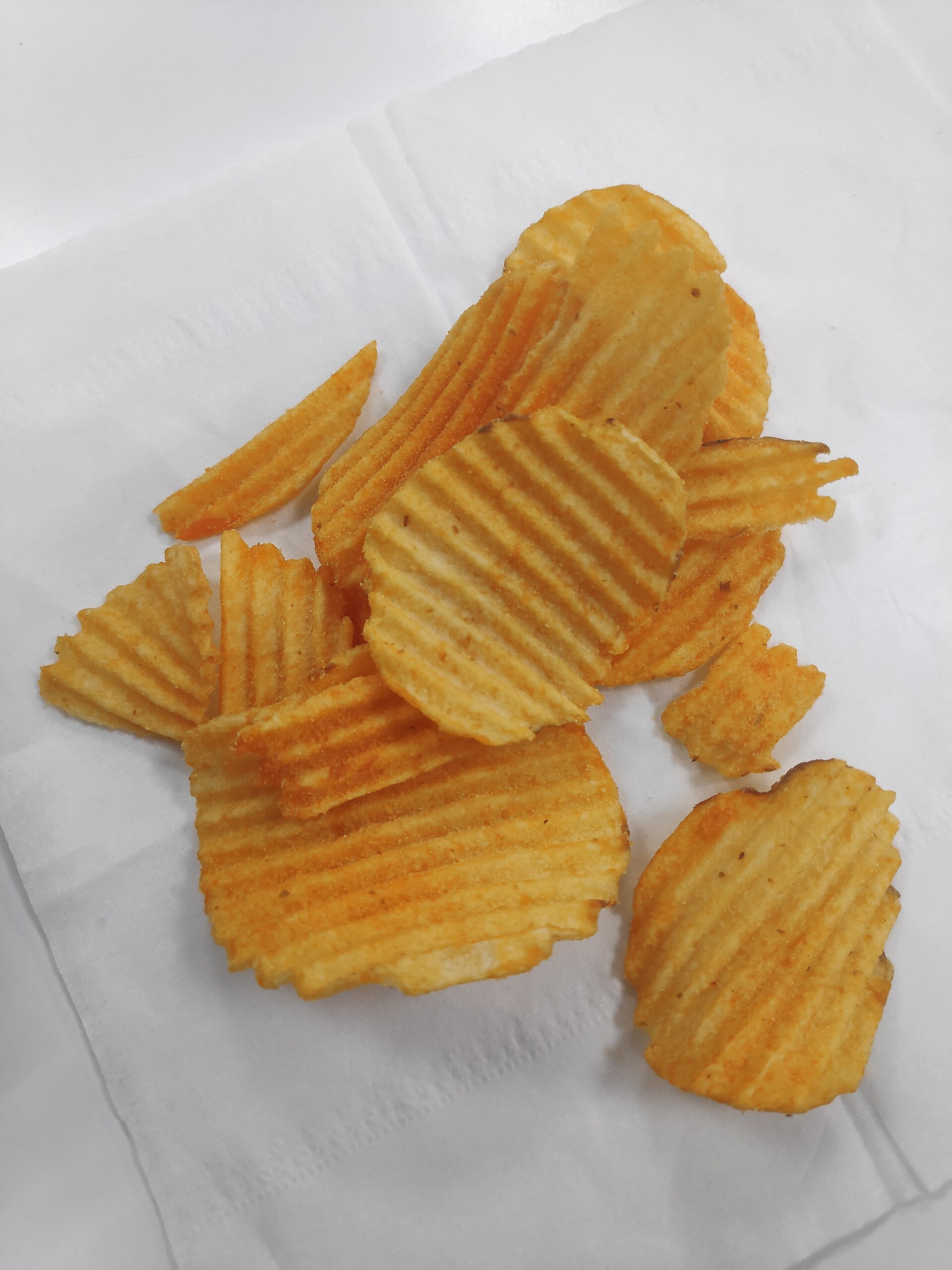
Photo: Potato chips (illustrative). Gaurav Dhwaj Khadka / Wikimedia Commons, CC BY-SA 4.0