Sprouting in store begins when tuber dormancy ends. How long dormancy lasts depends first of all on the variety. A study in the journal Field Crops Research, published on 15 March 2022, measured this effect.
The authors used 3,379 records from trials with 537 potato varieties over several years and locations. The variety explained 60.3% of the variation in dormancy. The year explained 13.9% and the location 5.4%.
The team tested about 250 possible predictors. The best model used just two: the variety class and the sum of daily maximum air temperatures from planting to harvest. It predicted dormancy with a validation precision of 14.59 days, the authors reported.
British storage trials
The levy board AHDB funded dormancy ranking trials at Sutton Bridge Crop Storage Research. An interim report from July 2020 covered 39 varieties for fresh, chip and crisp markets. Tubers were held at 15°C and 95% relative humidity. Sprouting was recorded when a sprout reached 3 mm.
In that season, the shortest dormancy was 155 days from tuber initiation, in this variety: King Edward. The longest was 264 days, in this variety: Desiree. For the same varieties, dormancy differed by 0 to 47 days between growing sites.
The project ran from October 2018 to September 2021. Rankings were not always stable between years. About 40% of varieties were within a 10% difference in dormancy between trial years 1 and 2. The share was 25% between years 2 and 3, and 67% between years 1 and 3.
A research review for AHDB from December 2021 puts the range for commercial varieties at 2–3 months up to 8 months, with Russet Burbank at the long end when stored at 6–8°C. High temperatures, low soil moisture and low soil fertility during tuber growth shorten the dormant period, the review said. Immature tubers also have a shorter dormancy.
Why it matters
Sprout control has become harder since the loss of the sprout suppressant CIPC in Europe. A variety with long natural dormancy needs fewer treatments in store. That saves money and reduces residue risk.
Store managers can use variety rankings to plan which lots to sell first. But the data also show that a hot, dry season can cut dormancy. So rankings are a guide, not a guarantee. Regular sprout checks remain necessary, especially for crops grown in hot conditions.
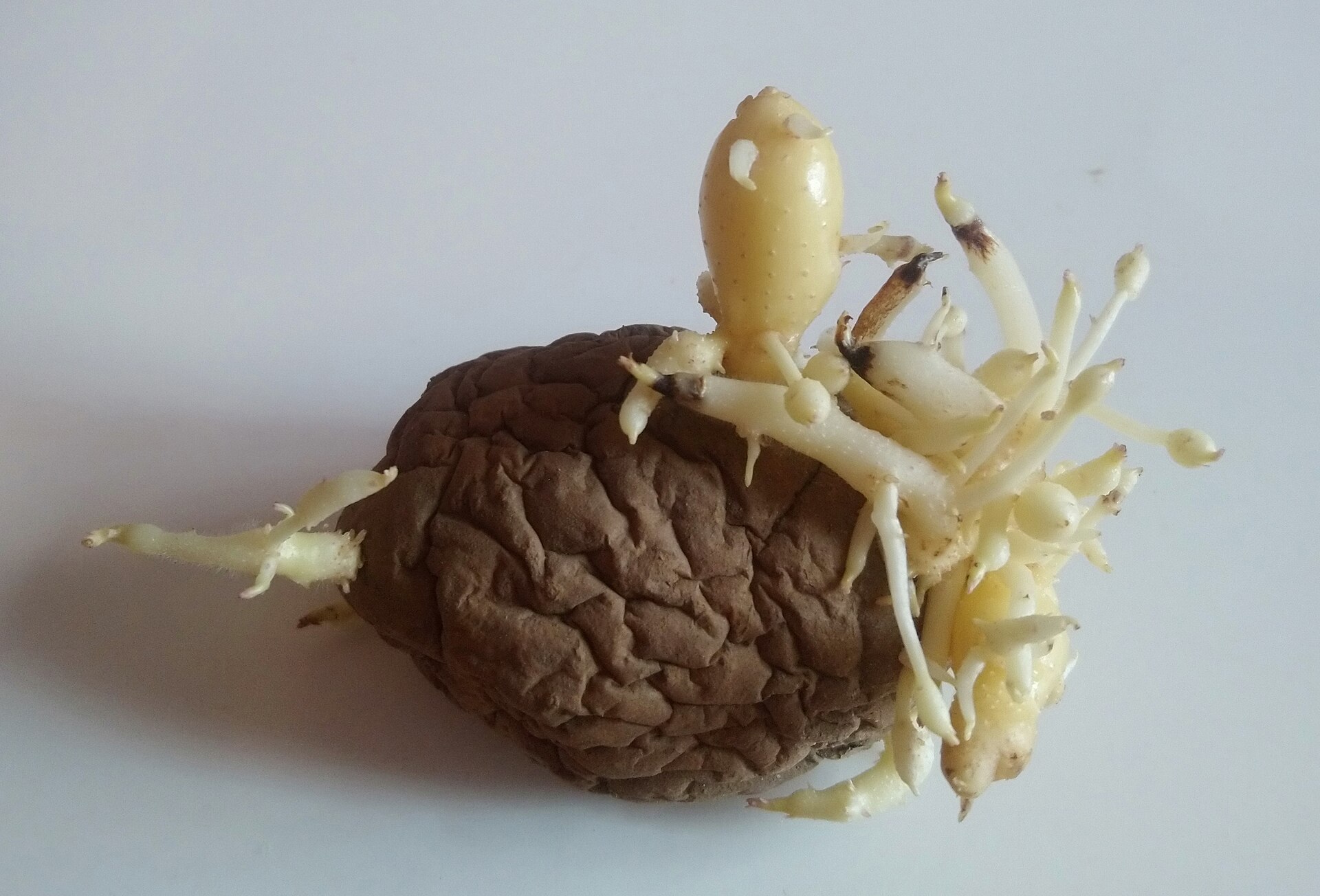
Photo: Sprouted potato tubers after long storage (illustrative). Spiritia / Wikimedia Commons, CC BY-SA 4.0