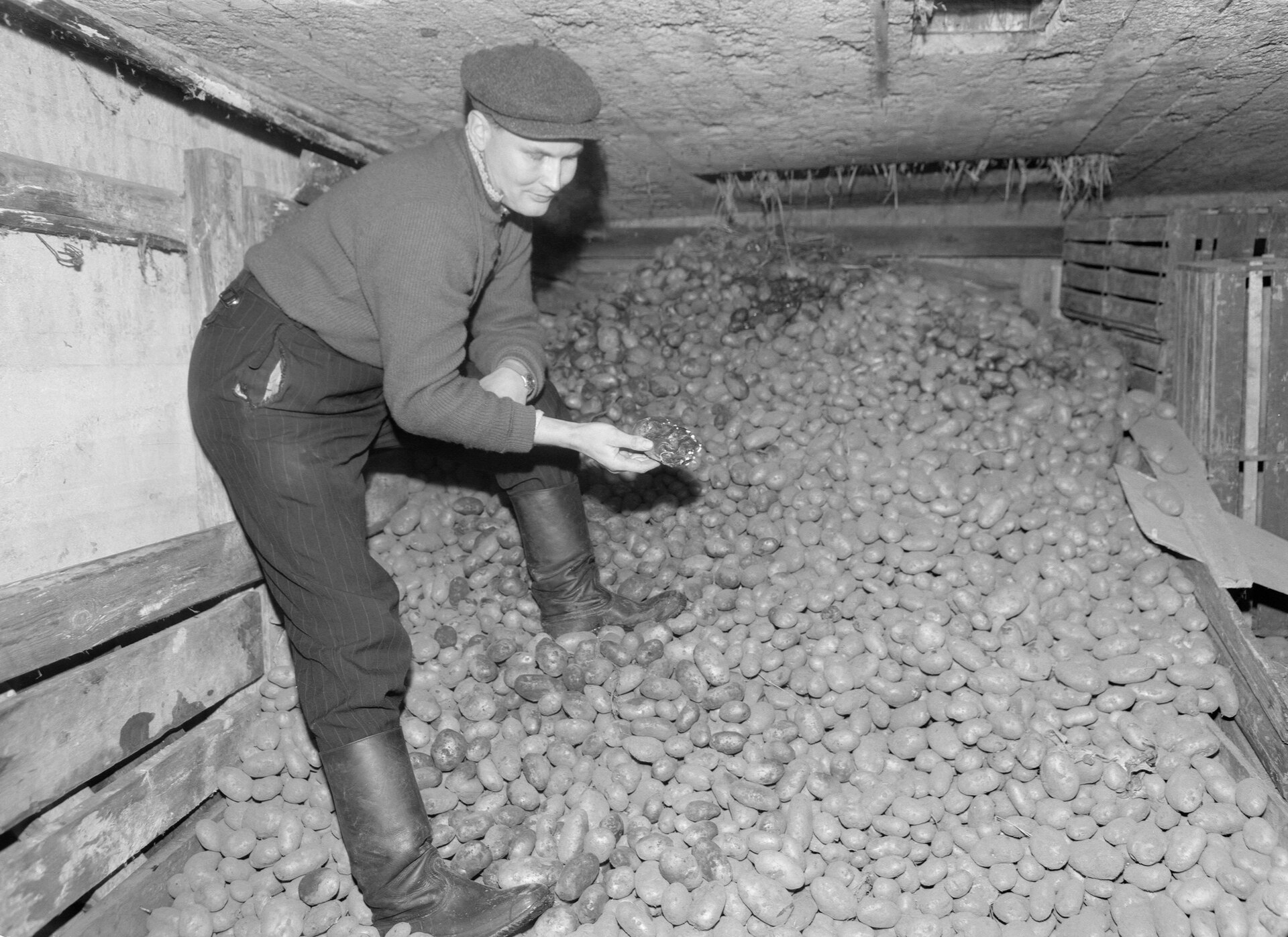
Potatoes lose weight in store mainly by losing water. Water makes up 78–88% of a tuber, according to a University of Idaho Extension bulletin published in December 2024. Of the water that leaves the tuber, 97.6% transpires through the skin. The remaining 2.4% exits through the lenticels, the small pores in the skin.
The humidity of the air around the tubers decides how fast this happens. Over six months of storage, potatoes kept at 90% relative humidity could lose 9% of their weight. That is nearly twice the loss at 95%, according to research by University of Idaho scientists Nathan Oberg, Nora Olsen and Gale Kleinkopf.
The value of five points
The same Idaho researchers put a money figure on the difference. They assumed a store of 100,000 hundredweight with potatoes worth $5.00 per hundredweight. In that example, a store kept at 90% humidity would return $22,000 less than one kept at 95%.
Idaho recommendations suggest a plenum humidity of at least 90%, and preferably above 95%, for the whole storage season. The plenum is the air duct that feeds air into the pile.
The first week is critical
Much of the loss happens very early. For the variety Shepody lifted under warm conditions, nearly half of total shrinkage occurred within the first week after harvest. The average pulp temperature in that case was 77°F, or 25°C, according to the Idaho research.
The 2024 bulletin reflects this early peak. In its example model, the loss factor is 0.7 for the first two weeks of storage and 0.2 for the rest of the season. Air in the store should be supplied to hold a temperature difference of 0.5°F to 2.0°F through the pile.
University of Maine Cooperative Extension gives 95–100% humidity as optimal during curing. It also warns that 100% humidity with wet floors is very different from 100% humidity with dry floors.
Why it matters
Stored potatoes are sold by weight. Every percentage point of shrink is lost income for the store owner.
Humidifiers, sensors and good airflow are the main tools. They matter most in the first two weeks after loading. Too much free water, however, brings disease risk, so the target is humid air, not wet potatoes.
Photo: Potato storage in Loppi, Finland, 1961 (illustrative). Erkki Voutilainen / Wikimedia Commons, CC BY 4.0