Global: Ridge Tops of 28–38 cm and Planting at 15–23 cm Cut Green Tubers, but Deep Planting Can Cost Yield
Idaho and Slovenian trials show deeper planting and wider ridge tops reduce field greening of tubers. But planting at 23 cm cut yield in two Russet varieties, and late hilling also lowered yield.
Green tubers are graded out because light in the field makes them turn green and form glycoalkaloids. The main field defence is soil: how deep the seed is planted and how large the ridge is. Trials in the United States and Slovenia, and guidance from Europe and the International Potato Center (CIP), show how these choices affect greening and yield.
At the University of Idaho, William Bohl and Stephen Love planted seed at 8, 15 and 23 cm. Their results, in the American Journal of Potato Research (2005), show a trade-off. For Russet Burbank and Frontier Russet, planting at 23 cm gave significantly lower total yield than shallower depths. Planting depth had little effect on Shepody yield. For Frontier Russet and Shepody, planting at 15 or 23 cm gave significantly less field greening. For Russet Burbank, planting at 8 cm and hilling to 23 cm at emergence also reduced greening. However, all hilling after emergence significantly reduced Russet Burbank yield.
Ridge shape matters as well. At the University of Ljubljana in Slovenia, Filip Vučajnk and colleagues compared ridge top widths of 10, 28 and 38 cm. In Potato Research (2017), they report that the 28 cm and 38 cm tops reduced the weight and share of green tubers compared with 10 cm, mainly on the ridge sides. A wider top left more soil between tubers and the side of the ridge. The area taken by a tuber cluster ranged from 220 to 360 cm².
Weekdays. Unsubscribe in one click.
Standard practice gives similar numbers. PotatoWorld says tubers are usually covered with 10–15 cm of soil, and 75 cm rows carry ridges about 25 cm high. In 90 cm rows, yield is usually one or a few percent lower, and full ground cover comes a few days later. In East Africa, a CIP guide for Kenya (2018) advises a first hilling about two weeks after emergence, when plants are 10–15 cm tall, to about 15 cm. A second hilling two to three weeks later should bring the ridge to about 30 cm high and 30–35 cm wide.
Why it matters
Every green tuber is a direct loss in the grading line. The research shows that the cheapest protection is a ridge built large and wide enough at the right time. Deep planting is not free, because it can cut yield in some varieties, and late hilling can damage roots and stolons.
Growers should check their ridge shape after planting and after the final hilling, and adjust tools and depth by variety, since varieties that set tubers near the surface green more easily.
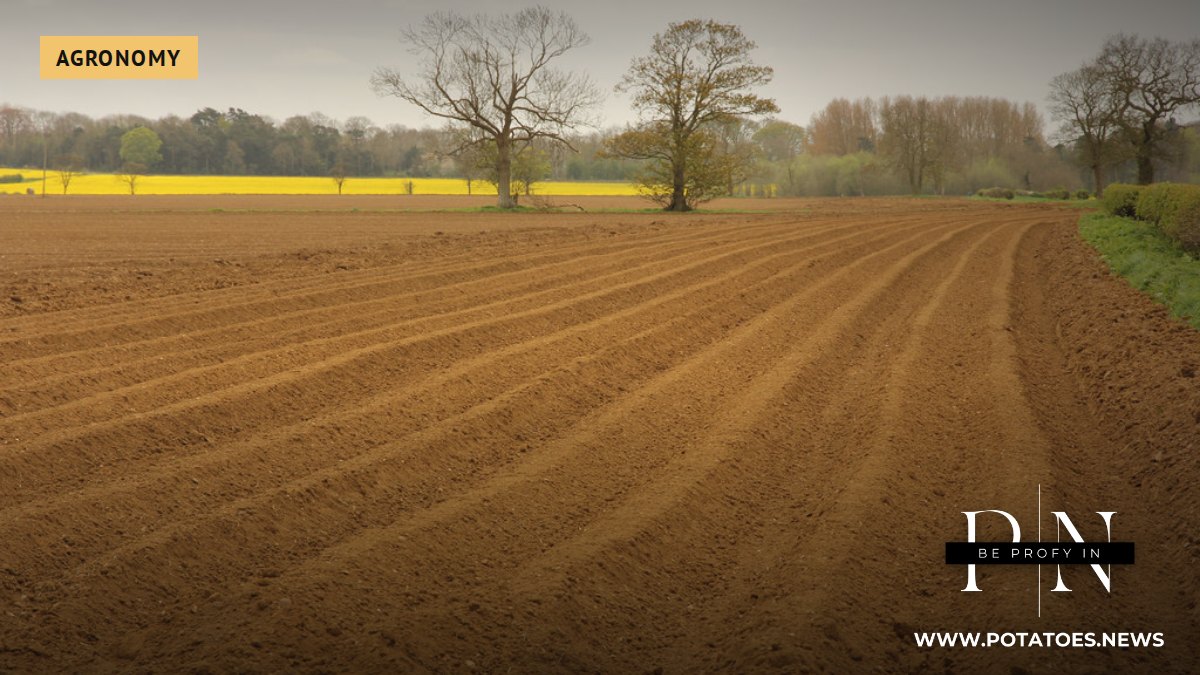
Photo: Potato ridges in a field (illustrative). Richard Croft / Wikimedia Commons, CC BY-SA 2.0