Magnesium is a nutrient that potato growers often overlook. Two recent sources give clear numbers on when a potato crop needs it.
A team from Tamil Nadu Agricultural University and the ICAR Indian Institute of Soil Science in Bhopal published a field study in Potato Research on 11 November 2025. The authors, led by T. Chitdeshwari, grew the variety Kufri Jyothi on acidic red lateritic soils with different natural magnesium levels. They applied magnesium sulfate at 0, 20, 40, 60, 80 and 100 kg per hectare.
- The critical soil magnesium level was 42 mg per kg.
- The critical plant level was 0.27% magnesium in potato plants at flowering.
- The best treatment for tuber yield was the standard NPK dose plus 60 kg of magnesium sulfate per hectare.
- The yield response was linear and significant, and it was higher in low-magnesium soils.
Guidance from the University of Minnesota Extension, written by nutrient specialist Carl Rosen and reviewed in 2024, uses a similar scale for irrigated potatoes. The rates are in pounds of elemental magnesium per acre:
Weekdays. Unsubscribe in one click.
- Soil test 0 to 49 ppm (low): 100 lb/A broadcast or 20 lb/A in the row.
- 50 to 99 ppm (medium): 50 lb/A broadcast or 10 lb/A in the row.
- 100 ppm or more (high): no magnesium needed.
The sufficiency range in petioles at tuber bulking is 0.30% to 0.55%, and 0.25% to 0.50% in whole leaves. Magnesium sulfate or potassium-magnesium sulfate can be broadcast before planting or banded at planting. Dolomitic lime, applied in years without potatoes, supplies both magnesium and calcium. The University of Florida IFAS advises up to 40 lb of magnesium per acre when the soil test is medium or lower.
Why it matters
Magnesium problems are most likely on acid, sandy soils. Minnesota Extension also warns that high rates of potassium fertilizer can cause magnesium deficiency. This matters because potato crops receive large amounts of potash. The Indian critical level of 42 mg per kg is close to the Minnesota boundary of 50 ppm between low and medium soils, although soil test methods may differ.
A soil test before planting and a tissue test at flowering or bulking show if magnesium is limiting. Fields with low magnesium and heavy potash use are the first to check.
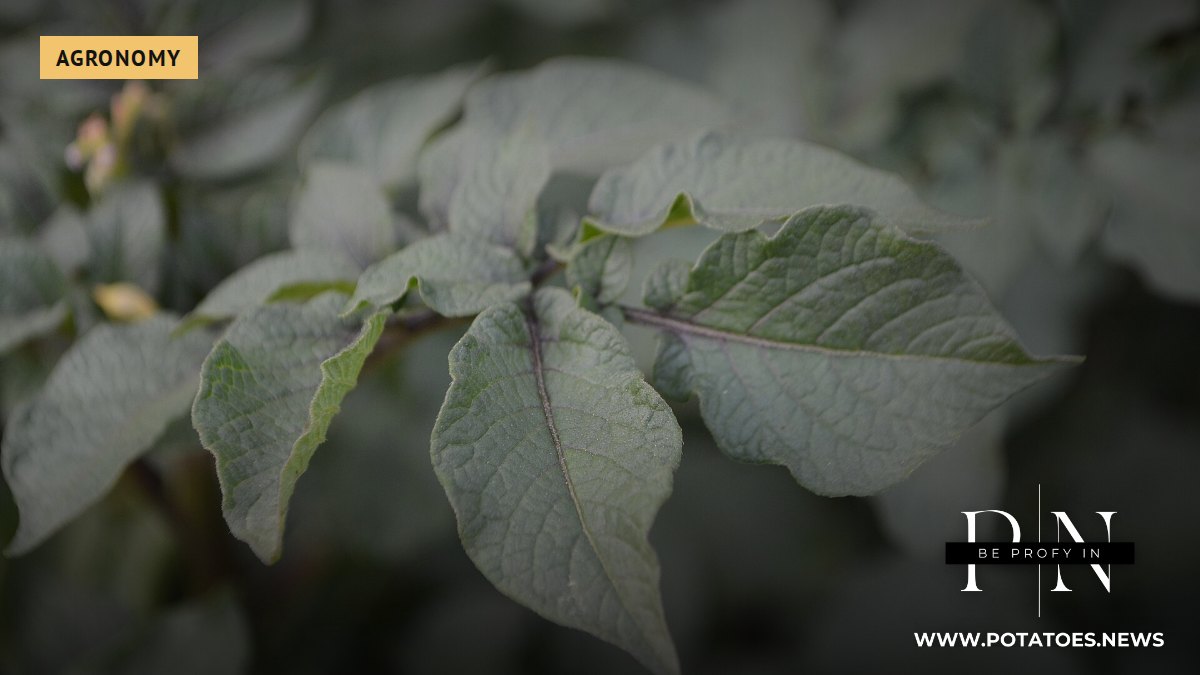
Photo: Leaves of a potato plant (illustrative). Samsmachado / Wikimedia Commons, CC BY 4.0