Global: Mop-Top Virus Can Survive 10–18 Years in Powdery Scab Spores
AHDB, the University of Maine and the PNW handbook show why powdery scab and potato mop-top virus stay in soil for a decade or more, and why clean seed is the main defence.
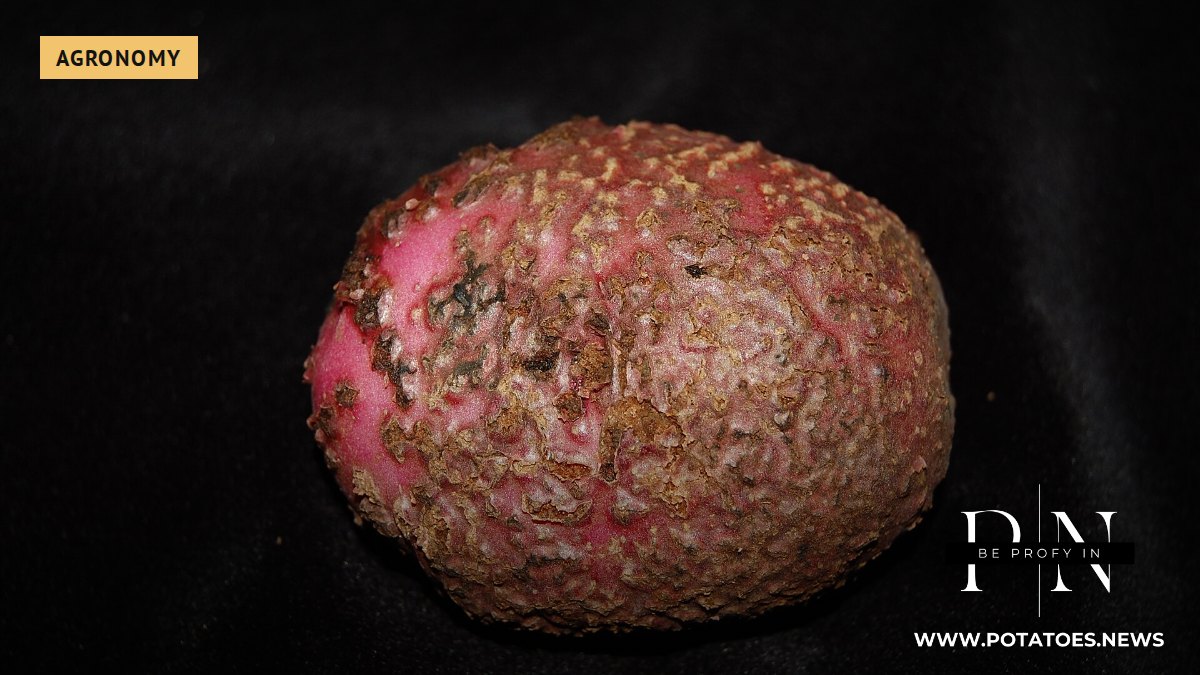
Powdery scab is caused by Spongospora subterranea, a soil-borne organism that forms resting spore balls. It damages the tuber skin with raised pustules that later burst into powdery scabs. It also carries potato mop-top virus (PMTV), which causes brown arcs and rings inside the tuber, a defect known as spraing.
The main problem is persistence. The AHDB knowledge library says the spore balls can survive up to ten years in soil. The Pacific Northwest Plant Disease Management Handbook gives 3 to 10 years. The University of Maine (Steven B. Johnson) goes further for the virus: PMTV can survive inside the spore balls for 10 to 18 years after the last potato crop.
Both US sources agree that the disease is favoured by cool, wet soils below 68°F (20°C). According to the University of Maine, the optimum for infection is 60°F (about 16°C), within a range of 52–75°F. It also says powdery scab is most severe when soil moisture exceeds 15%. AHDB links outbreaks to wet soil at tuber initiation and to heavy soils.
Weekdays. Unsubscribe in one click.
PMTV spread slowly across regions. The University of Maine lists first reports in Britain in 1966, Canada in 1991–92 and the United States in 2002. The virus does not always cause visible leaf symptoms. The main loss is quality: internal defects make tubers unfit for fresh market and processing. According to the University of Maine, no varieties are immune to powdery scab or PMTV.
Surveys show the pathogen can be present at low levels without major symptoms. In a Wisconsin state survey of 103 stored tuber lots from 16 growers in 2021–22, nine lots tested positive for low levels of Spongospora. All 103 lots tested negative for PMTV.
Control options are limited. The sources recommend clean seed on clean land, long rotations (the PNW handbook suggests 3 or more years), good drainage and less susceptible varieties. AHDB says the virus can be removed from seed stocks within a few generations by roguing plants with symptoms. The PNW handbook lists in-furrow fungicide treatments registered in the United States, such as fluazinam.
Why it matters
Once a field is infested, it stays a risk for a decade or more, longer than most rotations. That makes seed hygiene the key barrier. A grower who plants infected seed on clean land can create a long-term problem for every future potato crop on that field, including crops of other farms that rent it later.
Photo: Potato tuber with powdery scab lesions (illustrative). A.J. Gevens / Wikimedia Commons, CC BY-SA 3.0 us