Global: Hutton Criteria Cut the Late Blight Humidity Trigger From 11 to 6 Hours
Britain replaced the 1956 Smith Period with the Hutton Criteria in 2017. Tested on over 2,000 outbreaks, the new rule needs only 6 hours of 90% humidity and gave a much better accuracy score.
Late blight warnings in Great Britain changed in 2017. For about 60 years, growers used the Smith Period, a rule from 1956. It flags a risk when two consecutive days each have a minimum temperature of at least 10°C and at least 11 hours with relative humidity of 90% or more. The new Hutton Criteria keep the 10°C threshold but need only 6 hours of humidity at 90% or more on each of the two days.
How the new rule was built
The work was done at the James Hutton Institute in Scotland in an AHDB-funded project that ran from May 2014 to April 2017, with a budget of £67,650, according to AHDB. Controlled experiments showed significant levels of infection under drier conditions than the Smith Period requires. AHDB launched the Hutton Criteria as its national late blight warning system in 2017.
The researchers tested the models against more than 2,000 blight outbreaks recorded in Great Britain from 2003 to 2014, as reported in EuroBlight workshop proceedings and by Kitchen Garden magazine. According to the EuroBlight paper, the Smith Period flagged 7% of days before outbreaks as risk days, and the new model flagged 10%. Its accuracy score (AUROC) rose from 0.686, rated “fair”, to 0.973, rated “excellent”. The Smith Period also varied strongly between climate regions, while the new model performed more evenly across Great Britain.
Weekdays. Unsubscribe in one click.
Use outside the UK
The Hutton Criteria model is now part of the European IPM Decisions platform. Its factsheet warns that the model was adapted from UK work and has not yet been tested in other countries. Other countries use their own models, and local validation is needed before a UK rule is applied elsewhere.
Why it matters
Late blight can spread fast in warm, humid weeks. A warning rule that is too strict gives alerts too late, and growers may spray after infection has already started. Cutting the humidity requirement from 11 to 6 hours captured more real outbreak conditions without a large rise in alert days. For growers, the practical step is to link spray timing to a local weather station and a tested model, not to a fixed calendar.
Prevention & control · Editorial note
Late blight (Phytophthora infestans): what growers can do
- Prevention: plant healthy certified seed; remove cull piles and volunteer potatoes; choose more resistant varieties.
- Monitoring: follow Hutton Criteria alerts and inspect crops after warm, humid periods.
- Chemical protection in the United Kingdom: fluazinam (FRAC 29), cyazofamid (FRAC 21), propamocarb (FRAC 28), cymoxanil (FRAC 27) — check the national register of the United Kingdom.
- Resistance management: alternate or mix FRAC groups; EU_43_A1 is resistant to group 40, so do not rely on it alone.
This note is provided by the potatoes.news editorial team for information only. It is not a recommendation of any company and is not mandatory. Use only plant protection products authorised in your country and follow the label. Product names and registrations differ between countries; consult a local agronomist.
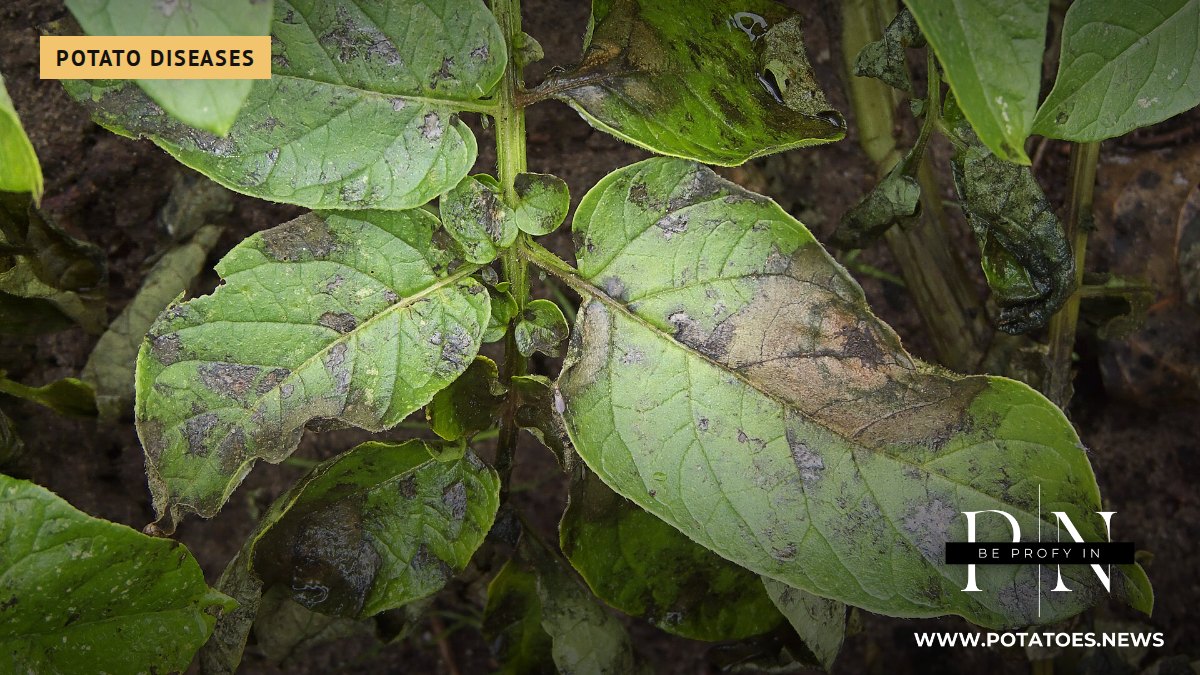
Photo: Late blight (Phytophthora infestans) on potato leaves (illustrative). Rasbak / Wikimedia Commons, CC BY-SA 3.0