In late September, a manufacturer said on LinkedIn that a heat-based haulm burner with a double burner unit had been commissioned in Manitoba, Canada. According to the company, the heat shock damages the cell structure, so the haulm then dies naturally. Independent trial data on diquat-free haulm kill come mainly from the UK.
The EU did not renew the approval of diquat. In the UK, sales stopped on 31 July 2019, and the use-up period ended on 4 February 2020. Growers had to switch to flailing, PPO desiccants or mechanical systems.
What the UK trials showed
The levy board AHDB funded desiccation trials in 2019 and 2020. The final report covers five replicated experiments and two demonstrations. The tested products were carfentrazone-ethyl, pyraflufen-ethyl, pelargonic acid and a brine product. Flailing and an untreated control were also compared.
- The two PPO desiccants were 2–4 days slower than diquat in killing leaves at most sites. In a Scottish seed trial, they were more than 7 days slower.
- Most chemical treatments received two applications. A third spray two weeks after the first gave no benefit.
- The report found no effect of method, chemical or timing on vascular browning or stem-end necrosis.
- Crops left to grow without defoliation added 8–10 t/ha in three weeks.
Skin set was only slightly delayed. According to the trial summary, the PPO combinations were 1–3 days behind diquat, flailing or haulm pulling. The AHDB guidance advises growers to expect a delay of one to four days.
Costs and passes
The main cost shock is for farms that used diquat alone. An AHDB economist calculated that a pyraflufen-then-carfentrazone sequence costs 151% more than diquat alone. A switch to flailing plus a spray raises costs by 205–211%, depending on the flail design. Farms that already flailed pay about 13% more when carfentrazone replaces diquat. Wet soils after flailing also caused compaction in wheelings, the researchers reported.
Haulm pulling is another option. According to a UK agronomist quoted by Farmers Weekly in 2022, a puller removed more than 95% of stems. Skin set was 7–10 days ahead of a flail-and-spray crop. The machine worked at 2.5–4.5 km/h in commercial use.
Thermal haulm killing has little public trial data. A review in the journal Potato Research says flaming does not depend on weather, but investment and operating costs are high. The same review warns that a very fast kill in poor conditions can cause stem-end browning.
Why it matters
Growers without diquat now trade speed, cost and soil damage. The UK data show that alternatives work, with only a few days of delay. However, they need more passes and more planning, especially on heavy or wet soils.
New thermal and electric machines promise one-pass kill without chemicals. Growers should ask for independent data on kill speed, stem-end browning, fuel use and cost per hectare before investing.
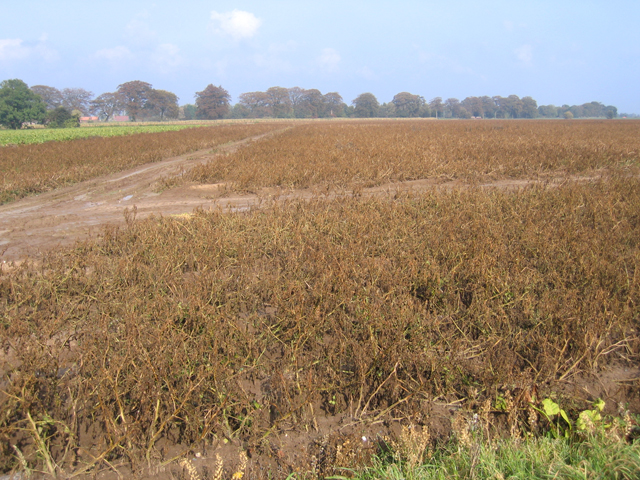
Photo: Desiccated potato haulms in a field in Lincolnshire, UK (illustrative). Rodney Burton / Wikimedia Commons, CC BY-SA 2.0