
Global: Fry Potatoes Below 1.070 Specific Gravity Fail Industry Standards
Specific gravity is the quickest farm test of dry matter in potatoes. Fry potatoes below 1.070 do not meet industry standards, and simple tests show growers where they stand.
Processors buy potatoes for their solids, not their water. Specific gravity is the standard way to measure those solids. Fry potatoes with a specific gravity below 1.070 will not meet industry standards, according to the Idaho Potato Commission. High-quality Russet Burbank potatoes measure close to 1.080.
Potatoes contain 75–80% water, according to Washington State University Extension. A University of Idaho guide gives a range of 75–85%. Starch makes up 80–85% of the dry matter.
Why solids matter to processors
High-gravity tubers absorb less oil during frying, the Washington State guide says. They also yield more finished product per pound of raw potatoes. When baked or fried, they are more mealy and have better colour. Low-gravity tubers absorb more oil.
Weekdays. Unsubscribe in one click.
The value difference can be large. The University of Idaho guide gives a worked example at $0.10 per pound of dry matter. On that basis, 15% dry matter potatoes are worth $1.50 per hundredweight. Potatoes with 25% dry matter are worth $2.50 per hundredweight.
How to measure
The chip industry often uses a hydrometer. Eight pounds of tubers go into a calibrated stainless steel basket. The frozen fry industry prefers weighing tubers in air and in water. Specific gravity equals weight in air divided by the difference between the two weights.
Details matter for accurate readings. Water and tubers should be at 50°F (10°C), or readings need correction. Wet tubers read about 0.001 units higher than dry ones. Air bubbles lower the reading. Larger tubers usually have a higher specific gravity, so samples must be representative.
Dry matter can also be measured directly. The University of Idaho recommends a 50–100 gram sample from five representative potatoes. A microwave dries it in 3–10 minutes. A food dehydrator needs 3–8 hours.
A quick check needs only salt and water. One cup of salt in 9.5 cups of water gives a solution of about 1.080, according to the Idaho Potato Commission.
What raises and lowers solids
Specific gravity is highest when temperatures stay at 68–78°F (20–26°C), the Washington State guide says. Consistent soil moisture and healthy foliage also help. Drought, excess nitrogen and high potassium applications lower it. Foliage damage from disease, insects or frost lowers it too. Storage above 48°F (9°C) burns starch through respiration.
Why it matters
Specific gravity decides whether a load meets a processing contract. Loads below 1.070 do not meet fry industry standards. Growers who test samples before harvest know what they are delivering.
Many of the drivers are in the grower’s hands. Nitrogen, potassium, irrigation and foliage protection all shift the final reading.
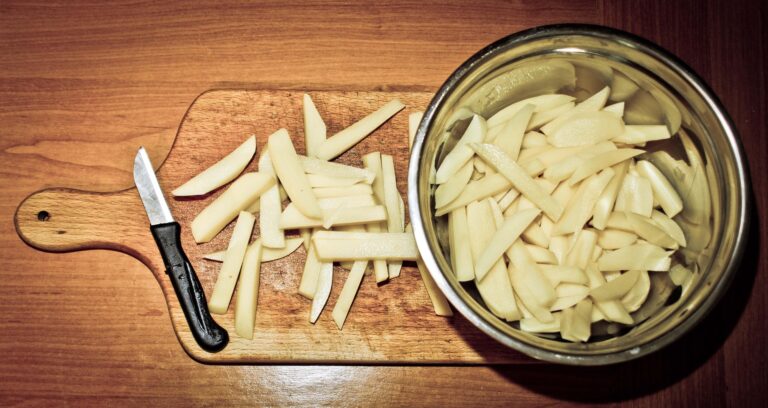
Photo: Hand-cut French fries in Rotterdam, the Netherlands (illustrative). Donald Trung Quoc Don / Wikimedia Commons, CC BY-SA 4.0