Global: Direct Tuber PCR Tests for PVY Replace Winter Grow-Outs as Swiss Lab Clears 1,000 Seed Lots in Six Weeks
Switzerland tests dormant seed tubers for PVY by RT-qPCR, and Idaho is developing the same approach to replace its winter grow-out in Hawaii. Results come months sooner, but uneven virus in tubers limits agreement with older tests.
Seed potato certification needs a final virus check after harvest. For decades this has been a “grow-out”: a sample of tubers is planted in a warm place over winter, and the leaves are tested for potato virus Y (PVY) and potato leafroll virus (PLRV). Laboratories in Europe and the United States now test the dormant tubers directly with RT-qPCR instead.
Switzerland has already made the change. In a 2021 paper in Potato Research, Olivier Schumpp and colleagues at Agroscope describe testing 900 to 1,000 seed lots and more than 180,000 tubers each year by RT-qPCR. The lab can process 1,000 lots within six weeks with six to eight staff. The old method needed 4 to 8 weeks just to break tuber dormancy with toxic chemicals before plants could grow.
The results were close to the old test, but not identical. In a comparison with ELISA, 30 lots (64%) gave comparable results. In 17 lots (36%) there were small differences. The authors link these to biology, not to the test: the virus is spread unevenly inside tubers, especially in cultivars that tolerate infection.
Weekdays. Unsubscribe in one click.
In the United States, the Idaho Crop Improvement Association (ICIA) still runs a winter grow-out in Hawaii. According to a report in Potato Business, it tests up to 900 seed lots a year, with 400 tubers per lot, using ELISA for PVY and PLRV. Since summer 2022, University of Idaho researcher Lisa Tran, advised by virologist Alexander Karasev, has worked on a dormant tuber test with qPCR at the ICIA facility in Idaho Falls. The report says the qPCR results for PVY and PLRV are comparable to the grow-out. Growers would get results months sooner. The work is supported by a $130,000 USDA Specialty Crop Block Grant and a $5.8 million USDA-NIFA-SCRI grant. The main challenge is scale: the lab must process 400 tubers per lot instead of 400 leaves.
Rules still require the old approach in many places. In Montana, certification rules say post-harvest testing at the winter test plot is required for all seed to be sold. Generation 2 seed may carry up to 1% PVY in summer tests, and seed replanted in Montana may not exceed 0.5%.
Why it matters
A grow-out gives the virus result in late winter, often only weeks before seed is shipped. A direct tuber test can give it before the selling season. Buyers can then choose lots with known virus levels earlier, and seed growers can price and plan their sales.
The Swiss data also show a limit. Because virus is uneven in tubers, the number of tubers and the way they are pooled decide how reliable a lot result is. Seed buyers should ask which method was used, not only what the virus level was.
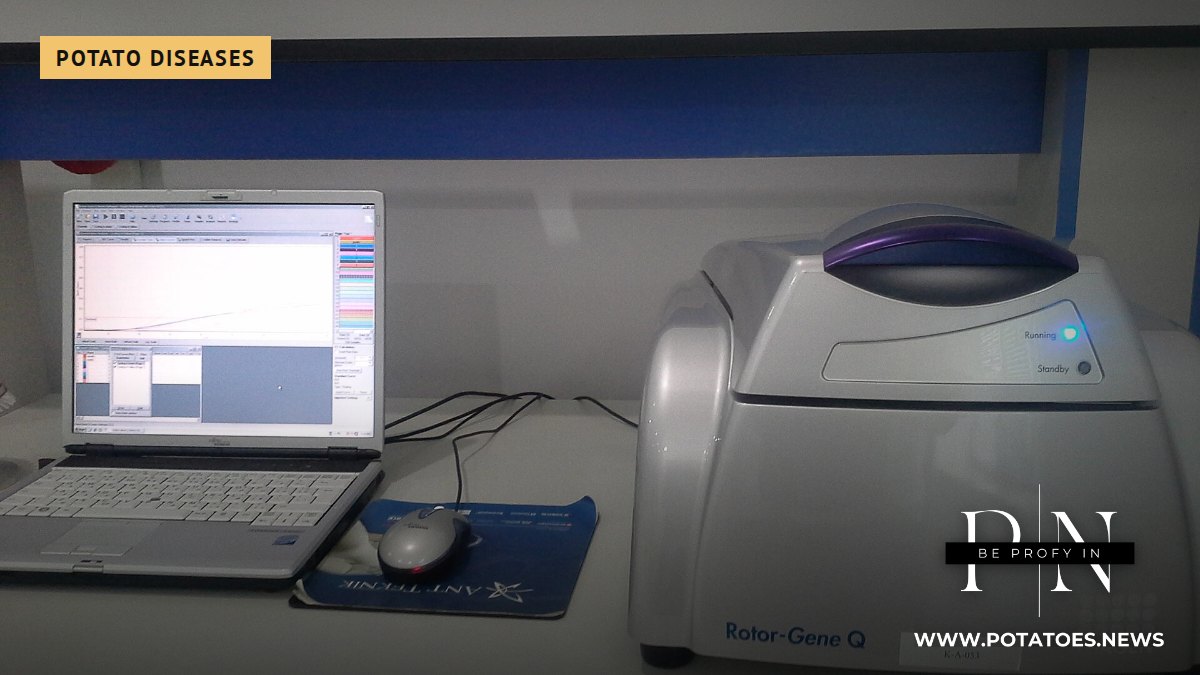
Photo: A real-time PCR device in a laboratory (illustrative). İnformatic / Wikimedia Commons, CC BY-SA 3.0