Global: Dickeya Blackleg Can Cut Potato Yields by 20–25% Above 25°C
Extension services in the US and the UK show why hot summers favour Dickeya blackleg over Pectobacterium, and why seed testing with 400 or more tubers per lot is the main defence.
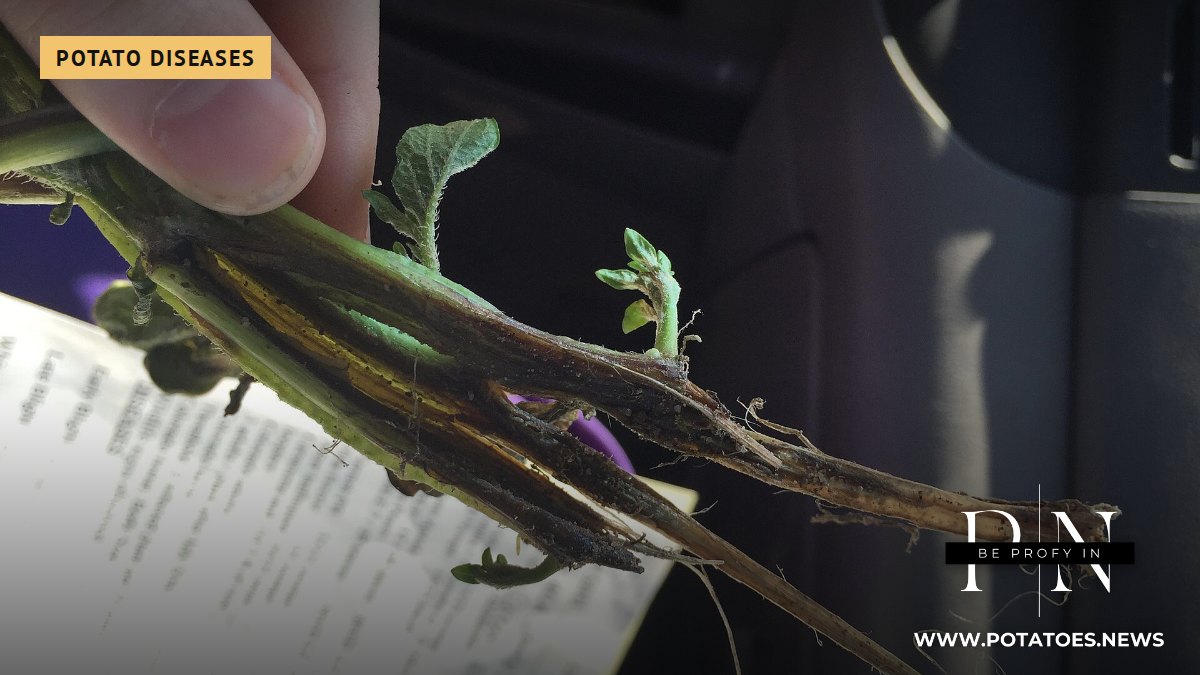
Blackleg is a bacterial disease that starts in the seed tuber and shows up in the field as black, rotting stems. Two groups of bacteria cause it: Pectobacterium and Dickeya. They look similar in the field, but they behave differently with temperature, and this matters for how growers read the risk.
According to a UMass Extension fact sheet (Angela Madeiras, 2018), Dickeya symptoms begin when soil temperatures reach 86°F (30°C) or more, with air temperatures generally at 77°F (25°C) or above. The optimum for Pectobacterium is about 65–80°F (18–27°C). A Spud Smart article by Khalil Al-Mughrabi gives the same split: Dickeya symptoms tend to develop above 25°C, while Pectobacterium dominates below 25°C.
The same article reports that Dickeya infections have cut yields by 20 to 25% or more on various cultivars in Europe and the Middle East. A new blackleg pathogen, Dickeya dianthicola, emerged in the eastern United States in 2015 and caused significant losses in some areas. Infected tubers look healthy at planting. The disease develops later, when the soil warms.
Weekdays. Unsubscribe in one click.
The AHDB knowledge library describes the field picture. An early attack can cause missing plants or stunted, pale-green to yellow plants. Stems turn black and sticky at ground level. The bacteria can also be present without symptoms (latent infection) until conditions suit them. The University of Maine notes that rot can occur between 45°F and 90°F but increases sharply above 70°F.
Because infection is often hidden, testing seed is the main defence. Spud Smart notes that a random sample of 400 tubers per lot will likely find lots with 1% or more infection. Finding lots with 0.3% infection needs about 1,200 tubers.
In the field, UMass advises clean certified seed, sanitising cutting machines, planting into soil of at least 10°C, no irrigation before emergence and avoiding surface water for irrigation. The bacteria do not survive more than a few months in soil, but they can persist in crop debris, weeds and volunteer tubers.
Why it matters
Warmer summers favour Dickeya over Pectobacterium. A seed lot that stayed clean in a cool year can show heavy blackleg in a hot one, because the infection was already there. For growers, the decision point is seed buying and seed testing, not spraying: no chemical cures blackleg in a growing crop.
Prevention & control · Editorial note
Blackleg (Pectobacterium, Dickeya): what growers can do
- Prevention: buy tested seed with low blackleg risk, avoid cutting seed or disinfect cutters, plant into warm, well-drained soil, avoid irrigation before emergence
- Monitoring: inspect fields for wilting plants with black stem bases; remove affected plants and tubers
- Chemical protection: no effective chemical control; prevention only
- Resistance management: not applicable; seed certification and store hygiene are the main tools
This note is provided by the potatoes.news editorial team for information only. It is not a recommendation of any company and is not mandatory. Use only plant protection products authorised in your country and follow the label. Product names and registrations differ between countries; consult a local agronomist.
Photo: Blackleg symptoms caused by Dickeya solani on a potato plant (illustrative). Jspychalla / Wikimedia Commons, CC BY-SA 4.0