Global: Deficit Drip Irrigation Raised Potato Irrigation Water Productivity by 32% in Meta-Analysis
A meta-analysis of 132 studies found drip irrigation gives the best water productivity for potatoes. Under water-saving regimes, drip lost 15% of yield against 26% for sprinklers.
As growers in the Southern Hemisphere plant spring potatoes, water is often the limiting input. A global meta-analysis published in August 2025 compares how irrigation methods change potato yield and water productivity.
Researchers from Gansu Agricultural University in China and the University of Western Australia analysed 132 studies with 3,740 observations in the journal Agronomy. Supplementary irrigation, compared with no irrigation, raised yield by 55% and crop water use by 39%, while water productivity stayed at a similar level. Drip irrigation gave the best water productivity, and sprinklers did better than flood irrigation.
The study also looked at deficit irrigation, where growers give less water than the crop’s full need. On average, this cut yield by 25% and water use by 24%, but raised water productivity by 9% and irrigation water productivity by 28%. The method mattered. Under deficit drip irrigation, yield fell 15% and irrigation water productivity rose 31.9%. Under deficit sprinkler irrigation, yield fell 26%, water productivity fell 14.6% and irrigation water productivity did not change. Supplementary irrigation of 60–90 mm improved both yield and water productivity, while more than 150 mm reduced them. Sandy soils gave the best response.
Weekdays. Unsubscribe in one click.
Field results
A field study at Niğde Ömer Halisdemir University in Turkey (2021–2022), published in Scientific Reports in 2023, tested drip irrigation at 100%, 66% and 33% of field capacity, with nitrogen from 0 to 500 kg/ha. Full irrigation with 300 kg N/ha gave the highest yield. The 66% level cut yield by 10.5–14.9% but gave the highest water use efficiency in both years. The 33% level cut yield by 37.2–39.8%.
In Kazakhstan, the Kazakh Research Institute of Potato and Vegetable Growing compared methods near Almaty in 2022–2024, according to a paper in the SABRAO Journal of Breeding and Genetics. Against furrow irrigation, water savings were 10–15% with sprinklers and 37–40% with drip, and yields rose by 4.9–5.1 t/ha with both methods.
Why it matters
The data show that the way water is cut matters as much as how much is cut. A moderate deficit under drip loses less yield than the same strategy under sprinklers. For farms with limited water, drip plus careful scheduling can protect most of the yield. For farms with enough water, full irrigation still gives the highest tonnage.
The best results in the meta-analysis came from moderate amounts on sandy soils, which suggests that more water is not always better.
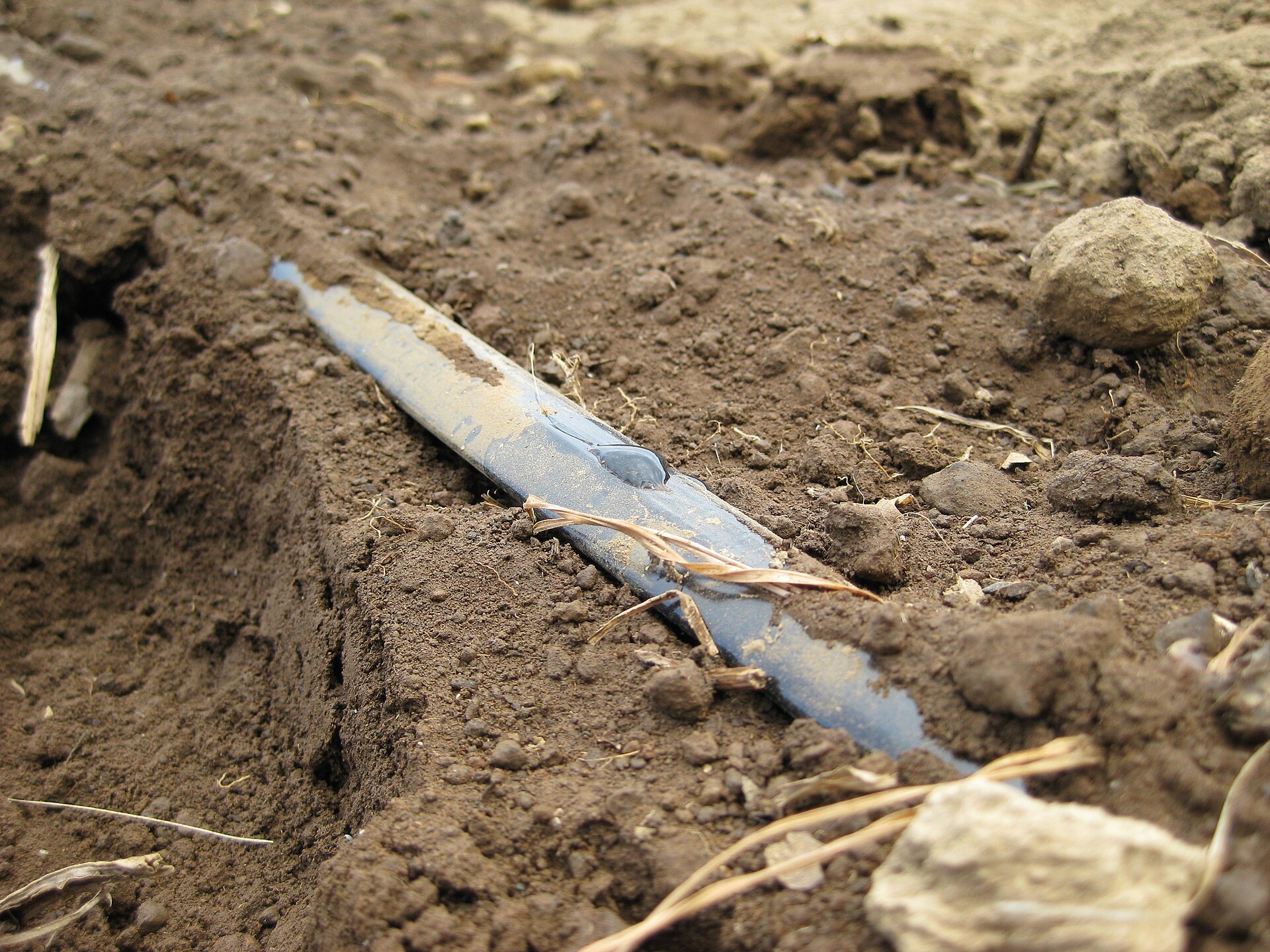
Photo: Drip irrigation tape in a field (illustrative). David Trainer / Wikimedia Commons, CC BY-SA 2.0