Seed potatoes age before they are planted. This physiological age changes how fast the crop emerges, how many stems it forms and when it matures. A 2021 research review for AHDB by Carvalho and colleagues explains how growers can measure and manage it.
Counting day-degrees
The review measures physiological age as accumulated day-degrees: the sum of daily mean store temperatures above 4°C. For example, 25 days at 14°C give 250 day-degrees (our calculation). Seed kept at 4°C gains almost no age, while warm storage ages it quickly.
For chitting, the review describes seed held at 10°C for 4 to 6 weeks before the planned planting date. In one method, store temperature is raised by 1 to 2°C a day to 18–20°C until sprouts appear, then lowered to 8–12°C with light. Suggested lighting is more than 100 W per tonne, or LED lighting at 10 W per square metre, for 8 to 10 hours a day, with humidity at 70–80%. Sprouts should be about 1–2 mm long when light exposure starts.
Weekdays. Unsubscribe in one click.
Faster emergence, earlier maturity
In a UK trial cited in the review, chitting cut the time to 50% emergence by 8 to 10 days in the varieties Markies and Pentland Dell. Chitted seed can mature up to two weeks earlier than unchitted seed. In Belgium, extending chitting to 7 weeks increased yields by 3 to 6 t/ha. The New Brunswick agriculture department in Canada also says green sprouting can advance maturity by about two weeks. It suggests warming seed at 10–15°C in the dark, and planting only when soil is at least 7°C.
Not a yield guarantee
Older seed does not always mean more yield. A 2024 study in Potato Research by Zou and colleagues stored seed of Agria, Festien, Innovator and Lady Claire at 4, 7, 10 and 17°C. The authors found no clear or consistent effect on final yield for storage between 4 and 10°C. Storage at 17°C more often reduced yield, with losses of up to 30% for Innovator at one site. Effects on stem and tuber numbers depended on the variety.
Why it matters
Seed age is a tool, not a fixed benefit. Early markets and short seasons gain most from chitting, because faster emergence and earlier bulking bring an earlier harvest. For long-season crops, too much warmth before planting can reduce yield in some varieties. Growers should record store temperatures, count day-degrees for each seed lot and test how their own varieties respond.
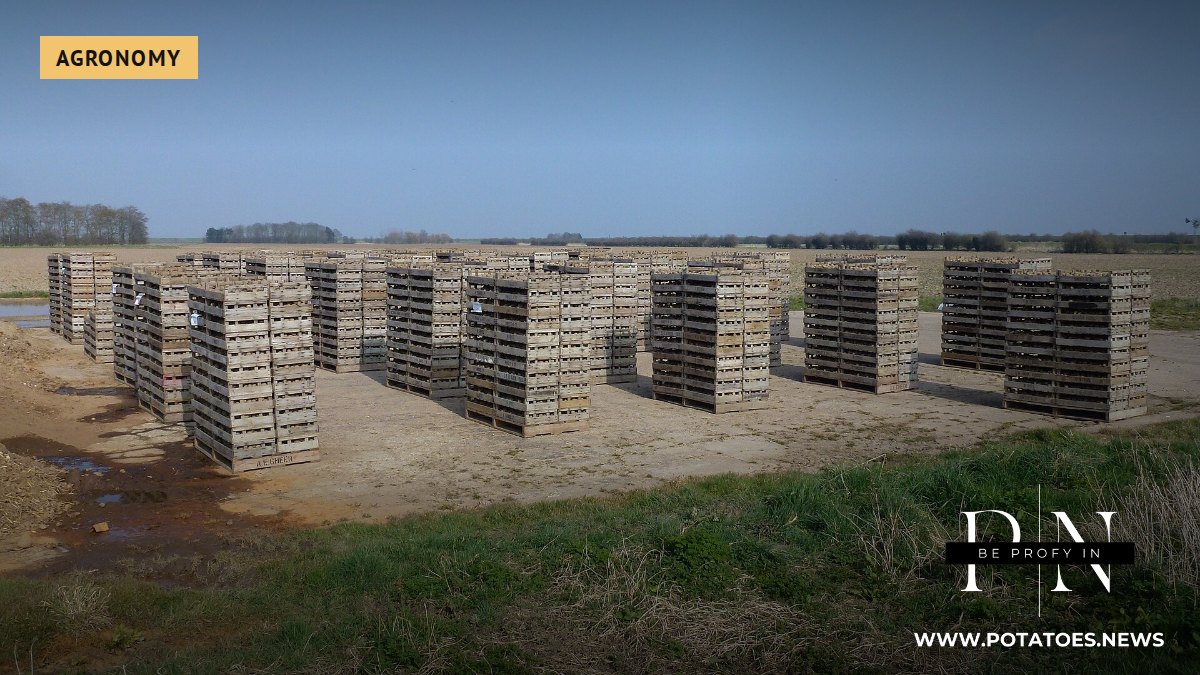
Photo: Chitting seed potatoes on a farm (illustrative). Richard Humphrey / Wikimedia Commons, CC BY-SA 2.0