Stems that dry out one by one while the rest of the plant stays green can point to black dot. The fungus Colletotrichum coccodes attacks roots, stolons, stems and tubers. Growers often confuse it with early dying, drought damage or silver scurf.
How the disease builds up
The fungus forms tiny black sclerotia, about 0.1–0.5 mm across. According to the levy board AHDB in the UK, these structures survive up to eight years in soil. A 2026 review in the journal Potato Research says they can survive more than a decade.
Inoculum builds up with every potato crop in the rotation, the University of Wisconsin says. Infected seed adds more. Disease severity rose with the amount of disease on seed tubers, the review notes. AHDB rates soil tests of 1–10 pg of fungal DNA per gram as low risk and more than 100 pg as high risk.
Stress drives symptoms. The Wisconsin team lists temperature and moisture extremes. Over-irrigation and long periods of wet soil also favour the disease. Infection can cause early senescence, stem girdling and wilting. Studies cited in the review report yield losses of 12% to 30%.
Time in the ground matters
The longer tubers sit in infested soil, the worse the blemish. AHDB says crops that spend 120 days or less from 50% emergence to harvest carry less disease. A 2021 trial in Tulelake, California, tested the red variety: Dark Red Norland. Vines killed at 95% green, with a two-week skin set, gave 14% black dot coverage. Vines killed at 10% green, with a four-week skin set, gave 30%.
Silver scurf follows the same pattern. Cornell University notes that late infection of mature tubers, even after vine death, can greatly increase silver scurf.
What happens in store
New black dot infections do not start in storage. But blemish often becomes more severe there, the Wisconsin team says. Warm, humid stores speed this up. AHDB advises a pull-down of about 0.5°C per day to the holding temperature. Silver scurf lesions raise water loss, and Cornell calls the resulting shrinkage economically significant.
Main tools are rotation of three years or more without other solanaceous crops, clean seed, weed and volunteer control, and careful irrigation late in the season. Prompt haulm killing and a short gap before harvest also help. In-furrow azoxystrobin reduced black dot in UK work. Product registrations differ by country, so growers must check local labels.
Why it matters
Black dot is a skin blemish that cuts value in washed and packed potatoes. Long intervals between haulm killing and harvest raise risk for both black dot and silver scurf.
Fields with a long potato history carry the biggest risk. A soil test before planting can steer those fields to processing or away from potatoes.
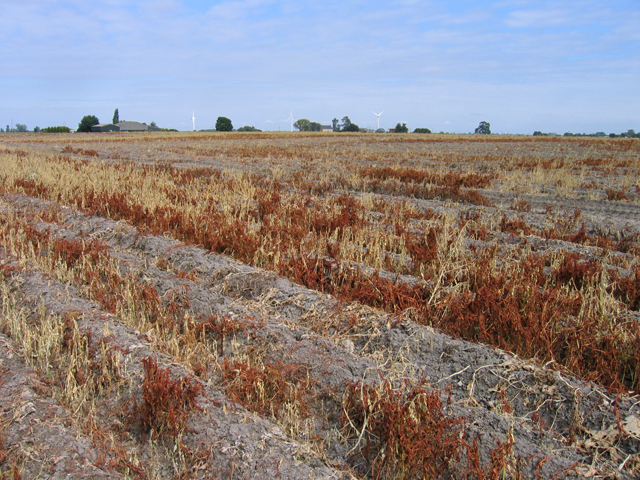
Photo: A potato crop with desiccated haulms before harvest (illustrative). Rodney Burton / Wikimedia Commons, CC BY-SA 2.0