The world average potato yield was 22.86 tonnes per hectare in 2024, according to FAOSTAT data summarised by Potatoes Without Borders. Behind that average, the differences between countries are very large.
By region, Oceania averaged 42.66 t/ha, the Americas 30.47 t/ha, Europe 25.25 t/ha, Asia 22.22 t/ha and Africa 15.43 t/ha. Africa’s yield fell by 0.84% from 2023.
Top and bottom
Country data from the FAO series on Our World in Data show the highest 2024 yields in New Zealand (51.3 t/ha), the United States (50.9 t/ha), the United Kingdom (46.6 t/ha), Denmark (45.8 t/ha) and Germany (45.0 t/ha). France, the Netherlands and Canada were all above 41 t/ha.
At the other end, Nigeria reported 3.8 t/ha, North Korea 3.2 t/ha and Bolivia 6.5 t/ha. Rwanda had 7.9 t/ha, Tanzania 8.7 t/ha, Kenya 9.7 t/ha and Ethiopia 12.3 t/ha. Some very small producers reported yields below 2 t/ha. The best national yield is about 14 times higher than Nigeria’s.
What explains the gap
A study by the International Potato Center (CIP) and partners in 13 African countries, carried out in 2013–2016, estimated that farmers harvest about 8 t/ha, while 32 t/ha is attainable. Closing the 24 t/ha gap could raise potato production in the region by 140%, CIP said. Experts ranked poor-quality seed as the first cause and bacterial wilt as the second. Other causes on the list included poor soil health, late blight, too little fertiliser, viruses, low-yielding varieties and poor timing, according to a World Potato Congress article by the same author.
Seed is the key point. According to CIP, 95% of potato farmers in Africa get seed from informal systems. Farmers who use recycled seed or seed of unknown origin harvest 6–10 t/ha, while quality seed can give 20–25 t/ha. In a trial in Mozambique, one CIP variety gave 38 t/ha with irrigation and fertiliser, against 15 t/ha without fertiliser.
Production of minitubers, the first stage of clean seed, rose from 483,000 to 4,921,000 units in seven East and Southern African countries in less than ten years, CIP reported in 2018.
Why it matters
The yield gap is also a market gap. Countries with low yields have the most room to grow without new land, but only if clean seed, fertiliser and disease control reach farmers. For seed companies and input suppliers, these are the markets where each extra tonne of seed can add the most potatoes.
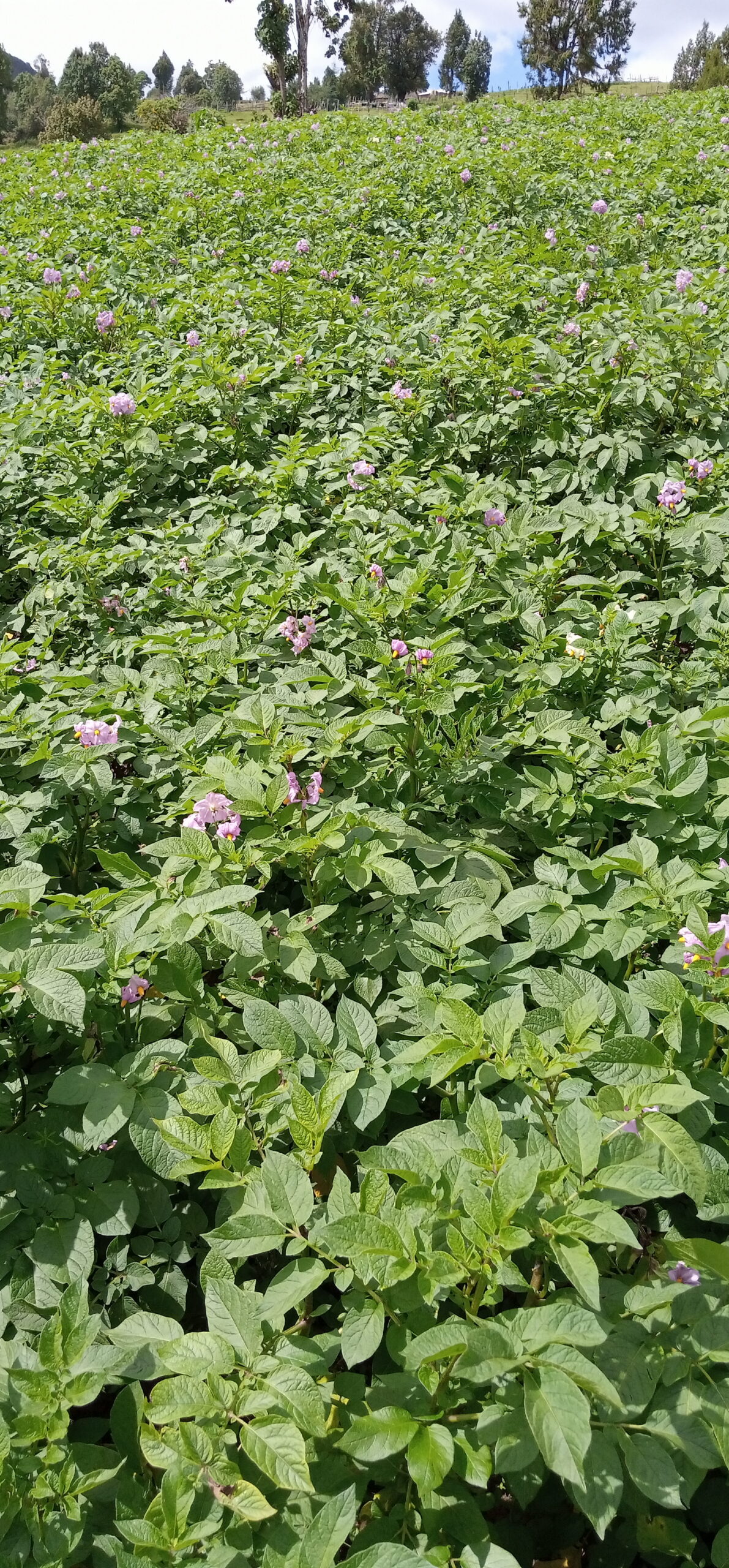
Photo: Potato farming in Elgeyo Marakwet county, Kenya (illustrative). Betwel chirchir / Wikimedia Commons, CC BY-SA 4.0