Global: As Little as 15% of Fan Air Reaches the Far End of Box Stores as Bulk Storage Wins on Cost
UK research shows bulk stores push almost all air through the crop, while in box stores as little as 15% can reach the far end. Boxes cost more overall but keep lots separate.
Potato stores are built in two main ways. In a bulk store, tubers lie in a deep pile and fans push air up through the crop. In a box store, tubers sit in wooden or plastic boxes, stacked in rows. British research and grower experience show the trade-offs in airflow, weight loss and cost.
The Potato Store Managers’ Guide from AHDB and Sutton Bridge Crop Storage Research explains the key difference. In a bulk store, virtually all the air from the fan passes through the crop. Most box stores use “overhead throw” ventilation, where air moves around the boxes, not through them. Recent research found that as little as 15% of the air from the fans reached the far end of such a store. Space ventilation can also leave boxes cool at the surface and warm in the centre, which raises the risk of condensation.
Both store types are usually designed for about 0.02 cubic metres of air per second per tonne. Bulk stores are moving to higher rates of up to 0.04. For drying, box stores may need up to 0.08 to allow for air leakage. “Letterbox” systems, which blow air into the pallet openings, work for drying only up to 8–10 boxes deep. The guide says boxes can be stacked up to eight high, while bulk piles deeper than 4 metres risk pressure bruising.
Weekdays. Unsubscribe in one click.
On cost, the guide says a bulk store with insulated, load-bearing walls costs more to build than a box store. But once the boxes are added, box storage is more expensive overall. The Andersons Outlook 2023, reported by Midland Farmer, put new boxes at £100–130 each delivered, and total storage costs at possibly more than £75 per tonne for the season.
Farmers Weekly reports that about two-thirds of processing potatoes in Britain are stored in bulk, while fresh-market potatoes are almost all in boxes. AHDB research cited in the article found that running costs vary by about 300% between the most and least efficient stores. One grower, Fridlington Farms, said a new bulk store cut running costs by about £15 per tonne compared with boxes, and weight loss fell to 6–7%, against more than 10% in its box store. The same article says a suction wall, which pulls air through boxes, costs about £6,000–13,000.
Why it matters
Weight loss and uneven cooling are paid for in lost tonnes and rejected loads. Bulk stores give better airflow and lower cost per tonne for large, uniform processing crops. Boxes give flexibility to keep many varieties and lots apart, which fresh packers need.
For existing box stores, the fastest gain is often not a new building but moving air through the boxes, for example with suction walls or lateral ventilation.
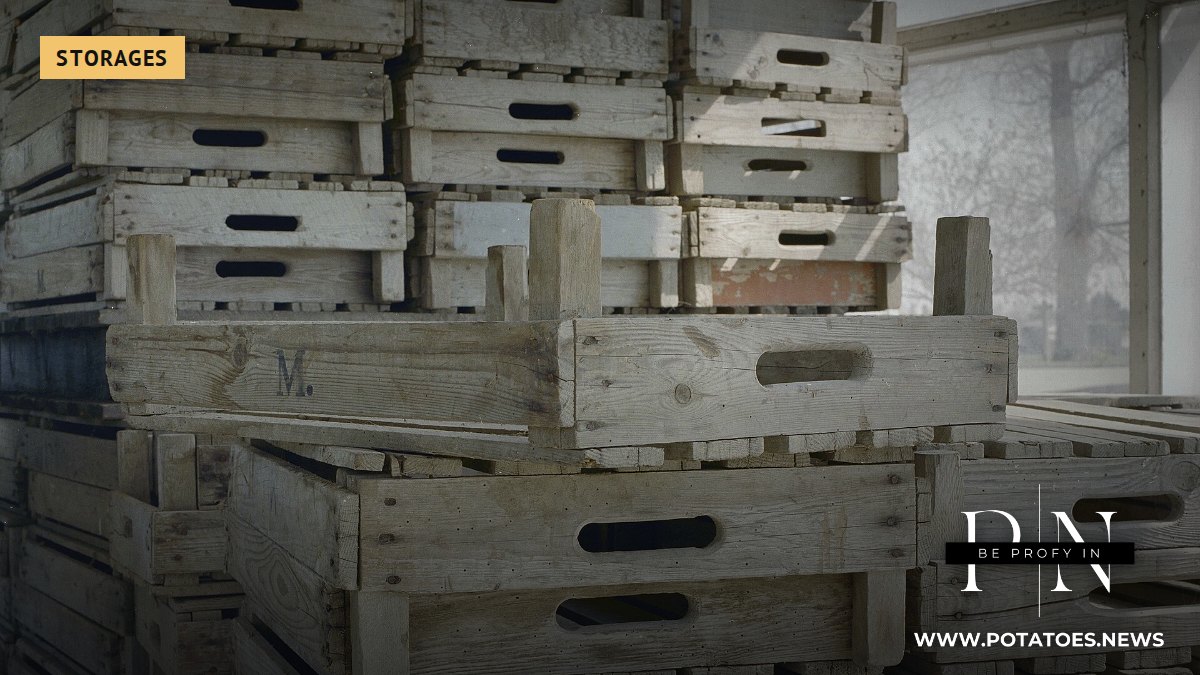
Photo: Wooden potato boxes in a store at Zuidland, Netherlands (illustrative). IJsbrand Heins / Wikimedia Commons, CC BY-SA 4.0