Global: A 4°C Gap Between Warm Air and Cold Tubers Is Enough to Cause Condensation in Potato Stores
UK and Irish storage guides use a 4°C rule for ventilation at loading. Airflow, pull-down speed and a warm pile top keep water off tubers in the first weeks.
Store loading is the riskiest time for water on tubers. Freshly harvested potatoes are often wet, damaged and still warm, while nights are getting colder. Storage guides from the United Kingdom, Ireland and the United States give simple numbers to keep tubers dry.
Condensation forms when warm, moist air meets a colder surface, such as potatoes at the top of a pile. The Potato Store Managers’ Guide from AHDB’s Sutton Bridge Crop Storage Research explains the two conditions: the air must be warmer than the tubers, and the tuber surface must be below the dew point of that air. As a general rule, a difference of 4 °C or more between warm air and cooler crop will cause condensation. At very low temperatures, a difference of only 1 °C may be enough.
For drying at loading, the guide gives minimum airflows of 0.02 m3/s per tonne for bulk stores, rising to 0.04 m3/s per tonne for early-lifted crops. Box stores may need up to 0.08 m3/s per tonne, because air leaks around the boxes. The guide advises ventilating whenever outside air is within ±4 °C of crop temperature.
Weekdays. Unsubscribe in one click.
Teagasc, the Irish agriculture and food authority, uses the same ±4 °C rule. It says regular blowing is needed for two to three weeks after harvest, because tubers produce heat during wound healing. It warns that pulling temperature down by more than 0.5 °C a day may create temperature gradients in the pile. Ware crops normally take two to three weeks to reach holding temperature. Moisture loss from wounds is about 100 times higher than from undamaged skin.
Watching the top of the pile
In the United States, John Klimes of the storage equipment company Agri-Stor told Potato Country that the top of a pile should be slightly warmer than the bottom, by 1 to 1.2 °F (about 0.6–0.7 °C). A pile with a cooler top attracts condensation. In that case he advises against raising fan speed and suggests heaters above the pile. A band of free water inside the pile shows that the dew point has been reached. He also recommends more air when carbon dioxide rises above 2,000 ppm.
Why it matters
Condensation puts free water back on tubers that the store is trying to dry, at the time when wounds are still open. A dew point chart and two thermometers, one in the air and one in the crop, cost little. Store managers who check the air–crop gap before each ventilation run can avoid wetting the crop.
The rules are simple enough for any store: ventilate within ±4 °C of crop temperature, cool slowly and keep the top of the pile a little warmer than the base.
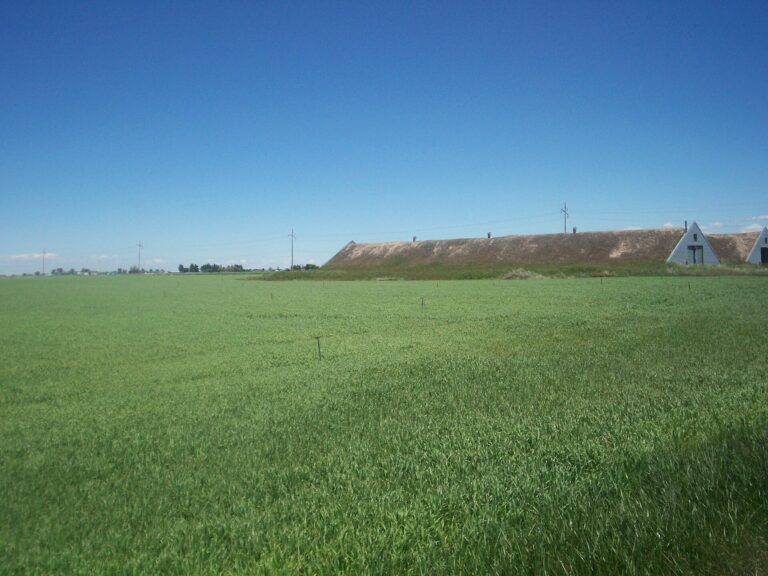
Photo: A potato warehouse in York, Prince Edward Island, Canada (illustrative). Larry from Charlottetown, PEI, Canada / Wikimedia Commons, CC BY 2.0