
Ethylene Over Chemistry: How the Global Potato Industry Is Tackling Storage After the CIPC Ban
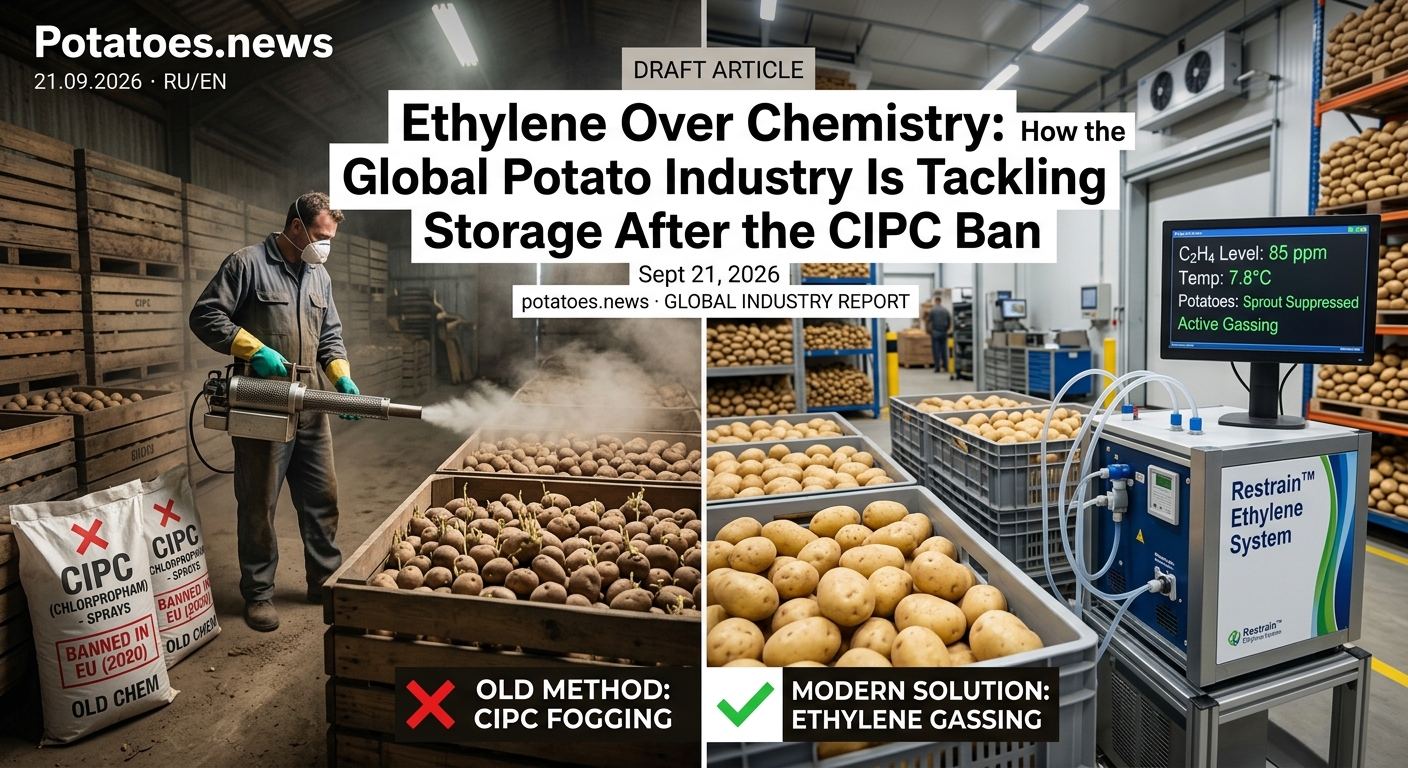
Harvest season is when growers decide not just how much they’ve brought in, but how to keep it. And the world’s toolkit for that keeps shrinking: chlorpropham (CIPC), the sprout suppressant that dominated storage rooms for decades, has effectively disappeared from the EU. The European Commission declined to renew its approval in June 2019, and a phased withdrawal began on 1 January 2020. Russia, meanwhile, just renewed chlorpropham’s registration for another decade — a divergence worth unpacking.
How CIPC works, and why it’s being phased out
Chlorpropham is a mitotic inhibitor: it blocks cell division in developing tuber buds, preventing sprouts from forming. According to the industry portal PotatoPro, at optimal residue levels (10–20 ppm) it suppresses sprouting by 80–95% for 6–9 months — roughly why it stood as the industry standard for table and processing potatoes for half a century. Its structural limitation: it isn’t compatible with seed potatoes, since it reduces viability. And regulators have grown steadily stricter about residues in stores and on tubers — that, rather than a single political decision, is what drove the Commission’s 2019 call not to renew the approval.
Four working alternatives
No single substitute for CIPC has emerged. Instead, the industry reaches for a toolkit matched to the job: maleic hydrazide (field-sprayed on foliage before harvest, translocates to the tuber, 5–7 months’ effect, timing-critical); 1,4-DMN (post-harvest aerosol mimicking hormonal signals, ~60–85% suppression for 4–6 months per PotatoPro, preserves seed viability above 98%, sold as 1,4SIGHT/1,4SEED, already a registered biopesticide in the US/Canada); essential oils including Biox-M (controlled dehydration of sprouts; carvone doesn’t affect fry colour and is seed-safe; mint blends hold 2–5 weeks per application); and ethylene, today’s most-discussed option — continuous gassing (~10–100 µL/L) that keeps sprouts weak and easily removed during grading, suppression reported at 70–90% for 4–6 months at 7–10°C, best suited of all the alternatives to seed potato (95–100% viability, fully reversible within 1–2 weeks of removing the gas), delivered via sensor-controlled generators (Restrain is a well-known commercial system), and priced comparably to CIPC per treatment while the gas itself runs several times cheaper than the other alternatives.
Weekdays. Unsubscribe in one click.
The caveats worth knowing upfront
Ethylene’s efficacy drops above 15°C storage temperature. Held for more than six months, tubers can see reducing sugars rise — darker fry/chip colour — which processors offset with blanching and a gradual rather than full-strength start to gassing. The practical headache is store airtightness: older, leaky buildings struggle to hold the target concentration, and daily ventilation is needed to keep CO₂ from building up.
The Russian angle: a closer parallel than it looks
Chlorpropham isn’t banned in Russia — it’s active in the state pesticide register (No. 197-07-4799-1, issued February 2025, valid through February 2035, registrant OOO Agrokhim-XXI), for storage-stage sprout suppression, applied only via thermal fogger, hazard class 2. But the registration excludes seed potatoes. So even without any EU-style ban, Russian seed potato producers already have no legal route to CIPC — exactly where ethylene or 1,4-DMN stop being a foreign trade-press story and become a live question.
Why it matters
Marketable percentage after storage drives a season’s economics more than storage volume alone. Table/processing growers in Russia face no near-term pressure to move off CIPC — its registration runs to 2035. But for seed potato operations the alternatives question is already live, and the global trend is worth watching either way: it’s cheaper to change storage technology on your own timeline than to be forced into it overnight.
The topic was raised by practitioners in the MAX messenger chat «КАРТОФЕЛЬ И Т.Д. (Potato etc.)», a community of more than 1,100 potato growers and industry specialists. Participants are not named. Join the discussion.