
El Niño passes its 2015 high as planting season opens across the southern hemisphere
Global, 16–21 September 2026. Potato growers in Australia, South Africa and India are heading into planting with the strongest El Niño in modern records building in the Pacific, and the event has not yet reached its peak.
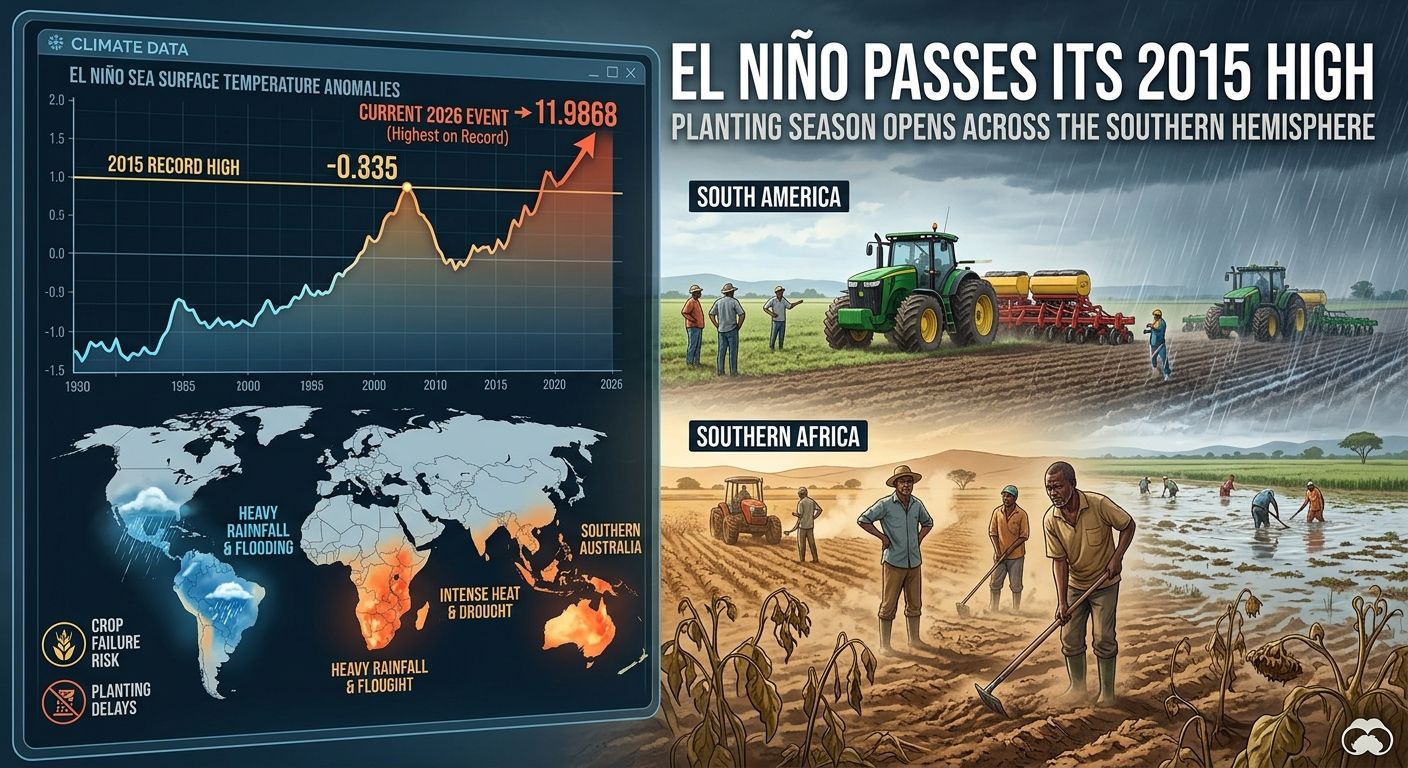
On 19 September, the daily sea-surface temperature anomaly in the Niño 3.4 region reached +3.05°C against the 1991–2020 baseline, according to Climate Reanalyzer. The previous high of +3.02°C was set in late November 2015. Two days later, the International Research Institute for Climate and Society (IRI) at Columbia University reported a weekly Niño 3.4 value of +3.0°C for the week centred on 16 September and classified the event as “very strong”.
A record, with a caveat
The headline figure needs some qualification. The +3.05°C reading is a single daily value measured against a fixed 1991–2020 baseline. The Relative Oceanic Niño Index (ONI), which adjusts for background ocean warming and is preferred by most meteorologists, sits just 0.01°C below the 2015 peak. IRI itself stops short of calling a record and says only that the 2026 event could rank among the strongest on record. The August monthly average stood at +2.52°C.
Weekdays. Unsubscribe in one click.
On the direction of travel, however, the forecasts agree. All 22 models in IRI’s ensemble, 13 dynamical and 9 statistical, project further strengthening. IRI puts the probability of El Niño conditions at 100% from September–November 2026 through February–April 2027, falling to 61% by May–July 2027. Most models show Niño 3.4 exceeding +3.0°C through autumn and winter. Climate scientist Zeke Hausfather, cited by The Guardian, puts the average of 14 models at around +4°C in November–December, well above any previous event.
IRI also expects a positive Indian Ocean Dipole (IOD) to develop in September and persist until at least December. In Australia, a positive IOD typically reinforces El Niño’s drying effect.
Australia: a hot, dry spring in the main growing states
The Bureau of Meteorology’s outlook for September–November leans towards below-median rainfall and above-average temperatures across much of southern and eastern Australia. That covers the key potato-growing states of South Australia, Victoria and Tasmania, where spring planting is under way. Western Australia, by contrast, leans wetter than usual. The Bureau cautions that a strong Pacific signal does not translate one-for-one into Australian impacts, noting that unusually warm coastal waters may partly offset the drying.
South Africa: dryland crops most exposed
The South African Weather Service (SAWS) expects below-normal rainfall across most of the country for October–December 2026, with above-normal temperatures very likely, and a similar outlook for November–January. SAWS has said the event could become the strongest in living memory. The last strong El Niño, in 2015/16, brought South Africa its worst drought in 23 years.
Analysts list potatoes among the most vulnerable rain-fed summer crops. Some producers are already adjusting. According to Daily Maverick, Zandrug Boerdery will skip high-summer plantings and move them to late summer instead. Drought is not a certainty, however: during the very strong 1997/98 El Niño, parts of South Africa’s summer rainfall region received slightly above-normal rain.
India: the monsoon deficit is a water-supply question
India’s south-west monsoon is ending about 15% below the long-period average, according to the India Meteorological Department (IMD). That could make it the weakest season in nearly two decades, and kharif crops and food inflation are already feeling the effects.
For potatoes the risk is less direct. The rabi crop is planted in October–November, and most production in Uttar Pradesh, West Bengal, Bihar and Punjab is irrigated. The concerns are therefore reservoir and groundwater levels, higher irrigation costs, and a warm autumn that could delay planting.
South America: more than floods
IRI reports that the Niño 1+2 index off the coasts of Ecuador and Peru has stayed above +4°C for six weeks, raising the risk of heavy rain and flooding along the coast and in the south-east of the continent. The Andean highlands, where most of Peru’s and Bolivia’s potatoes are grown, tend to see the opposite pattern: strong El Niño events have historically brought rainfall deficits there rather than excess rain.
Why it matters
The 2026/27 El Niño looks set to be the defining weather story of the season for potatoes on both sides of the equator. Its expected peak coincides with planting in the southern hemisphere and India, and its effects on yields, quality and seed and ware prices are likely to run well into the first half of 2027.
Sources: Climate Reanalyzer; NOAA / IRI Columbia University; Bureau of Meteorology; South African Weather Service; The Guardian