Ecuador: Potato Output Falls 15.6% to 221,187 Tonnes as Harvested Area Shrinks 24%
Ecuador harvested 221,187 tonnes of potatoes in 2024, down from 262,038 tonnes, as the harvested area fell to 13,689 hectares, national statistics office INEC reports.
Ecuador produced 221,187 tonnes of potatoes in 2024, according to the national statistics institute INEC and its annual crop survey ESPAC. This is 15.6% less than the 262,038 tonnes of 2023. Farmers planted 14,548 hectares and harvested 13,689 hectares, about 24% less than the 17,997 hectares harvested a year earlier. Sales reached 206,632 tonnes.
Because output fell less than area, average yield rose. By our calculation it was about 16.2 tonnes per hectare in 2024, against about 14.6 tonnes in 2023.
Trend
The 2024 result breaks a period of growth. In 2022 Ecuador planted 19,390 hectares, harvested 17,926 hectares and produced 251,433 tonnes. In 2023 production rose to 262,038 tonnes on 19,836 planted hectares. In 2024 the planted area dropped by more than 5,000 hectares.
Weekdays. Unsubscribe in one click.
One province leads
Potatoes grow mainly in the Andean highlands. Carchi, on the border with Colombia, is the key province. It had 32.2% of the planted area in 2024 but 60.7% of national production, thanks to a yield of 29.7 tonnes per hectare. Other provinces had much lower yields: 13.5 tonnes per hectare in Tungurahua and 11.3 tonnes in Imbabura.
By planted area, Chimborazo followed Carchi with 21.4%, then Tungurahua (10.7%), Cotopaxi (7.6%) and Imbabura (7.5%). Carchi, Chimborazo and Tungurahua together had 65.0% of the harvested area.
Farmers and consumption
Potatoes are a crop of many small farms. An INEC survey cited in May 2024 counted 88,130 potato producers, 10.5% of all agricultural producers in the country. Consumption was estimated at about 30 kg per person per year. In 2023 Carchi supplied 44% of production, a share that grew to 60.7% in 2024.
Why it matters
Ecuador’s potato supply is becoming more dependent on one province. Carchi farmers reach yields close to 30 tonnes per hectare, while many highland farms stay near 11–14 tonnes. When area falls in the lower-yield provinces, national output falls less, but supply becomes more concentrated.
This creates both risk and opportunity. A bad season in Carchi would now affect most of the national market. At the same time, the yield gap between provinces shows room for better seed, fertilisation and advice in Chimborazo, Tungurahua and Cotopaxi.
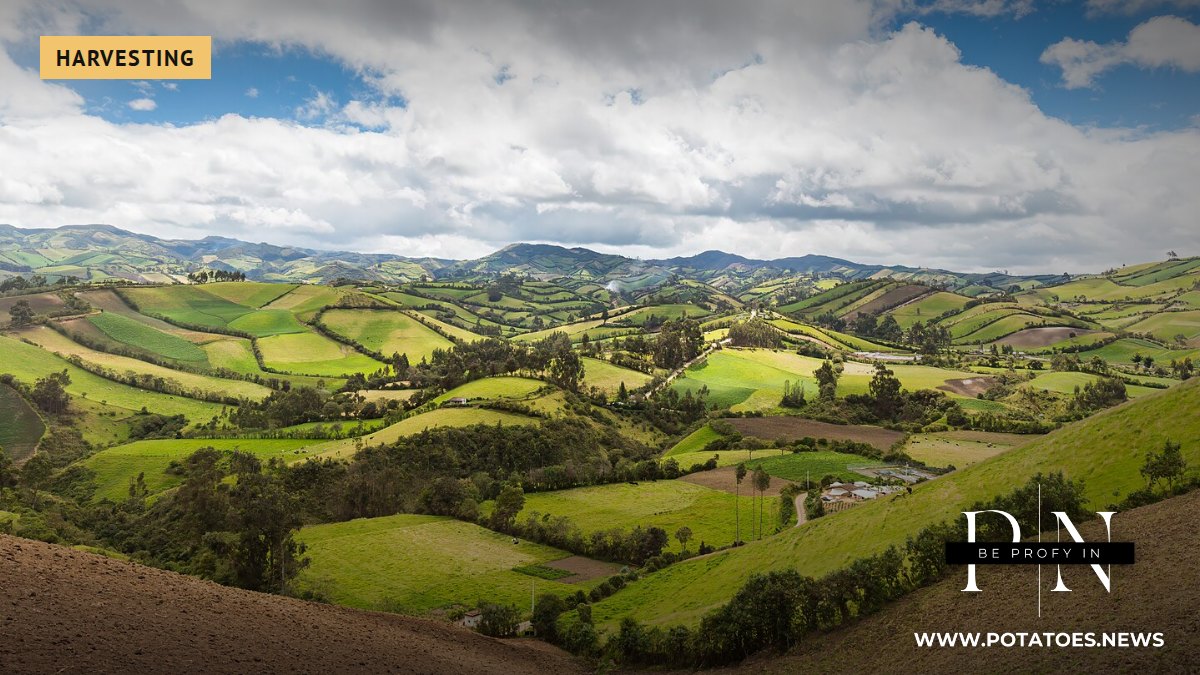
Photo: Farm fields near Julio Andrade, Carchi province, Ecuador (illustrative). Diego Delso / Wikimedia Commons, CC BY-SA 4.0