

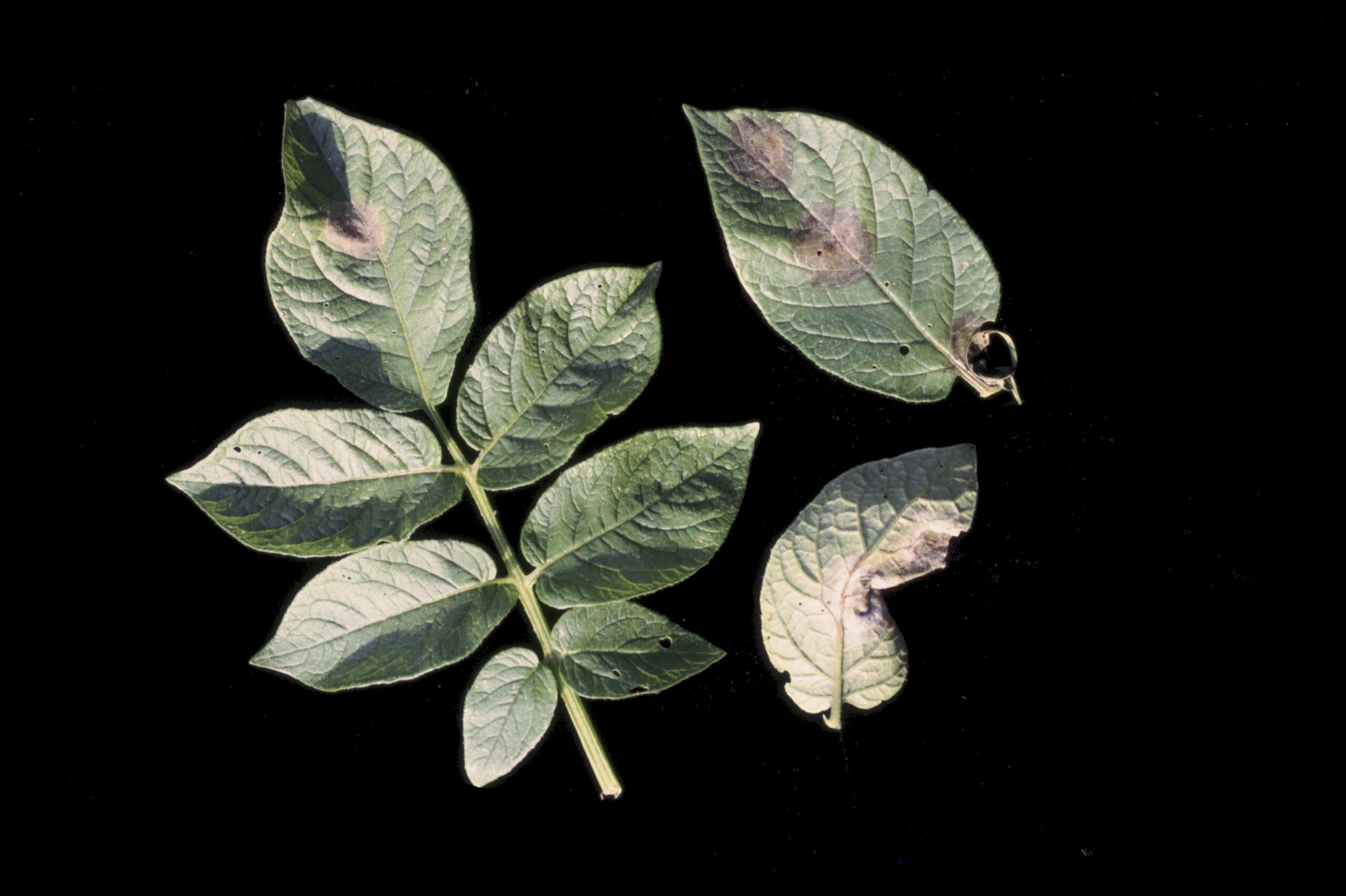
Late blight is the most destructive disease of potato worldwide, and the benchmark against which every fungicide programme in the crop is designed. The causal organism, Phytophthora infestans, is not a true fungus but an oomycete — a relative of brown algae — and that distinction matters in practice, because oomycetes are insensitive to several groups of fungicides developed against fungal diseases. This is the pathogen behind the Irish famine of the 1840s, and it remains capable of destroying an unprotected crop within two to three weeks in favourable weather.
Foliar symptoms begin as small, water-soaked spots, pale to dark green, usually at the tips and margins of the upper leaves where moisture lingers longest. Within days the spots expand into irregular brown-black lesions that can consume an entire leaflet; in humid weather a faint white mildew of sporangia appears on the lesion edge on the underside of the leaf. Under severe pressure stems blacken and the canopy collapses while still green — a detail that separates late blight from most other potato leaf diseases, which typically work from the bottom of the plant upward on senescing tissue.
On tubers, late blight shows as irregular, slightly depressed brown to purplish areas on the skin. Cutting into the flesh reveals a firm, dry, reddish-brown granular rot, usually no more than 5–15 mm deep. The damage does not stop at harvest: infected tubers brought into store continue to deteriorate, and secondary bacterial soft rot often turns a small late-blight pocket into a full storage loss.
The disease is driven by cool, wet weather: nights of 10–15 °C with days around 15–21 °C, relative humidity above 90 % and prolonged leaf wetness. Under such conditions a lesion can produce a new generation of sporangia within four to seven days, and wind carries those sporangia for tens of kilometres. The pathogen overwinters in infected seed tubers, unharvested cull piles and volunteer potatoes, which is why crop hygiene around the field is part of disease control, not housekeeping. Forecasting services — based on temperature and humidity records from local weather stations — remain one of the most cost-effective decision tools a grower has.
Control is prevention-centred: once late blight is established in a canopy, curative options are limited. Standard practice is a protectant backbone — chlorothalonil or mancozeb, in FRAC groups M5 and M3 — supplemented during high-risk periods with systemics such as cymoxanil, cyazofamid, fluazinam or mandipropamid, and in some regions phenylamides. The pathogen adapts quickly: resistance to metalaxyl and mefenoxam is now widespread, and reduced sensitivity has been documented in several other FRAC groups. Alternating modes of action within a season is therefore not a recommendation but a requirement for keeping the chemistry working. Haulm destruction two to three weeks before harvest, harvesting in dry conditions, destroying cull piles, and planting certified disease-free seed close the cultural side of the programme.
Variety resistance is advancing but still incomplete. No major commercial variety is fully immune, yet the difference in field tolerance between susceptible and partially resistant varieties is large enough to cut the number of fungicide applications per season — which is why resistance breeding, including genes introgressed from wild Solanum species, is one of the most closely watched directions in global potato research.

