
Common scab
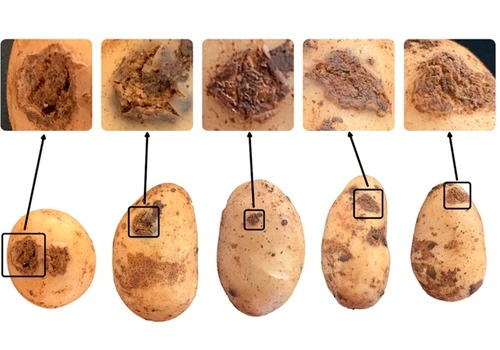
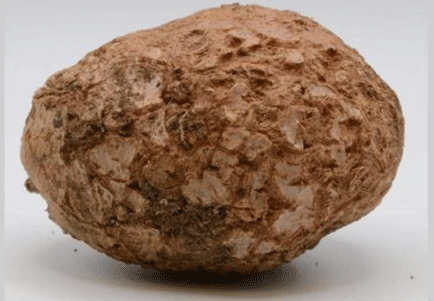
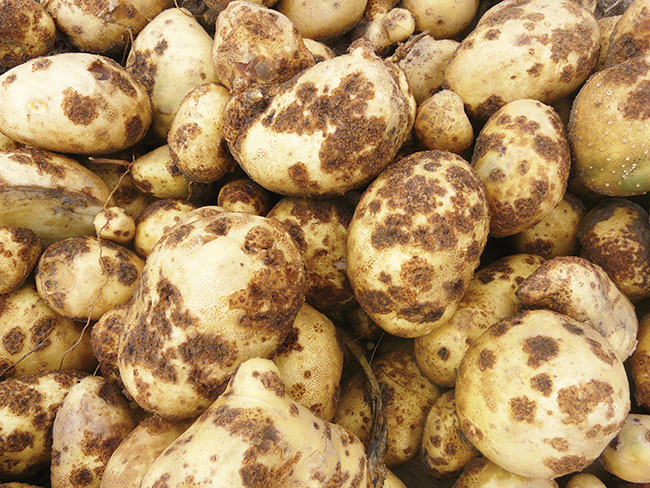
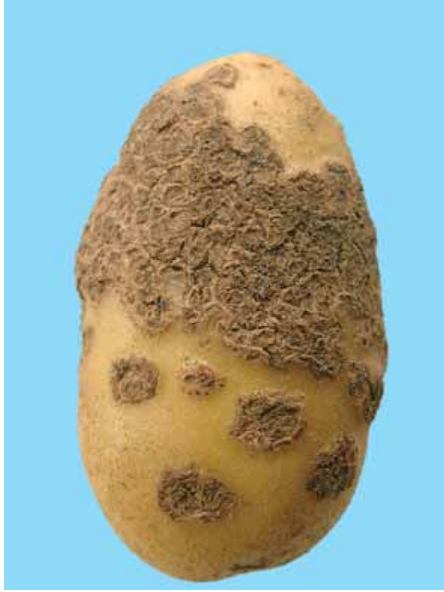
Common scab is a cosmetic disease, not a yield disease — and that is exactly why it costs growers money. The pathogen, Streptomyces scabies and several related species, does not reduce tuber size or storage weight. It downgrades the crop at the point where a buyer looks at the skin: fresh-market and seed lots with heavy scabbing move to processing or are rejected outright, at a lower price than the same tonnage would have earned clean.
The infection window is narrow and specific. Tubers are vulnerable from initiation until they reach roughly 2 cm in diameter — a period of four to six weeks depending on variety and temperature. Outside that window, a scab-causing organism in the soil does little damage even in a highly susceptible field. Inside it, a week of dry soil is enough to set the season’s cosmetic quality.
This is why irrigation timing, not fungicide choice, is the primary lever growers have. Common scab is caused by a bacterium-like actinomycete, not a fungus, so most standard fungicide programmes have no effect on it at all — a point worth stating plainly, since scab is still sometimes treated as a spray problem in grower conversations.
Soil pH is the second lever. Scab-causing organisms are markedly more active above pH 5.5, which puts fields that have received lime for a rotation partner — cereals or brassicas, typically — at elevated risk in the potato year that follows. Growers rotating out of a limed field should expect to manage scab risk through moisture rather than pH correction in that same season, since pH does not shift quickly enough to help mid-rotation.
Variety choice narrows the range of outcomes but does not remove the risk. Field tolerance to common scab varies by a wide margin between commercial varieties, and that difference shows up consistently across seasons and regions — which makes it one of the more reliable tools in a grower’s hand, alongside irrigation scheduling, on land with a known scab history.
In the news
Global Potato Brief
Top five stories, prices, disease alerts and events. Weekday mornings, no advertising.