
Decades of development lead to mechanization of agriculture
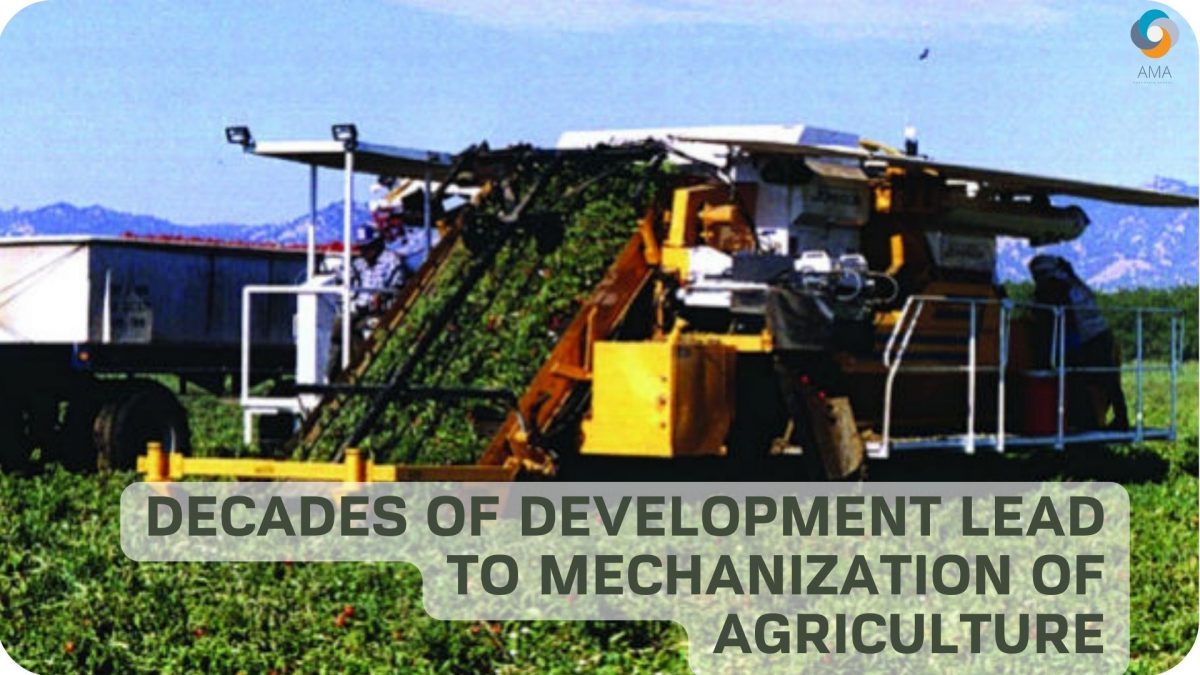
Mechanized agriculture is the process of using agricultural machinery to mechanize work, greatly increasing productivity.
In modern times, powered machinery has replaced many jobs formerly carried out by manual labor, or by working animals such as oxen, horses and mules. The impact of mechanized harvesting on commercial vegetable crops may best be seen in the expansion of tomato harvesting technology.
A report issued in 2010 by Iowa State University agriculture and life sciences professor Wallace Huffman focused on the status of labor-saving mechanization in U.S. fruit and vegetable harvesting. It was the end of the Bracero program in 1964 that signaled reduced availability of harvest labor for fruit and vegetable growers, Huffman said.
Weekdays. Unsubscribe in one click.
In anticipation of this event, scientists at the University of California, Davis, began work on new tomato varieties and mechanical harvesters that would work together in the 1950s.
The mechanical tomato harvesters and new processing tomato varieties had progressed to a state where farmers could expect to reduce harvesting costs, 262 mechanical harvesters were sold to growers and processors in 1965.
Steady improvements in these complementary technologies have contributed to the success of the mechanical tomato harvester. Virtually all California processing tomatoes are currently mechanically harvested, according to the report.
Huffman pointed to several potential advantages of harvest mechanization: reduced harvest costs, eliminating problems associated with labor shortages, permitting longer harvesting days and reducing exposure of harvested crops to human bacteria.
In the mid-1940s, Jack Hanna of the Department of Vegetable Crops at UC Davis began breeding a tomato variety that would ripen uniformly and detach from the plant during machine harvesting, thereby withstanding the stress of mechanical harvesting.
According to Huffman, Colby Lorenzen, a UC Davis agricultural engineer, and Hanna began to develop a mechanical tomato harvester in 1949. In the late 1950s, another UC Davis agricultural engineer developed a vine separator for Lorenzen’s machine.
By 1960, the University of California had obtained a patent for the new tomato variety, and Blackwelder Manufacturing, a California company, decided to manufacture and sell the first mechanical tomato harvester commercially.
Commercial use of the new tomato variety and the harvester began in 1962. When the Bracero program ended in 1964, this rapidly increased the demand for mechanical harvesters. In 1965, the 232 mechanical harvesters were enough to harvest roughly 25 percent of the tomato crop. By 1970, 95 percent of the California processing tomato crop was harvested by machine.
In succeeding years, Huffman said, labor use per ton gradually declined as the machinery was refined and new tomato varieties yielded higher and adapted better to machine harvesting. For the mechanical tomato harvesters to work well, tomato fields needed to be flat and well graded, and needed to have long rows (at least 600 feet) to reduce harvest-time losses in turning.
Growers soon learned improved weed control, field preparation, layout and irrigation techniques, and breeders continued to develop varieties that were better suited to mechanization. Equipment companies improved the reliability of the machines and reduced time lost to in-field repairs.
Huffman said some growers began a night harvest shift. By the 1970s, machines could harvest 220 acres in a season, with an average labor need of 1.6 hours per ton. However, the harvesters still used considerable amounts of hand labor, according to the report.
Hand-harvested processing tomatoes were expensive, accounting for almost 50 percent of total production costs. The first harvester reduced harvest costs to 33 percent of total costs, Huffman said. After the electronic sorter was introduced, harvester costs dropped to 16 percent of total costs by 1979.
Harvest costs have slowly declined since then. More recently, improvements in harvester reliability, along with brush shaker innovation, have reduced labor requirements another 60 percent.
By 2010, the harvest labor requirement per ton for processing tomatoes dropped by 92 percent, Huffman said.
According to Huffman, the efficiency gain of the mechanical tomato harvesting system was at least partially responsible for the expansion of processing tomato production in California. It increased from about 2.5 million tons per year in the 1960s to 10 to 11 million tons per year in 2008-2009.
California now produces more than 95 percent of the U.S. processed tomato crop. The California farms growing processing tomatoes have also dramatically increased their acreage.
In the pre-harvester era of 1956, average acreage was only 91 acres. This increased to 362 acres by 1976, when mechanical harvesting had spread throughout the industry. In 2007, the average acreage of processing tomatoes was 600, which provides considerable scale of operation, Huffman said.
Huffman said the most storied success in mechanical fruit and vegetable harvesters is the self- propelled Johnson Tomato Harvester, which is manufactured and sold by California Tomato Machinery. However, mechanical harvesters built by other companies are being used by growers to harvest fruits and vegetables for processing.
Pik Rite of Lewisburg, Pennsylvania, is among the companies that have expanded in tractor-drawn mechanical harvesters for cucumbers, carrots and peppers headed for processing, Huffman said.
The cucumber harvester has a special dirt removal system that uses blasts of air, along with a “scrubber” belt, to remove trash. It also has oversized conveyor chains that leave all oversized fruit in the field for better harvesting efficiency.
Huffman said fresh-market tomatoes, iceberg lettuce, organic lettuce, strawberries and other crops currently have substantial hand- harvesting costs – and continue to be targets for further mechanical harvesting breakthroughs.
Precision, robotics
According to New Holland, combines might have taken the harvesting job away from tractors, but tractors still do the majority of work on a modern farm. They are used to push implements – machines that till the ground, plant seed and perform other tasks.
Tillage implements prepare the soil for planting by loosening the soil and killing weeds or competing plants. The best known is the plow, the ancient implement that was upgraded in 1838 by John Deere. Plows are now used less frequently in the U.S. than formerly, with offset disks used instead to turn over the soil, and chisels used to gain the depth needed to retain moisture.