Colombia: Potato Output Up 33% Since 2010 to 2.49 Mt as Yields Rise
FAOSTAT data show Colombia harvested 2.49 million tonnes of potatoes in 2024. Growth came from yields, while the harvested area stayed near 110,000 hectares.

Colombia produced 2.49 million tonnes of potatoes in 2024, according to FAOSTAT. In 2010 the figure was 1.87 million tonnes. Output therefore grew by about 33% in 14 years.
The growth came from productivity, not from land. The average yield rose from 17.2 t/ha in 2010 to 22.7 t/ha in 2024, according to FAOSTAT. Dividing output by yield gives a harvested area of about 108,000 hectares in 2010. The same calculation gives about 110,000 hectares in 2024.
Many small producers
The sector is spread across many farms. Fedepapa, the national potato growers federation, says on its website that Colombia has about 90,000 potato producers. It reports a presence in more than 10 departments. The main producing areas are Cundinamarca, Boyacá, Nariño and Antioquia, according to the industry portal PotatoPro.
Weekdays. Unsubscribe in one click.
These are Andean highland regions. With about 110,000 hectares and 90,000 producers, the average farm grows only a little over one hectare of potatoes. This is a rough calculation, since some growers farm much larger areas.
A levy funds the sector
Colombia finances its potato sector through a compulsory levy. Law 1707 of 2014 set the promotion fee at 1% of the sale value of domestically produced potatoes. Both ware and seed potatoes are covered. Buyers collect the fee once during marketing. They must transfer it within the first 10 days of the following month.
The money forms the National Potato Promotion Fund (FNFP), managed by Fedepapa. According to the federation, the fund pays for research, technology transfer, training, phytosanitary control, information systems and consumption promotion. Fedepapa also runs a potato observatory and a daily price bulletin.
Still a yield gap
A yield of 22.7 t/ha is solid for the Andes. It is well above the FAOSTAT 2024 averages for Ecuador at 16.2 t/ha and Peru at 19.5 t/ha. Yet it remains below Mexico at 32.7 t/ha and far below northwest European levels above 40 t/ha.
Why it matters
Colombia shows how a levy-funded sector can raise yields without expanding land. Further gains will depend on seed quality, disease control and mechanisation on steep plots. For suppliers, 90,000 producers form a large but fragmented customer base. For processors, supply comes from many small lots that need aggregation.
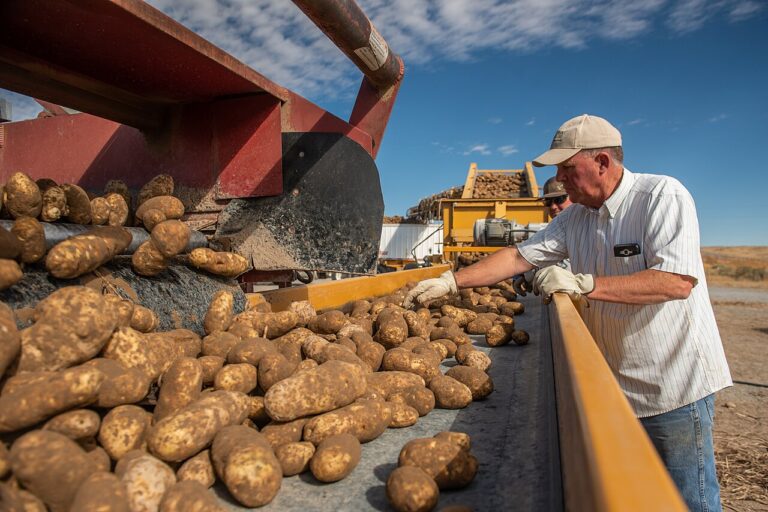
Photo: A potato crop near Tunja, Boyacá, Colombia (illustrative). Petruss / Wikimedia Commons, CC BY-SA 3.0