
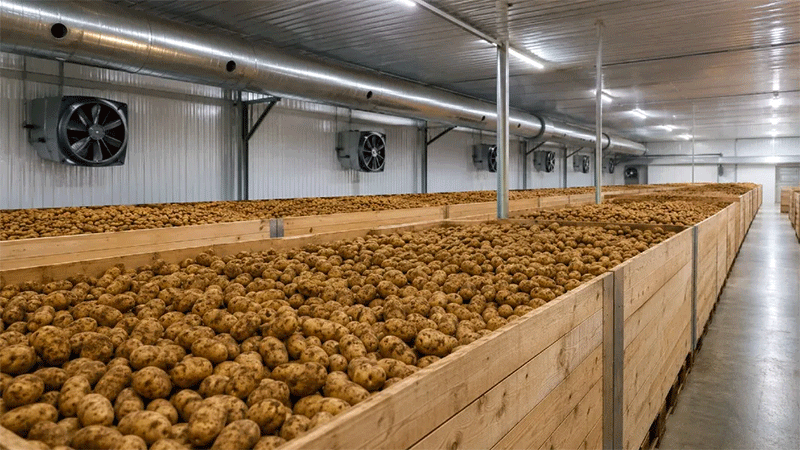
Potato storage has never been a passive affair – it demands discipline, technical precision, and constant attention to a living crop that continues to respire and age after harvest. But today, storage managers face a new and unsettling reality: the crop arriving at their doors is already shaped by climate stress. Hotter growing seasons, erratic rainfall, drought, waterlogging, heat waves, delayed harvests, and shifting disease pressure are all altering tuber physiology before the first bin is filled. Dormancy – once treated as a stable variety trait – is proving highly variable, with stressed crops entering storage physiologically older, breaking dormancy earlier, and threatening processing quality and seed vigour. Meanwhile, disease risk is climbing, sprout suppression (especially in the post-CIPC era) demands sharper precision, and traditional practices built around predictable behaviour are increasingly failing. The authors argue that storage can no longer be managed by habit; it must be managed by crop condition, with aggressive risk sorting, better lot assessment, and a willingness to move vulnerable lots earlier than planned.
Yet the solution is not merely more technology, though sensors, CO₂ monitors, and automated controls are becoming indispensable. Data, the article stresses, must serve human judgement – not replace it. Experienced storage managers remain irreplaceable, but they need better tools, clearer interpretation, and practical guidance to answer critical questions about curing, temperature uniformity, humidity, and sprouting onset. Infrastructure, too, deserves a hard re-evaluation: many stores were built for a climate that no longer exists, and insulation, ventilation, cooling capacity, and airflow design may all fall short under warmer harvest conditions. Above all, the human burden is real – growers and advisors carry enormous financial risk with every decision. The future of potato storage, the piece concludes, demands a fundamental mindset shift: from viewing the store as a passive holding area to recognizing it as an active, climate-resilience management system. It is no longer a place where potatoes simply wait – it is where the industry’s ability to adapt to a changing world will be tested most severely.
