Chile: early stock exhaustion keeps potato prices high until at least October
Key takeaways
- 23.7% year-on-year rise in the February average sack price
- 24,519 pesos: top Santiago price for a 25 kg Asterix sack
- 70% price fall in March 2024 after the 2023 shortage
- 14 million pesos per ha: 2023 storage-crop cost estimate
Why it matters
- For farmers
- Plan storage and planting for volatility: a large crop next season could send prices below cost, so avoid overexpanding on current high prices.
- For processors
- Chile lacks processing capacity to absorb surplus tonnage; this is an open opportunity if support programmes emerge.
- For traders
- Expect Santiago premiums over south-central markets to persist until new-crop supply arrives from October.
60-second summary
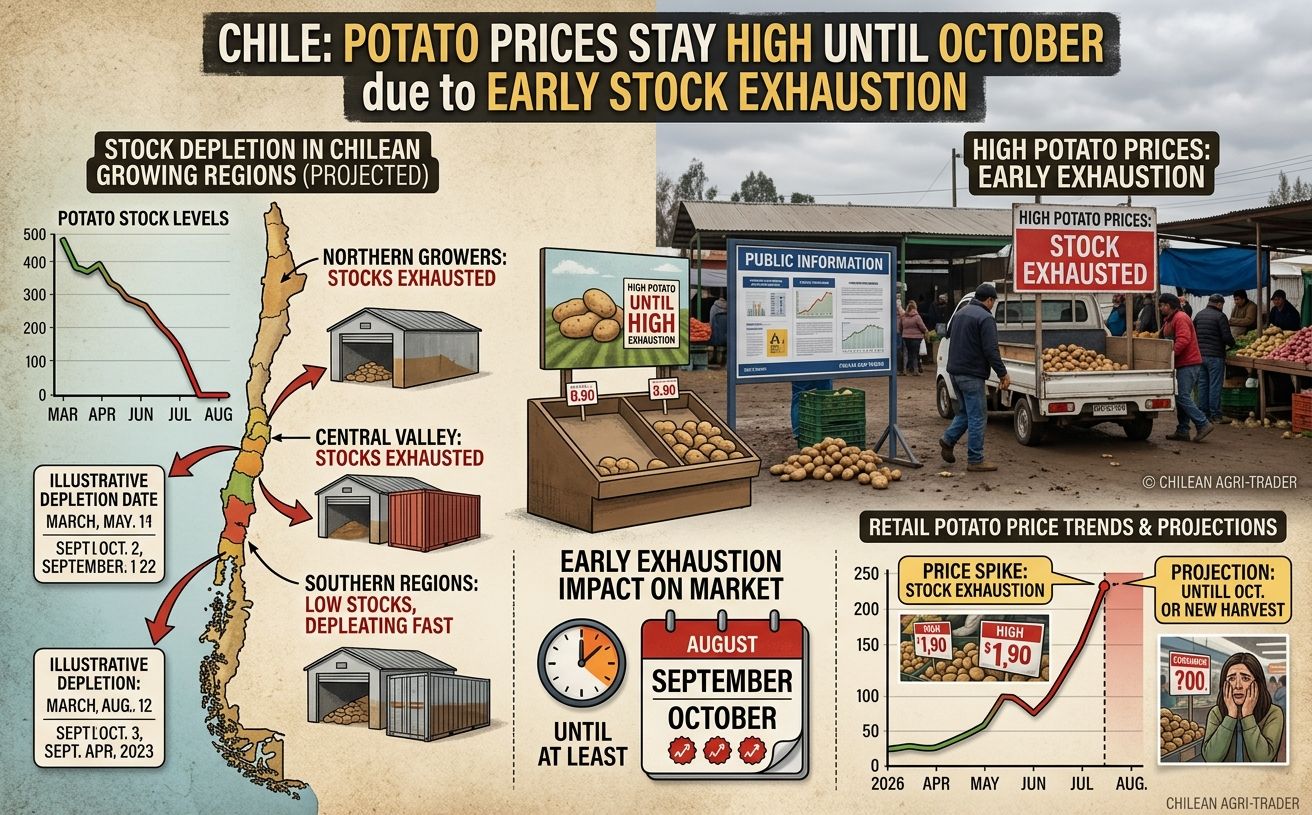
In Chile's south-central zone the crop is harvested in March–June. This season stored potatoes ran out in July, leaving gaps through August and September because northern early crops failed to arrive on time, according to Luis Miquel of Consorcio Papa Chile. He expects high prices to last until new-season supply arrives, not before October. In Santiago's Lo Valledor market the Asterix variety sold at CLP 22,828–24,519 per 25 kg sack in mid-September, about a third above south-central markets. Miquel expects only a slight increase in planted area as a strong dollar and high fuel costs raise input prices. He warns of a bumper-crop trap: a good season can push prices below cost, as happened in March 2024 when prices fell about 70%. A processing industry could absorb surplus, he said, but it is not on the agenda. February's national average was already up 23.7%.
Chile’s potato market is caught between two problems. This season, storage stocks ran out months early, and prices will stay high until new-crop supply arrives. Next season, a large harvest could push prices below the cost of production. Consorcio Papa Chile, the national growers’ association, says relief will depend on the weather and will not come before October.
A shortage built in the previous season
Chile’s potato calendar runs opposite to Europe’s. In the main producing regions of the south-central zone, the crop is harvested between March and June. From July to September, the market relies on stored potatoes (papa de guarda) and on early crops from the north of the country.
This year that bridge collapsed. Luis Miquel, general manager of Consorcio Papa Chile, told the regional newspaper La Tribuna on 17 September that the problems date back to the previous campaign. Growers planted a smaller area, many used poor-quality seed, and yields fell short of expectations.
Weekdays. Unsubscribe in one click.
As a result, stored potatoes were completely exhausted in July. That left supply gaps through August and September, because northern production failed to reach the market on time owing to weather and other factors. Miquel did not specify what the weather problems were.
Miquel said high prices would persist until new-season potatoes start to arrive. That timing would depend on the weather and would not be before October.
Sharp regional gaps in wholesale prices
The wholesale data show how tight the market is and how unevenly the pressure is spread. The agricultural outlet Diario Frutícola analysed the bulletin of ODEPA, the Chilean agriculture ministry’s statistics and policy office, for the week of 14–18 September:
- Santiago (Lo Valledor, the capital’s main wholesale market): the Asterix variety sold at CLP 22,828–24,519 per 25 kg sack, equivalent to roughly CLP 913–981/kg.
- Talca and Chillán, in the south-central growing belt: the same variety fetched about CLP 18,000 per sack, around CLP 720/kg.
- La Calera (Femacal market): prices ranged from CLP 19,300 to 19,800 per sack.
That puts Santiago up to a third above the south-central markets. The spread is a reminder that a single national average can mask large differences by variety and location.
For comparison, ODEPA’s February 2026 average wholesale price across all varieties and markets was CLP 7,667 per 25 kg sack, already 23.7% up year on year. The two figures are not like-for-like, because one is a national all-variety average and the other a single variety on a single market. Even so, the direction and scale of the rise are clear.
The current shortage also comes on top of an earlier, cost-driven increase. In Talca, in the Maule region, a sack rose from CLP 5,000–6,000 in January to CLP 13,000–14,000 by the end of March. At the time, the rise was attributed mainly to higher fertiliser and fuel costs.
Modest expansion, heavy costs
Planting in the main producing areas begins after 18 September, the start of the Fiestas Patrias, Chile’s national independence holidays. Miquel expects a slight increase in planted area, but not a significant one. Growers are hoping for favourable weather that would deliver enough volume to supply the storage market through next winter.
If output falls short, Miquel warned, the same pattern could repeat: stocks would again run out early and prices would climb.
Costs are the main constraint on planting decisions. Miquel said the strong US dollar and high fuel prices were pushing up the cost of imported inputs and, with them, the cost per hectare. In 2023 he put the full cost of establishing a hectare of graded and packed storage potatoes at nearly CLP 14 million, roughly double the previous level of CLP 7 million. No updated figure for 2026 has been published, so this is a historical reference.
The bumper-crop trap
Miquel describes a paradox at the heart of the business. When a season goes well and tonnage is high, prices fall so steeply that they can drop below the cost of production. He said the market was so sensitive to supply that an extra couple of thousand tonnes was enough to send prices crashing.
Recent history supports the point. In late 2023, after an earlier contraction in planting, potatoes reached as much as CLP 2,500/kg in some greengrocers. The high prices encouraged growers to plant more. By March 2024 prices had fallen by around 70%, with retail prices of CLP 600–700/kg.
Processing as a buffer — for now, only an idea
Miquel suggested that a processing industry able to absorb surplus tonnage in heavy years could dampen this volatility. He argued that, given Chile’s existing production capacity and the professional level of its growers, such an industry could be encouraged through dedicated support programmes. However, he stressed that setting up this kind of industry was not currently on the agenda.
Global Potato Brief
Top five stories, prices, disease alerts and events. Weekday mornings, no advertising.
What next
Relief depends on the weather and is not expected before October, when new-season potatoes start to arrive; planting in the main areas begins after 18 September.
Sources
- La Tribuna, 17 September 2026 — interview with Luis Miquel (primary source) — https://www.latribuna.cl/agroforestal/2026/09/17/clima-semillas-y-costos-de-insumos-condicionan-el-mercado-de-la-papa.html
- San Carlos Online (republication) — https://www.sancarlosonline.cl/2026/09/precios-de-la-papa-seguiran-altos-por.html
- Argenpapa, 21 September 2026 — https://www.argenpapa.com.ar/noticia/17776-chile-nuble-los-precios-de-la-papa-seguiran-altos-hasta-octubre-por-falta-de-stock-y-atraso-de-la-cosecha
- Diario Frutícola, 21 September 2026 — analysis of ODEPA's wholesale bulletin for 14–18 September — https://www.diariofruticola.cl/noticia/noticias-agricolas/2026/09/ultimo-informe-odepa-precios-mayoristas-tomate-se-dispara-y-supera-1500-por-kilo-en-el-sur
- ODEPA, Boletín de la papa, March 2026 — https://www.odepa.gob.cl/publicaciones/boletines/boletin-de-la-papa-marzo-2026
- Diario Frutícola, 31 March 2026 — price surge in Maule — https://www.diariofruticola.cl/noticia/noticias-agricolas/2026/03/alza-historica-de-la-papa-golpea-a-consumidores-y-productores-en-el-maule-saco-sube-a-14000
- La Tribuna, 13 October 2023 — per-hectare cost estimate — https://www.latribuna.cl/agroforestal/2023/10/13/precios-de-la-papa-debieran-comenzar-a-bajar-en-el-corto-plazo.html
- El Pingüino, 12 March 2024 — price collapse after the 2023 shortage — https://www.elpinguino.com/nacional/precio-de-la-papa-registra-fuerte-caida-ante-aumento-de-la-oferta
Linked in this material
Related stories

Graphene-Modified EPS Modular Stores Give Small Farmers Affordable Potato Storage
China: Harvest Peaks in Hebei’s Bashang Potato Belt, Where Weichang County Grows 600,000 mu