Canada: National Pink Rot Survey Tests Fungicide Sensitivity After Wet Harvest Start
Agriculture and Agri-Food Canada has started a national survey of potato pink rot to monitor fungicide sensitivity. Late-August rain left wet spots in fields and may raise pink rot levels this harvest.
Agriculture and Agri-Food Canada (AAFC) is running a national survey of potato pink rot. The aim is to check whether the disease is becoming less sensitive to fungicides. The request for samples was published on 29 September 2026 by Dennis Van Dyk, a vegetable crop specialist with the Ontario agriculture ministry, on the ONvegetables blog.
The survey is led by Dr. Rick Peters of AAFC. Researchers want infected tubers from potato regions across the country. Growers who want to take part in Ontario are asked to contact Dennis Van Dyk to arrange samples.
The timing is linked to the weather. According to the post, rain in late August and early September left wet spots in many fields, and pink rot is likely to increase. Pink rot is caused by the soil-borne pathogen Phytophthora erythroseptica. It develops best in wet, poorly drained soil. Infected tubers can rot in the field and spread the problem into storage.
Weekdays. Unsubscribe in one click.
Resistance is not a new question in Canada
Canada has tested pink rot for fungicide resistance before. A national study in 2013 and 2014 followed a severe pink rot outbreak on Prince Edward Island in 2012. According to a 2016 report in Grainews, that study found resistance to metalaxyl in 39% of samples nationally. In Ontario and eastern Canada, 50% of isolates were resistant. Resistance was first found in New Brunswick in 2004. At that time, western Canada was only starting to show resistant isolates.
Metalaxyl and its active form, mefenoxam (metalaxyl-M), have long been the main products against pink rot. In the 2016 report, Rick Peters named phosphite products as an alternative. He advised growers to mix or rotate products and to use non-chemical methods as well.
The 2026 post does not give a deadline, a sample target or a list of the fungicides that will be tested. Results are also not yet known.
Why it matters
Pink rot is mainly a harvest and storage risk. A wet end of season, like the one described in Ontario, can raise losses in store. If the pathogen has become less sensitive to standard products, growers may pay for treatments that do not work well.
A new national picture, ten years after the last one, will help growers, agronomists and seed suppliers choose products, plan rotations and decide which fields need extra drainage or care at harvest. Growers who find pink rot this autumn can add their samples to the data set.
Prevention & control · Editorial note
Pink rot (Phytophthora erythroseptica): what growers can do
- Prevention: drain wet field areas, avoid lifting in waterlogged soil or at high pulp temperature, keep rotations long
- Monitoring: grade out soft, wet tubers before storage; send suspect samples for sensitivity testing
- Chemical protection in Canada: metalaxyl-M / mefenoxam (FRAC 4) — check the national register of Canada; resistance to this group is known
- Resistance management: do not rely on FRAC 4 alone; use it only as registered and combine with cultural control
This note is provided by the potatoes.news editorial team for information only. It is not a recommendation of any company and is not mandatory. Use only plant protection products authorised in your country and follow the label. Product names and registrations differ between countries; consult a local agronomist.
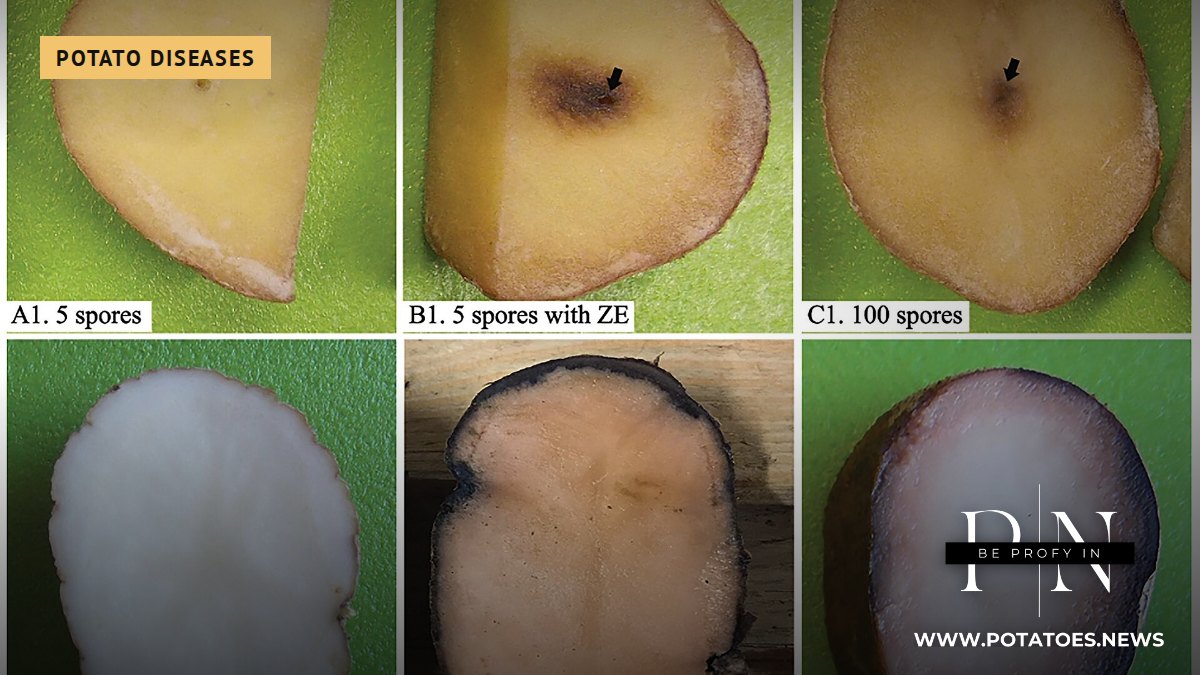
Photo: Potato tubers inoculated with the pink rot pathogen in a laboratory study (illustrative). He Jiang et al. / Wikimedia Commons, CC BY 4.0