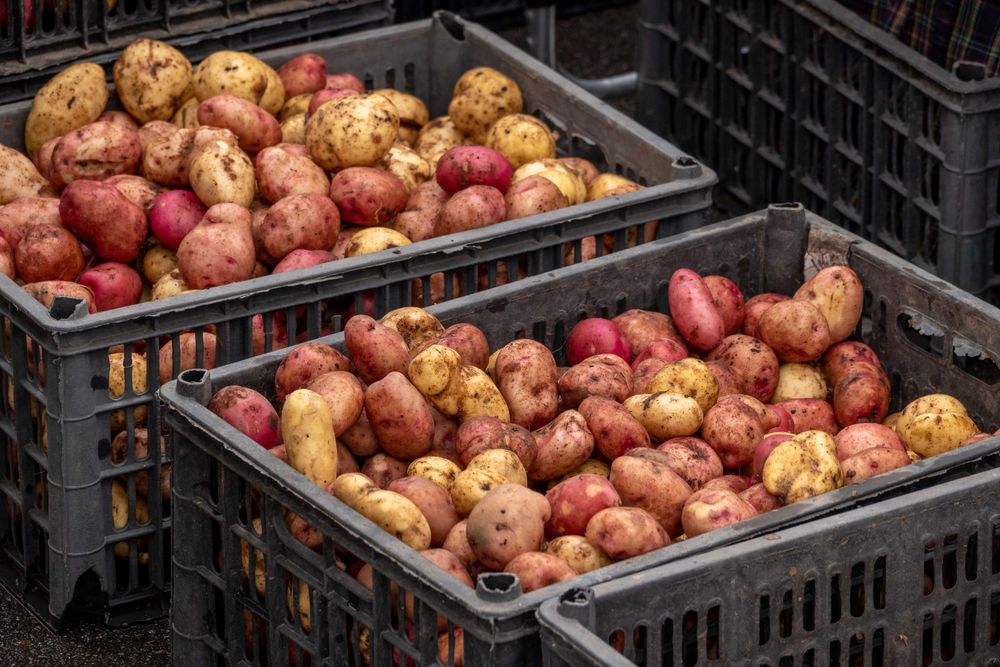
Potato breeding research is increasingly focused on how tuber characteristics influence damage during harvesting, storage, grading and packing — with marketable output after handling, rather than field yield alone, emerging as the key performance measure.
Potato breeding research is examining how tuber characteristics influence damage during harvesting, storage, grading and packing. The objective is to increase marketable yields while maintaining crop quality and meeting market specifications — a shift that reflects how much value is lost between the field and the packhouse rather than in the field itself, and how rarely that loss shows up in trial statistics.
Measuring skin damage. Research published in Crop Science in 2020 demonstrated methods for measuring skinning and skin color following mechanical harvesting and grading, giving breeders and postharvest specialists a standardized way to quantify a problem long judged by eye. USDA research also found that wound-healing capacity declines during storage, highlighting the need to assess handling performance at different stages of the season rather than only at harvest — tubers lifted in good condition do not necessarily keep that condition through months in store, and varietal differences in healing matter as much as differences in initial toughness.
Weekdays. Unsubscribe in one click.
Genetics of bruise resistance. A 2023 genome-wide association study of a tetraploid potato breeding population, published in BMC Plant Biology, identified five markers significantly associated with tuber bruising, including two near polyphenol-oxidase genes on chromosome 8 linked to melanin formation; a parallel transcriptomic analysis flagged genes tied to cell-wall strength and to sensing mechanical force. The authors stressed that the findings are preliminary — based on a relatively small sample and five significant markers — and that further validation is required before the markers can be used in routine selection programs. Research published in 2024 separately examined tuber shape, size and specific gravity, providing data for selection based on specific market requirements — from fresh-pack to processing.
New detection tools. More recent studies have investigated early detection of blackspot bruising, spectroscopy for identifying internal defects, and three-dimensional imaging for measuring tuber volume during harvesting. Together these point toward a future in which handling damage is detected at the machine rather than discovered in the packhouse days later — and in which breeding programs can screen for the traits machines actually punish.
Commercial conditions as the test bench. Researchers emphasize that breeding selections must be evaluated under commercial handling conditions. Assessments should account for skin damage, internal bruising, size distribution, equipment compatibility and postharvest losses. The main performance measure is acceptable marketable output after handling and grading — not field yield alone. That reframing has practical consequences: a variety that wins the plot trial but loses a meaningful share of its pack-out to bruising may be worth less to a grower than a slightly lower-yielding one that ships clean.
For an industry investing heavily in optical grading and automated packing, the breeding agenda is quietly converging with the machinery agenda: varieties are increasingly judged on how they survive the equipment, and equipment is tuned to the varieties. Programs that connect the two — breeding trials run through real packing lines — are likely to define the next generation of successful cultivars, and to narrow the gap between what trials measure and what markets pay for.
Sources: FreshPlaza; BMC Plant Biology via PMC.