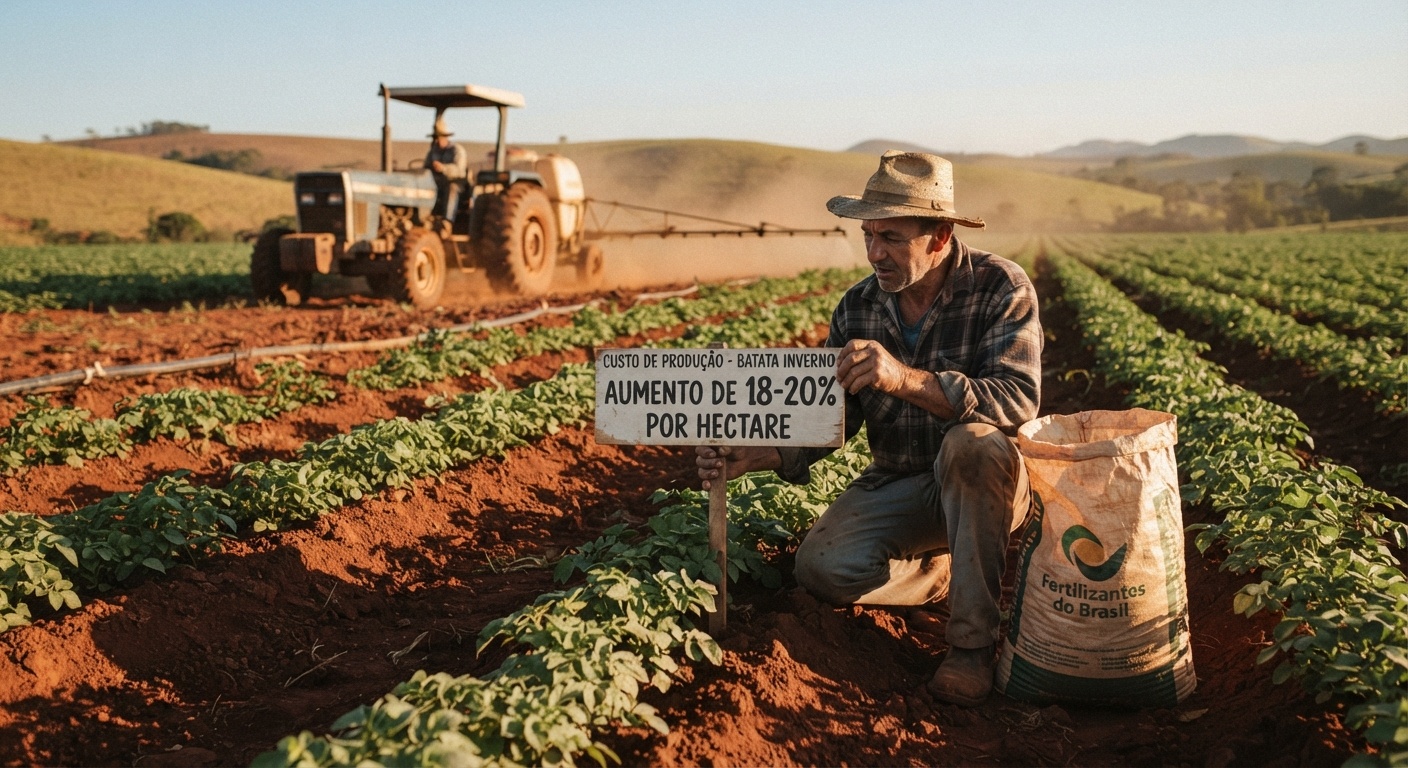
The cost of producing winter-crop potatoes in Brazil has risen by between 18.3% and 20.1% per hectare compared with the 2025 winter season, according to Cepea. The increase comes just as growers have less of their own cash to hand and borrowing is dearer, clouding the outlook for the 2026/27 rainy-season crop.
The figures come from Hortifruti Brasil, the magazine published by Cepea, the applied economics research centre at the University of São Paulo’s Esalq campus. The range reflects four production models assessed by its analysts: depending on the model, total cost per hectare climbed by 18.3% to 20.1%. Reports on the study point to diesel, fertilisers, crop spraying and the cost of capital as the main sources of pressure on grower budgets.
Weak prices left growers short of cash
Last year was a hard one for Brazilian potato growers. A surplus of supply pushed prices to historically low levels in 2025. Cepea’s January–October average for the year was the fourth lowest in real terms since its price series began in 2001, behind only 2011, 2017 and 2018. Record yields softened the blow by cutting the cost of producing each tonne, but they could not make up for the weak returns.
Weekdays. Unsubscribe in one click.
Those thin returns have left growers with fewer of their own funds to put into the next planting. According to the report released on 13 November, producers are leaning more heavily on outside financing at precisely the moment credit is harder to obtain and more expensive. That squeezes investment ahead of the 2026/27 rainy-season crop, known in Brazil as the “safra das águas”, which is planted and harvested roughly between October and March.
What each market demands
Cepea sees different openings depending on where the crop is sold. In the fresh market, growers can set themselves apart through presentation, quality and clearer information on culinary uses. For processing, notably frozen french fries and crisps, access depends on raw material meeting the buyers’ specifications and on the grower’s ability to deliver steady volumes at a competitive cost.
Reading the numbers
A higher cost per hectare does not automatically mean a higher cost per tonne, because the final figure depends on yield, as the record 2025 harvest showed. How far the latest rise will squeeze margins will therefore depend on yields and prices over the coming season, as well as on whether growers can secure affordable finance to plant.
Sources
Argenpapa, “Brasil: El costo por hectárea de la papa de invierno subió entre 18,3% y 20,1% en 2026”, 15 November 2026 (citing Hortifruti Brasil/Cepea via Compre Rural): https://www.argenpapa.com.ar/noticia/18139-brasil-el-costo-por-hectarea-de-la-papa-de-invierno-subio-entre-18-3-y-20-1-en-2026
Cepea, “HF Brasil/Cepea: com preço baixo da batata, produtividade recorde salva a lavoura em 2025”, 13 November 2025: https://cepea.org.br/br/releases/hf-brasil-cepea-com-preco-baixo-da-batata-produtividade-recorde-salva-a-lavoura-em-2025.aspx