Bioprotection and Crop Resilience: Managing PVY and Late Blight Under Shifting Climatic Pressures
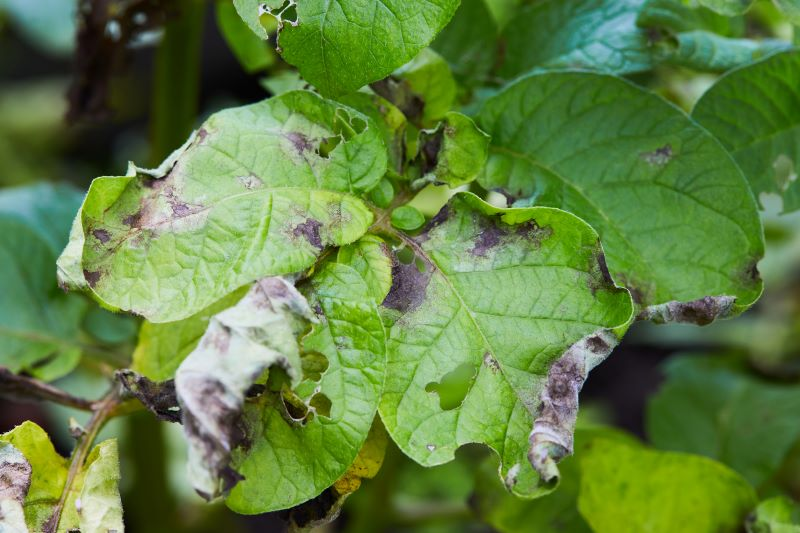
Minsk — Priluki. As the growing season enters its critical late-summer maturation and pre-harvest phase, potato growers across Belarus and neighboring regions face a dual phytopathological threat: aggressive strains of late blight (Phytophthora infestans) driven by persistent moisture and temperature fluctuations, alongside the silent spread of recombinant strains of Potato Virus Y ($\text{PVY}^\text{NTN}$ and $\text{PVY}^\text{N-Wi}$).
At the Institute of Plant Protection of the National Academy of Sciences of Belarus (Priluki), ongoing field trials and epidemiological monitoring reveal that standard calendar-based chemical spray programs are losing ground. Managing these yield-limiting pathogens now requires an integrated strategy combining genetic tolerance, precision vector suppression, and anti-resistance fungicide rotations.
The Evolution of Late Blight: The Shift to A2 Strains
Over the past decade, the population structure of Phytophthora infestans in Eastern Europe has shifted significantly toward the A2 mating type. This allows the pathogen to reproduce sexually, generating soil-borne oospores capable of surviving harsh winters and initiating infections up to 2–3 weeks earlier in the vegetative cycle.
Weekdays. Unsubscribe in one click.
Critical Management Windows:
- Rapid Canopy Growth (Pre-flowering): Use translaminar and systemic active ingredients (e.g., propamocarb, mefenoxam, metalaxyl-M, mandipropamid) to protect rapidly expanding new foliage.
- Post-Flowering to Canopy Stabilization: Rotate multi-site protectants and translaminar compounds (e.g., fluopicolide, cyazofamid, zoxamide) to block sporangia germination on mature leaf surfaces.
- Pre-Harvest and Skin Set: Apply antisporulant and tuber-rot protection actives (e.g., fluazinam, amisulbrom, ranman) to prevent viable zoospores from washing down into the ridge and infecting tubers before harvest.
Comparison of Key Disease Control Strategies
| Parameter | Late Blight (Phytophthora infestans) | Potato Virus Y (PVYNTN / PVYN-Wi) |
| Primary Vector / Pathway | Airborne sporangia, infected seed tubers, oospores in soil | Non-persistent transmission by aphid vectors (Myzus persicae, Aphis nasturtii) |
| Direct Crop Damage | Rapid foliar defoliation, stem rot, dry/brown tuber rot | Mosaic, leaf drop, Potato Tuber Necrotic Ringspot Disease (PTNRD) |
| Seed Certification Threshold | Zero tolerance for active tuber rot | Strict ELISA/PCR limits ($\le 0.5–2.0\%$ depending on seed class) |
| Chemical / Bio Control | Multi-site protectants + systemic active ingredient rotation | Mineral oil barriers (paraffinic oils) + systemic insecticide programs |
| Varietal Defense Mechanism | Major $R$-genes combined with quantitative field resistance | Hypersensitivity ($Ny$ genes) and extreme resistance ($Ry$ genes) |
The PVY Crisis: Protecting High-Generation Seed Stocks
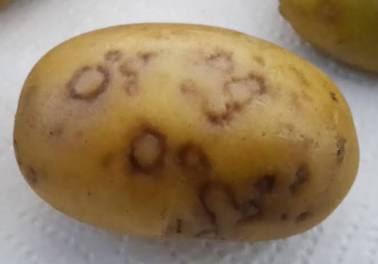
Unlike late blight, Potato Virus Y cannot be cured with synthetic chemistry once inside the plant vascular system. The emergence of the $\text{PVY}^\text{NTN}$ necrotic strain has made the virus a direct threat not only to seed vigor, but also to commercial table and processing markets by causing necrotic ringspots within the tuber flesh.
Integrated Virus Suppression Protocol:
- Mineral Oil Sprays: Applying high-grade horticultural paraffinic mineral oils at 5–7-day intervals forms a thin protective barrier on the leaf cuticle. When an aphid probes the leaf, the oil disrupts virus retention on its stylet, reducing transmission efficiency by up to 65–80%.
- Border Crop Traps: Surrounding seed potato multiplication blocks with non-host barrier crops (e.g., winter rye or oats) encourages probing aphids to clean their stylets before landing on seed rows.
- Vector Trapping and Real-Time Forecasting: Yellow water pans and suction traps monitor aphid migration peaks, triggering precise insecticide applications when alate (winged) populations surge.

Biological Priming and Induced Systemic Resistance (ISR)
Researchers at the Plant Protection Institute are evaluating microbial and elicitor-based bioprotection agents to reduce the chemical footprint:
- Bacillus-based biologicals: Strains of Bacillus subtilis and Bacillus amyloliquefaciens produce lipopeptides (surfactin, iturin) that inhibit spore germination while triggering systemic acquired resistance (SAR).
- Phosphite Formulations (Potassium Phosphite): Act as direct oomycete inhibitors and stimulate plant defense pathways, hardening cell walls against hyphal penetration.