Belgium: Latest Trial Digs Put the Potato Yield at 37.3 t/ha, About 11 t/ha Below the Five-Year Average
New figures from trial digs in early September show a very wide spread between fields, a low share of large tubers and a growing gap between Flanders and Wallonia. The Belgian farmers' union shared the data with potatoes.news.
The latest trial digs in Belgium put the practical potato yield at 37.3 tonnes per hectare. That is about 11 tonnes below the five-year average. The data come from the agricultural research centre Viaverda in East Flanders. The Belgian farmers’ union shared them with potatoes.news on 24 September.
The research centre carried out its most recent trial dig on Monday 7 September. The total gross yield rose to 40.2 tonnes per hectare. When only tubers of 35 mm and larger are counted, including waste, the practical yield is 37.3 tonnes per hectare.
The differences between fields are very large. Yields range from 17 tonnes per hectare, where the crop died early, to 56 tonnes on an irrigated field that was still green. A quarter of the lots stay below 30 tonnes, and a quarter reach more than 50 tonnes. Flanders is now 6 tonnes per hectare ahead of Wallonia, at 40 tonnes.
Weekdays. Unsubscribe in one click.
Tuber size is also a problem. On average, 24 tonnes per hectare are in the size class of 50 mm and larger. That is only 59% of the yield, against a long-term average of 80%. More than half of the lots have not yet reached the norm of 60%, or have only just reached it.
Over the past five years, the yield at the end of the season averaged 48 tonnes per hectare. After the hot and dry summers of 2018 and 2022, the yields were 42 and 43 tonnes per hectare. Some irrigated fields were still growing in early September.
On 18 September, Belgian farm media reported a yield of 33.6 tonnes per hectare. Asked about it, the crop production adviser of the union, Pieter Van Oost, said that the most recent and reliable data now come from the trial digs. He also asked that reports pay attention to quality: tuber length, second growth and underwater weight.
Belgium in the European picture
The union also shared a table from the North-Western European Potato Growers (NEPG) for the four main producing countries, without seed and starch potatoes. It puts the Belgian area at 89,105 hectares, 17.5% less than in 2025, and the average yield at 38.5 tonnes per hectare, 21.6% lower. The Belgian crop is estimated at 3.43 million tonnes, 35.3% less than in 2025 and below the five-year average of 4.46 million tonnes.
Belgium has the largest drop in production of the four countries. The table shows 7.55 million tonnes for Germany (minus 24.3%), 6.49 million tonnes for France (minus 21.5%) and 3.23 million tonnes for the Netherlands (minus 23.5%). Together, the four countries are estimated at 20.7 million tonnes, 25.4% less than in 2025.
The table and the trial digs use different methods, so their yields are not directly comparable. Our earlier report on the European harvest is available here.
Why it matters
Belgian processors buy potatoes by size and quality, not only by weight. A smaller area, lower yields and a low share of large tubers mean less raw material that meets their specifications. Our report on the dependence on the Fontane variety explains why the problem is so concentrated.
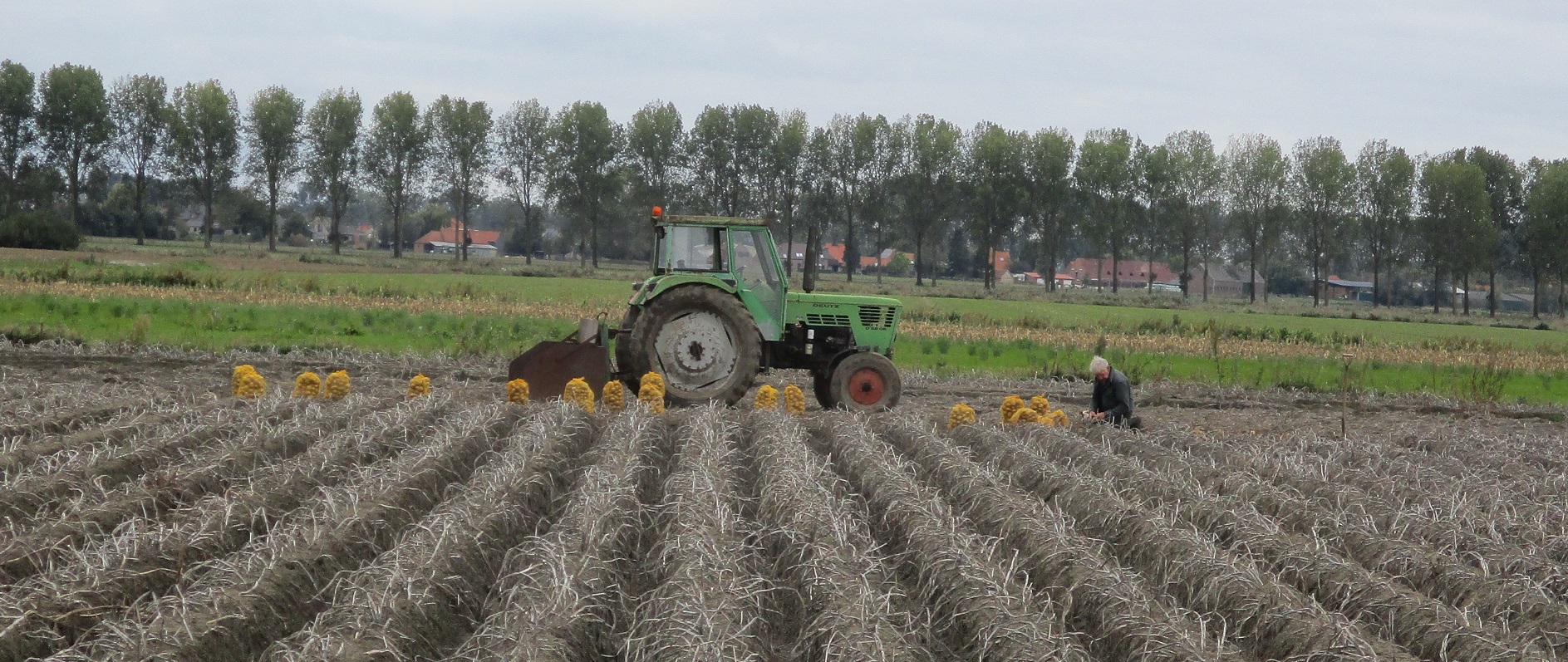
Photo: Potato harvest in Sint-Laureins, East Flanders, Belgium, in October 2022 (illustrative). Spotter2 / Wikimedia Commons, CC BY-SA 4.0