Base phosphorus and potassium: forms, balance and placement
Potato tubers remove about 5.8 kg K₂O per tonne, according to the PDA — but multiplying yield by that figure gives offtake, not a fertilizer rate.
Potato Nutrition series · Part 03 of 24 · All parts in order
Phosphorus moves little in soil, and the potato root system is relatively limited. Its availability in the young root zone is therefore often more important than the formal amount per hectare. The UK Potash Development Association (PDA) explains that phosphate recommendations for potatoes are significantly higher than crop offtake, while potassium demand is especially high during active growth and bulking.
The PDA's March 2026 overview gives a reference point for the balance: tubers contain around 5.8 kg K₂O per tonne. So 40 t/ha means roughly 232 kg K₂O/ha removed, and 70 t/ha about 406 kg. This is an offtake calculation, not a fertilizer rate: part of the K comes from the soil, and the maximum K accumulated by the crop exceeds what the tubers remove. A rate cannot be obtained by simply multiplying yield by a coefficient.
Weekdays. Unsubscribe in one click.
Calculation with the PDA coefficient: 5.8 kg K₂O per tonne of tubers
K₂O removed by tubers, kg/ha. This is offtake, not a fertilizer rate.
The source of potassium also matters. In Ireland, Teagasc stresses that for some processing purposes sulphate forms can maintain dry matter better than chloride; but excess potassium of any form can also reduce dry matter. The chloride form is not banned in principle: the choice depends on timing, soil and contract requirements for the tubers.
Geography and practical application
British and Irish recommendations work as a calculation method for a humid temperate climate; low-K fields in Eastern Europe need their own diagnosis. On the irrigated sands of Idaho, special attention goes to the K accumulation phase and monitoring.
Regional notes
- Russia & Central Asia (Kazakhstan, Uzbekistan): low-K sandy soils in central Russia and irrigated sierozems in Central Asia need their own K diagnosis; the PDA offtake figure only helps with the balance.
- Latin America (Brazil, Andean countries): tropical soils often fix phosphorus, so placement near the row matters more than in temperate soils.
- Africa (Kenya, Nigeria, Zimbabwe, Zambia): P is a common constraint on acidic soils; K was long assumed adequate but Kenyan data show depletion on intensively cropped fields.
- South-East Asia (Vietnam, Thailand, Philippines): on leached highland soils, K can be lost with heavy rain; split K where the label and soil allow.
Agronomic guidance here is general practice; agree rates and timing with your agronomist.
Partner material: Uralchem products — conditional selection
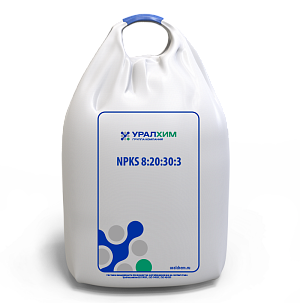 NPKS 8:20:30:3
For base or banded application, Uralchem's granular NPKS 8:20:30:3 can be considered: according to the catalogue it contains 8% N (ammonium form), 20% P₂O₅, 30% K₂O and 3% S. The rate is calculated from soil analysis and the balance of all nutrient sources; a brand name does not replace a field calculation. In a band at planting, keep the fertilizer away from the seed tuber: a high-K granular grade raises the salt (and chloride) load near the sprout.
Product images: Uralchem.
Where Uralchem supplies: Russia and the CIS, Latin America, Africa (through its distributor United Fertilizer Company Limited) and South-East Asia, where the company is developing distribution in Vietnam, Thailand and the Philippines. Availability of specific grades varies by country — check with the local distributor.
Not a rate recommendation — consult your agronomist.
Sources
- Potash Development Association, Nutrient Considerations for Potatoes (March 2026).
- Teagasc, Potato agronomy and nutrition.
- University of Idaho Extension, Nutrient management: Potatoes.
Partner data (Uralchem)
Potato Nutrition series · Part 03 of 24
← Previous part 02: Soil pH and potatoes: why the 5.0–6.0 range is not universal
Next part 04: Ammonium or nitrate: nitrogen forms in potato nutrition →
All 24 parts of the Potato Nutrition series in order