Argentina Unveils First Gene-Edited Potato Lines: OLI INTA and PIRU INTA Target Bruising and Cold-Induced Sweetening
Key takeaways
- 74% less browning and 69% lower PPO activity in OLI INTA
- 23 June 2026: OLI INTA enters Argentina's cultivar registry
- 90-120 days: PIRU INTA keeps frying quality at 4C storage
- 7.3 vs 4.6: PIRU INTA colour score beats standard Atlantic
Why it matters
- For farmers
- Growers using OLI INTA potatoes can expect fewer bruise-related rejections and less sorting labour after harvest, transport and storage impacts, cutting waste and improving payouts on quality grading.
- For processors
- Chip processors can plan longer cold storage of PIRU INTA-based potatoes (90-120 days at 4C) without frying-colour loss or rising acrylamide, smoothing raw-material supply outside the harvest window.
- For suppliers
- Seed suppliers should track PIRU INTA's pending registration to add it alongside the already-registered OLI INTA once approved, and prepare multiplication for both lines.
- For investors
- Investors in Argentine ag-biotech can note that INTA/CONICET's gene-edited lines are regulated as conventional varieties, avoiding GMO-style approval costs and delays.
60-second summary
Argentina has registered its first gene-edited potato lines, developed by INTA Balcarce with CONICET using CRISPR/Cas9 to switch off the potato's own genes rather than insert foreign DNA. OLI INTA, registered on 23 June 2026, silences the polyphenol oxidase gene behind browning after mechanical damage, cutting relative browning by 74% and PPO activity by 69%, meaning fewer bruised tubers and lower losses for growers and packers. PIRU INTA, built on the Atlantic variety by switching off the vacuolar invertase gene, slows the buildup of reducing sugars in cold storage, holding frying colour for 90-120 days at 4C (IBVL colour score 7.3 versus 4.6 for standard Atlantic after 120 days) while cutting acrylamide. This lets chip processors store raw material year-round without losing quality. Because no foreign genes are introduced, regulators treat both lines as equivalent to conventionally bred varieties. OLI INTA is registered; PIRU INTA's registration is pending.
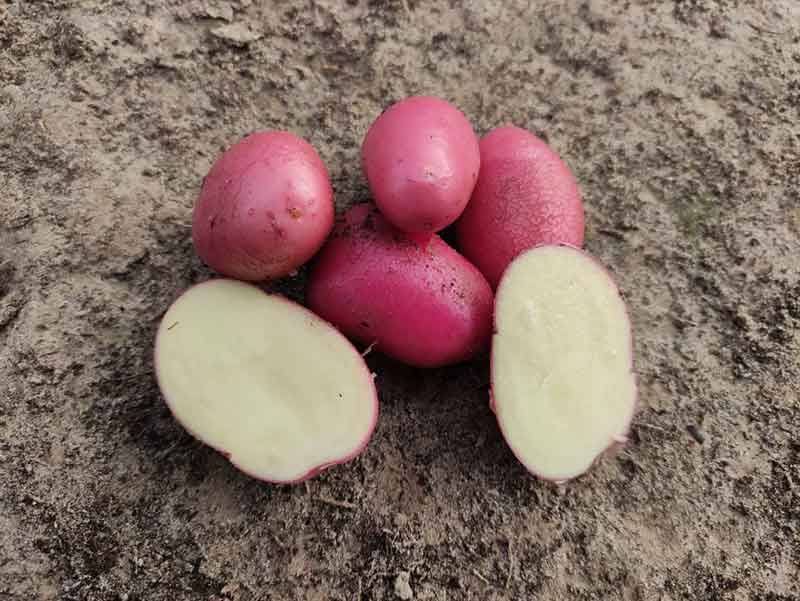
Argentina has officially introduced its first two potato lines developed through gene editing — OLI INTA and PIRU INTA — each addressing a distinct challenge facing the industry. OLI INTA holds the distinction of being the first officially registered gene-edited agricultural crop in Argentina. It was developed by the Agro-biotechnology Laboratory of INTA Balcarce in collaboration with CONICET and formally entered into the National Register of Cultivars (INASE) on 23 June 2026. PIRU INTA, meanwhile, tackles a separate but equally costly problem: cold-induced sweetening (CIS), a phenomenon in which potatoes stored at low temperatures to prevent sprouting accumulate reducing sugars. When fried, these sugars react with amino acids, leaving chips or French fries dark brown, bitter and containing acrylamide — a potentially harmful compound.
The science behind OLI INTA involves switching off, via CRISPR/Cas9, the polyphenol oxidase (PPO) gene — the enzyme responsible for the browning of flesh after mechanical damage. This so-called enzymatic browning is what causes potatoes to develop dark spots from impacts during harvesting, transport or storage. The results are striking: no sub-skin bruising or discolouration after impact, a 74% reduction in relative browning compared with the control group, and a 69% drop in PPO enzyme activity. For growers and processors, this translates into less waste and fewer losses, better final product quality and less manual sorting — directly improving profitability and reducing production waste. PIRU INTA, for its part, was created by switching off the vacuolar invertase (InvVac) gene, which converts sucrose into reducing sugars during cold storage; the work was carried out on the popular industrial variety Atlantic.
The practical value of PIRU INTA lies in its ability to preserve frying quality for 90–120 days at 4 °C. Its IBVL colour score after 120 days of storage at 4 °C reached 7.3, compared with 4.6 for the original Atlantic, alongside a significant reduction in acrylamide formation. This allows chip processors to store raw material in cold conditions year-round without losing quality or worrying about sprouting, ensuring stable supply and keeping production capacity utilised outside the harvest season. Importantly, both lines differ fundamentally from GMOs: gene editing introduces no foreign DNA from other species, but merely switches off the potato’s own genes in a targeted manner. As a result, they are treated regulatorily as equivalent to varieties obtained through conventional breeding. OLI INTA is already registered, while PIRU INTA is in the registration process and is expected to be officially entered into the register in the near future.
Global Potato Brief
Top five stories, prices, disease alerts and events. Weekday mornings, no advertising.
What next
PIRU INTA's registration with INASE is expected soon, after which both gene-edited lines will be in Argentina's cultivar registry.
Sources
- INTA Balcarce (Agro-biotechnology Laboratory) with CONICET; registration entered in Argentina's National Register of Cultivars (INASE).
Linked in this material
- Country
- Argentina
- Technologies
- CRISPR/Cas9; gene editing
- Sections
- Growing seedsNewsSeeds
Related stories
Netherlands: Over 28% of Tested Seed Potato Lots Downgraded After Virus Checks

Bangladesh: State Seed Agency Produced 44,182 Tonnes of Seed Potatoes Last Season