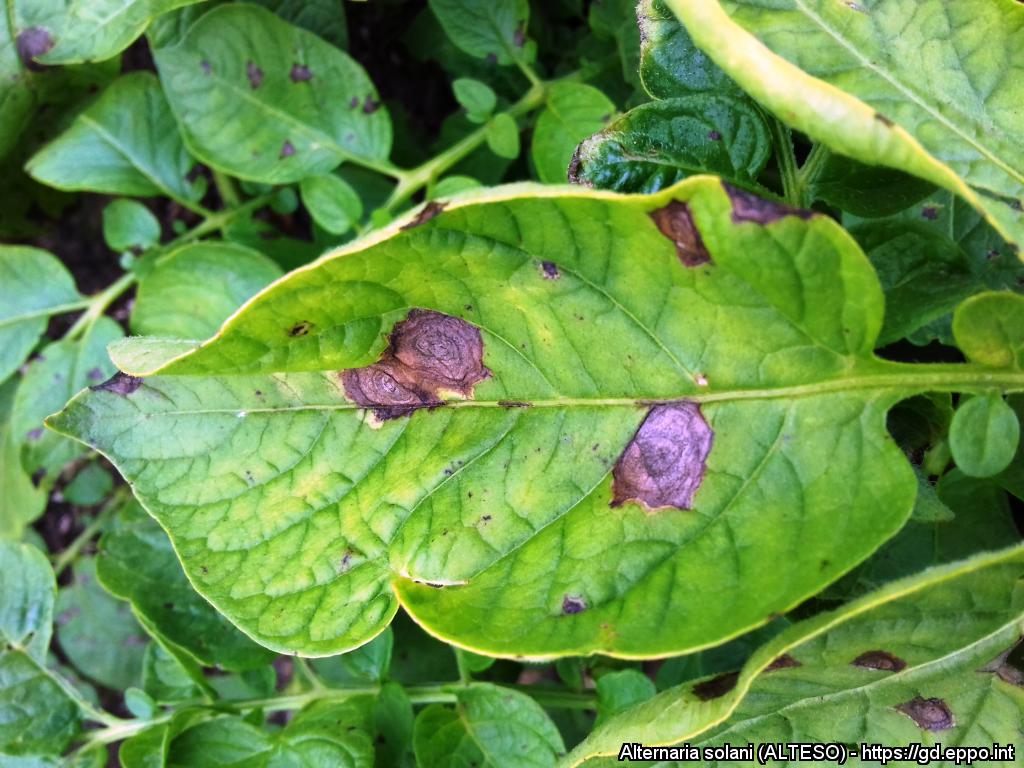
Alternaria spp. cause different diseases in potato and tomato crops. Early blight caused by Alternaria solani and brown spot caused by Alternaria alternata are most common, but the disease complex is far more diverse.
Alternaria species adopt a wide variety of lifestyles. They mostly live as saprophytes in soil and decaying plant material. There are Alternaria species, especially A. alternata, that cause allergies in humans or are pathogenic in immunocompromised patients. On plants, they are necrotrophic pathogens and cause economically relevant crop diseases and post-harvest rots . However, Alternaria can also live as an endophyte inside plants without causing disease.
Several other large-spored Alternaria from the section Porri have also been reported on potato and tomato. Alternaria blumeae was reported on potato and tomato. Alternaria crassa is reported on tomato and other hosts, but not potato , and an A. crassa isolate from another host was able to infect tomato. Alternaria argyroxiphii was reported on potato and even though it was not found on tomato plants, it was capable of infecting them under laboratory conditions.
Early blight lesions start as small, brown spots and progress into dark brown to black lesions that usually develop concentric, target-like rings . They are relatively easy to identify, as they have a distinctive bull’s-eye-shaped appearance with concentric rings. Affected leaves become yellow and senescent until they dry up or fall off. In severe cases, this can cause complete defoliation.
Brown spot (BS) is caused by small-spored Alternaria of section Alternaria . Generally, A. alternata is reported as the causal agent for BS on potato and tomato, but some authors simply include A. alternata sensu lato as one of the species causing EB. Even though EB caused by large-spored species is considered the dominant disease, small-spored species are often recovered more frequently on potato . A. alternata f. sp. lycopersici is synonymous with A. arborescens. Both A. alternata and A. arborescens are often reported as causal agents of disease in tomato. In susceptible tomato cultivars, A. alternata f. sp. lycopersici (now A. arborescens) causes stem canker disease, visible as dark brown cankers on the stems and necrosis of leaves . Stem canker is distinct from EBDC due to important differences in pathogenesis, such as the prevalence of stem infections , the use of host-selective toxins , and the observation that jasmonic acid signalling increases susceptibility , resulting in significant differences in the molecular mechanisms of infection. Landschoot, Vandecasteele, De Baets, et al. (2017) showed that some A. arborescens isolates can also infect potato crops.
Brown spot disease starts with small brown spots that are dispersed all over the leaf surface . Brown spot lesions are smaller than EB lesions and range from dots up to 10 mm in diameter . They also do not develop concentric rings. The spots can occur at every growth stage of the plant. With disease progression, the lesions coalesce into larger necrotic areas with brown margins, which can eventually cause dried, senescent leaves .
No teleomorphs of EBDC-causing Alternaria spp. are known. Thus, reproduction happens via multicellular and asexual conidia . Conidia are released from their conidiophores by wind or rain, achieving high abundance in the air and soil . Optimal conditions for germination of EBDC conidia are 25°C, moistened host tissue, and 100% humidity . Germination usually occurs within 3 h, followed by a latent period preceding epidermal penetration that shortens with increasing virulence . Entrance to host tissues is implemented by either invading wounds, thrusting penetration hyphae between epidermal cell interfaces via an appressorium, or by directly penetrating the epidermis using cell wall-degrading enzymes (CWDEs) . Successful colonization leads to necrotic lesions after roughly 1–2 weeks, often circumscribed with a yellow halo of senescent tissue from the diffusion of fungal-derived phytotoxins . Lesions produce additional conidia that systemically colonize the host to form secondary infections on leaves, stems, fruit, and tubers. Infections appear more prevalent in older, senescing tissues . Primary lesions are often inconspicuous, and secondary sporulation leads to heavy infection later in the season. Due to the broad host range of EBDC, especially A. alternata, inoculum can originate from or spread to secondary hosts. Conidiospores have thick, often melanized, cell walls and can probably survive in the soil for a certain amount of time. In the absence of suitable hosts, EBDC may enter a saprobic lifestyle . After prolonged periods of unfavourable conditions late in the season, intercalary hyphae form chlamydospores that aggregate into microsclerotia . Microsclerotia tolerate adverse environmental conditions and overwinter in the soil until conditions become favourable for pathogenesis, exhibiting greater virulence in soil compared to any other cell type.
Disease pressure is therefore highly cultivar-dependent and, especially in potato, often linked to the maturity time. Early maturing varieties tend to be more susceptible because they retain older, senescent foliage that can serve as an easier entry point for the pathogen. However, to our knowledge fully resistant cultivars do not exist. Whereas holistic control strategies are being discussed , the complexity of the host–pathogen interaction makes fungicide application still the most effective measure against Alternaria spp. in an integrated plant protection strategy.
However, over the last decades loss of sensitivity and ultimately fungicide resistances have been reported for all major fungicide classes against EBDC. Two major fungicide groups target fungal respiration. Quinone-outside inhibitors (QoIs), including, for example, azoxystrobin and pyroblostrobin, inhibit the mitochondrial respiration by preventing the electron transport chain of complex III . Another group of respiration inhibitors are the succinate dehydrogenase inhibitors (SDHIs), for example, boscalid. These also interfere with the electron transport chain, but at a different target site, namely succinate dehydrogenase, which is part of complex II .
The QoI resistance is mainly attributed to one specific point mutation in A. solani (F129L) and A. alternata (G134A) . Studies from the United States showed a rapidly increasing level of resistance against QoIs, specifically azoxystrobin . The decreasing sensitivity was first observed two years after the fungicide became commercially available and Gudmestad et al. (2013) found the associated point mutation in 99% of the samples in 2010 and 2011. Leiminger et al. (2014) reported a similar development in Germany. QoIs were first registered as an early blight-specific fungicide in 2007 and the first resistant isolates were found in 2009. In a later study from Sweden, Edin (2012) found the F129L mutation in nearly all tested isolates.
In contrast to QoI resistance, the SDHI resistance is associated with several point mutations. These mutations are distributed between subunit B (H278R and H278Y), subunit C (H134R), and subunit D (H133R and D123E) . The first isolates with a mutation leading to boscalid resistance were found in Idaho in 2009 and 2010, fewer than five years after the fungicide was registered in the United States . By 2014 and 2016, the occurrence of double mutations was confirmed in the United States and Belgium, respectively . Studies from Nottensteiner et al. (2019) and Bauske et al. (2018) revealed at least one of the sdh mutations in 43% of German isolates and almost all US isolates, respectively. Whole genome sequencing of 48 A. solani isolates from all over Europe revealed that SDHI resistance mutations arose in different genetic backgrounds, indicating that SDHI resistance evolution happened multiple times independently, thus highlighting the evolutionary potential of A. solani .
The third fungicide group used against Alternaria spp. are demethylation inhibitors (DMIs). The mechanism of DMI resistance is associated with changed expression levels and possible mutation of the target site Cyp51 . Overall, resistance against this group, which includes for example difenoconazole, is less prevalent than resistance against the respiration inhibitors. However, DMI-resistant A. alternata isolates have been found on many crops .
Photo: Maria A. Kuznetsova (All-Russian Phytopathology Research Institute), EPPO Global Database, https://gd.eppo.int
Reference: Schmey, T., Tominello-Ramirez, C.S., Brune, C. & Stam, R. (2024) Alternaria diseases on potato and tomato. Molecular Plant Pathology, 25, e13435. Available from: https://doi.org/10.1111/mpp.13435